If you are sourcing a shockwave therapy machine for a clinic, a rehabilitation centre or a distribution portfolio, the question that decides your order is rarely "which technology is better". It is "which of the two families in front of me actually fits the cases that walk through my door". Radial (electromagnetic) shockwave systems and focused shockwave systems are both non-invasive, both use a handpiece and a coupling medium, and both are sold into the same physiotherapy, sports-medicine and pain-management market. Under the housing, however, they generate and deliver energy in fundamentally different ways, and that difference changes the indications you can accept, the way you schedule patients, and the consumable bill you will pay for years.
This guide is written for buyers, not for engineers. It answers the eight questions that decision-makers actually ask when they compare radial shockwave therapy with focused shockwave therapy, and it ends with the one section most suppliers hope you will skip: the list of parameters you should insist are written on your quotation before you transfer any money. Where a manufacturer's manual does not state a figure, we say so plainly and tell you what to ask for instead. Nothing here is padded with invented numbers.
The difference is not the speed of the treatment or the brand of the box. It is where the energy is concentrated once it leaves the applicator. A radial system builds a pressure wave at the tip of the head and releases it into the tissue in a spreading, roughly hemispherical pattern. The energy is strongest at the surface and fades as it travels deeper, which makes the therapy comfortable over broad areas and effective for superficial muscle, tendon and fascial work. This is why radial shockwave is often described as a pressure-wave or "electromagnetic" therapy.
A focused system is the opposite geometry. The wave is generated inside the handpiece and then converged, so that the energy arrives at a tight focal zone at a chosen depth rather than at the skin. The peak energy is delivered away from the surface, in a small volume, which is what allows higher energies to reach deep tendon insertions and chronic calcifications without loading the superficial tissue in the same way. In practice this is also why focused platforms are usually described in terms of the depth at which the focus sits, not just the energy that leaves the handle.
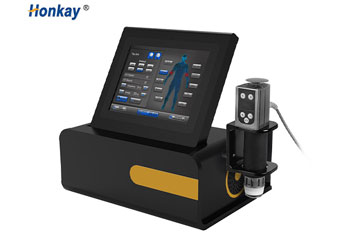
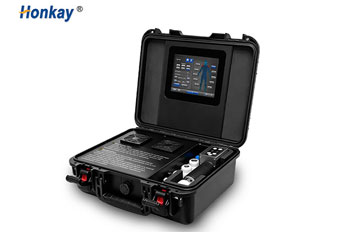
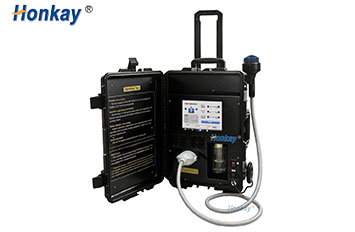
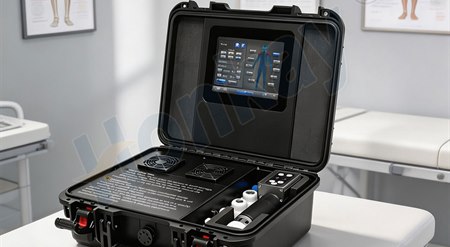
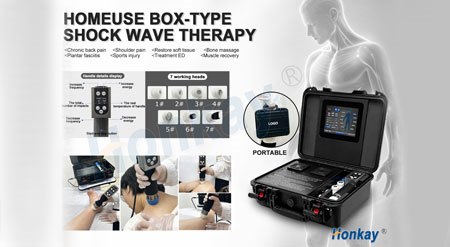
Our own two platforms illustrate the split clearly. The radial / electromagnetic machine is a suitcase-format unit built around an electromagnetic generator with an adjustable shock frequency of 1-22 Hz and an energy range of 30-185 mJ, supplied with seven interchangeable treatment heads and an 8-inch touchscreen that lets the operator select the body part before treatment. The focused shockwave platform is a single-handle unit that generates electromagnetic focused shock waves, with the focus depth adjusted by changing the water level inside the handpiece; its frequency is controlled by a slider over a 0-10 Hz range and its intensity by a 0-100% slider.
| Parameter | Radial / electromagnetic (suitcase format) | Focused platform (standing or desktop) |
|---|---|---|
| Energy geometry | Pressure wave released at the applicator tip and spread radially into the tissue | Energy converged into a focal zone at the chosen treatment depth |
| Input voltage | 220V / 50Hz and 110V / 60Hz | AC 110V / 220V, 50/60Hz |
| Rated power | 200VA total power | 700W rated power (the manual states W, not VA) |
| Shock frequency | 1-22 Hz | 0-10 Hz slider |
| Energy setting | 30-185 mJ, set directly in mJ | 0-100% intensity slider; the manual states no mJ range |
| Applicators | Seven interchangeable treatment heads | Single handle |
| Operator interface | 8-inch touchscreen with body-part selection | 10.4-inch liquid-crystal touchscreen with twelve body-part presets including ED |
| Depth control | Set by head selection and energy level | Set by the water level in the handpiece bladder; intelligent zoom covers 0-8 cm |
| Main wearing parts | Bullet approximately 1,000,000 impacts; air tube approximately 5,000,000 impacts | Stated as a no-consumables design |
| Form factor | Aviation-case style pull case, 53 x 42 x 25 cm | Standing and desktop housings with identical specifications, so you match the machine to the room rather than to the performance. Allow 30 cm of clearance around the body for heat dissipation; packaging dimensions and shipping weight are not stated in the manual |
Read that table as a buyer and one line should stand out. The radial machine tells you the energy in millijoules. The focused machine tells you a percentage. We come back to that in the quotation section, because it is the single most common reason two "similar" focused machines cannot be compared on paper.
Depth is where the two technologies stop being interchangeable. Radial energy is densest near the skin and its useful working zone is shallower, which suits the structures you can feel with your thumb: the plantar fascia, the common extensor tendon at the elbow, the patellar tendon, the muscle bellies and fascial planes of the back and thigh, and the broad areas you treat in a cellulite or recovery programme. Because the energy is spread over a wide area, a single pass covers more tissue and treatments generally feel more comfortable to the patient.
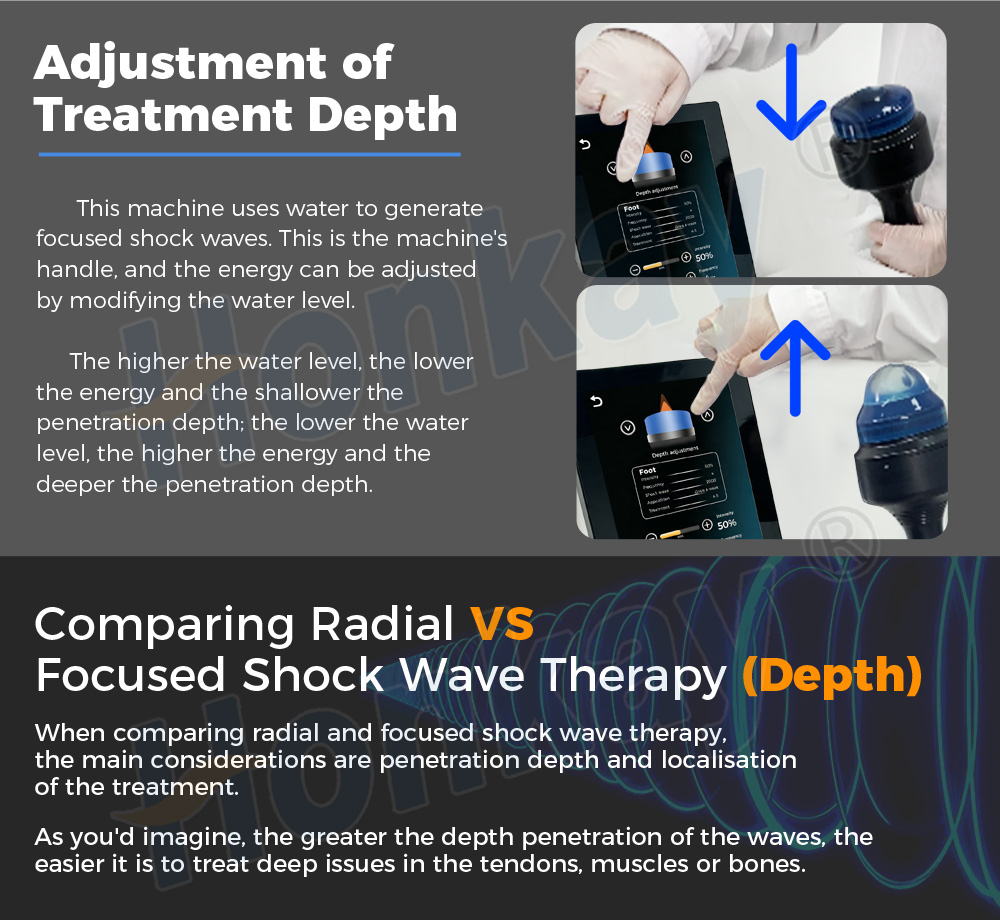
Focused energy is designed for the tissue you cannot reach with your thumb. The focal zone can be steered to sit several centimetres below the surface, so the platform is aimed at chronic tendon insertions, deep calcifications, long-standing tendinopathies and the muscle and bone interfaces that respond poorly to surface-level pressure waves. Our focused platform adjusts the focus depth mechanically, by raising or lowering the water level inside the handpiece, and the intelligent zoom covers a depth range of 0-8 cm. That is a wide working envelope, and it is the reason focused systems are usually bought by clinics that already have a radial unit and now want to accept the deeper, more chronic referrals.
Turn the comparison into an indication list and the practical split looks like this. Our radial unit is indicated for frozen shoulder, tennis elbow, plantar fasciitis, tendon calcification, lumbar muscle strain and patellar tendinitis, working through five mechanisms: pain relief, anti-inflammatory and swelling reduction, microcirculation improvement, tendon and fascia repair, and adhesion release. The focused platform manual lists periarhritis of shoulder, tennis elbow, plantar fasciitis, tendinitis, periostitis and muscle strain, and adds an ED programme as a body-part preset. Notice that both lists contain the same classic tendon conditions. That overlap is exactly why the mechanism, not the indication name, has to drive your decision: a tennis elbow that is superficial and long-standing responds to radial work, while the same diagnosis with a deep, calcified, chronically resistant insertion is the case a focused platform is built for.
This is the question that generates the most disappointment after delivery, so it is worth being precise. Radial and focused are two different energy geometries, and the two machines we build are not a switch on a menu. The radial platform is an electromagnetic unit with seven dedicated heads. The focused platform is a single-handle unit whose energy is generated and converged inside one handpiece. If your case mix genuinely needs both, the honest answer is that you buy both, or you start with the one that covers the larger share of your current bookings and add the other as the practice grows.
There is a second, practical reason for that answer. A clinic that offers both can keep a single treatment room producing revenue for a wider range of referrals, and it can price superficial recovery work and deep chronic treatment differently. Distributors reach the same conclusion for a different reason: a two-platform line gives them a radial entry product for volume customers and a focused flagship for clinics that are ready to move up.
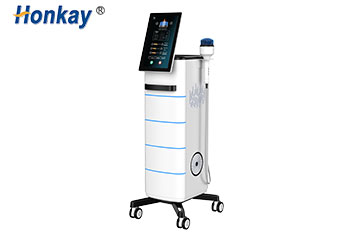
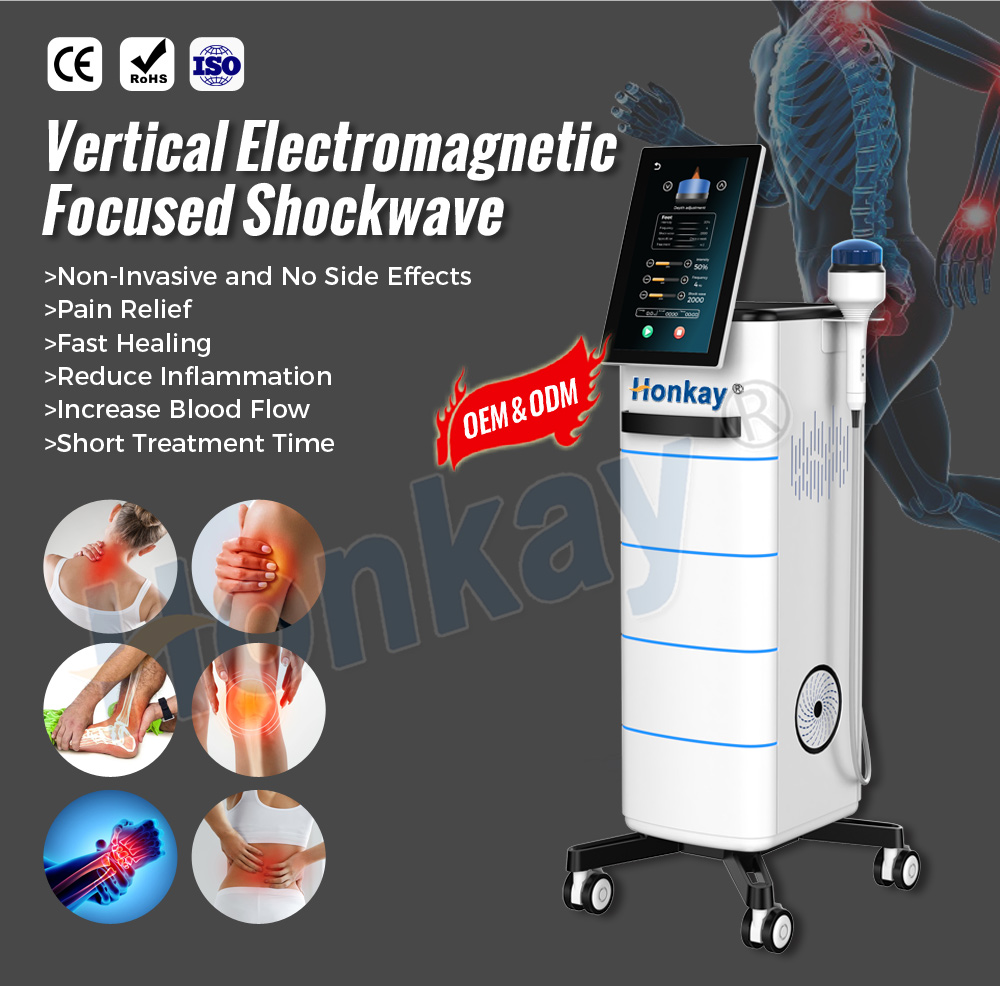
The focused shockwave machine is a single-handle unit. It is built in standing and desktop housings that share the same specification, so choosing between them is a room-fitting decision rather than a performance one, and the unit pictured here is the standing version. It runs on AC 110V / 220V, 50/60Hz with a rated power of 700W as stated in the manual, and it is operated through a 10.4-inch liquid-crystal touchscreen with twelve body-part presets covering neck, shoulder, back, hip, elbow, wrist, hand, knee, calf, ankle, foot and ED. Energy is generated electromagnetically and coupled to the patient through a water bladder in the handpiece, with a single handle covering the different depth requirements. Depth is adjusted by raising or lowering the water level: the higher the water level, the lower the energy and the shallower the penetration; the lower the water level, the higher the energy and the deeper the penetration.
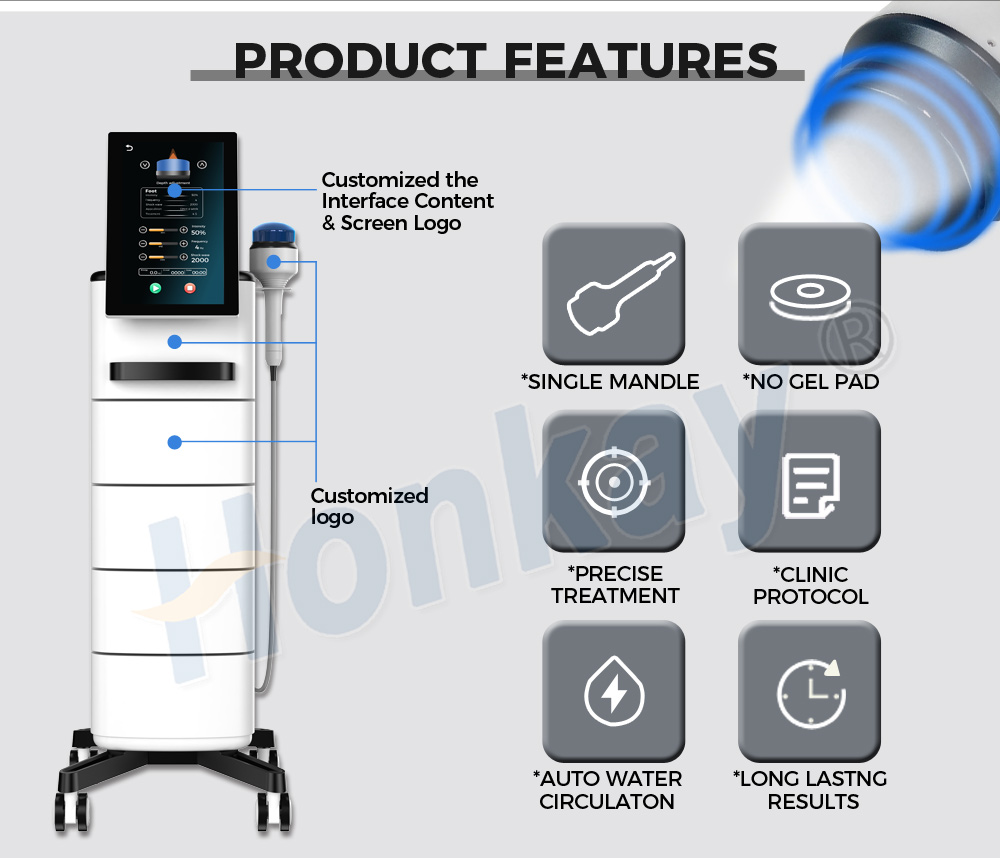
Three technique rules from the manual matter to your staff. For tendon-insertion tendinitis, the fixed-point vertical shock method is used with the probe held perpendicular to the marked target and 100-200 impacts delivered per target. For fascial adhesion or a nodule, the slow mobile scanning method is used with the probe at 15-30 degrees to the skin, scanning at about 1 cm per second and pausing for 30-50 impacts at the nodule. For chronic pain, the fan-shaped diffusion shock method covers 2-3 cm per fan direction with 50-80 impacts, keeping clear of nerve trunks. The manual also sets one hard limit that belongs in your staff handbook: fixed-point impact on the same area must not exceed 300 impacts. Consumables are handled unusually: the focused platform is described as a no-consumables design, so instead of a projectile you service water. Change the water every 15 days in frequent use, and if the machine will sit idle for more than 30 days, drain the water tank and the handpiece.
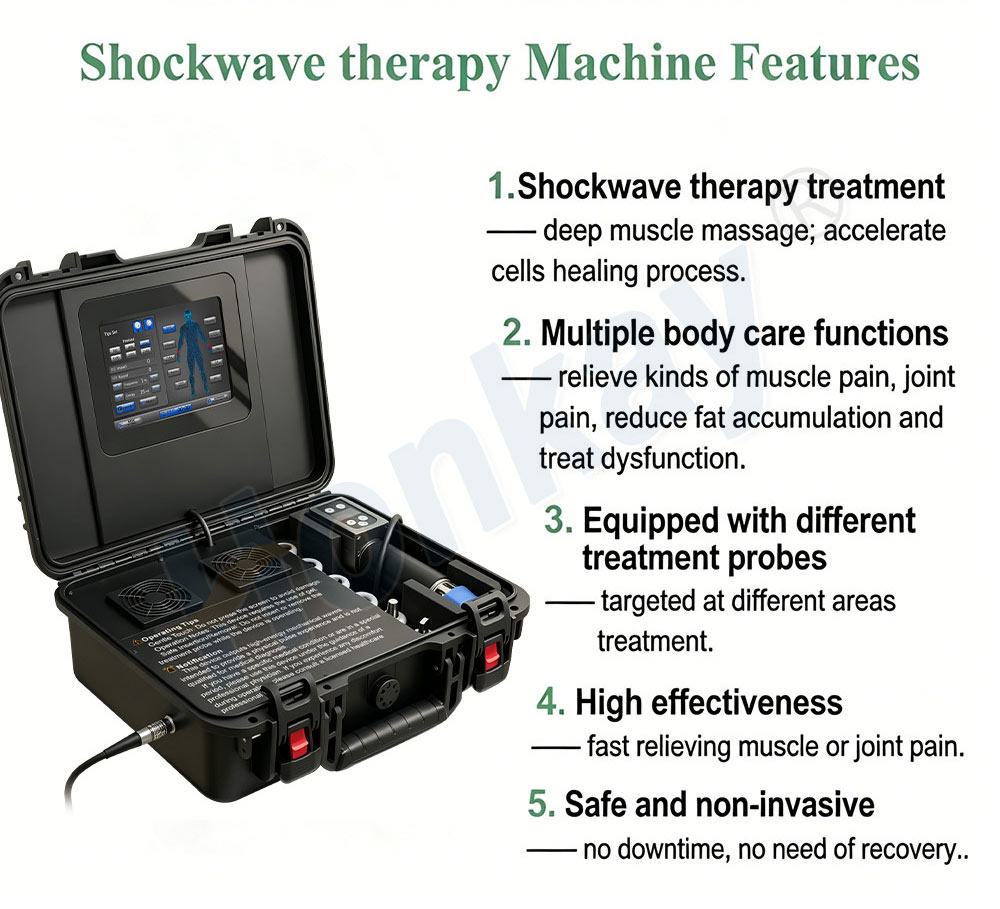
The suitcase-format radial / electromagnetic shockwave machine runs on 220V / 50Hz or 110V / 60Hz with a total power of 200VA, delivers a shock frequency from 1 Hz to 22 Hz and an energy intensity from 30 mJ to 185 mJ, and is controlled through an 8-inch touchscreen with body-part selection. Cooling is handled by twin fans built into the case, and the whole system packs into an aviation-case style pull case measuring 53 x 42 x 25 cm, which is why this format travels so well for mobile therapists, sports teams and distributors who ship to multiple sites. Seven interchangeable heads are supplied, and the sixth and seventh heads are assigned to ED treatment.
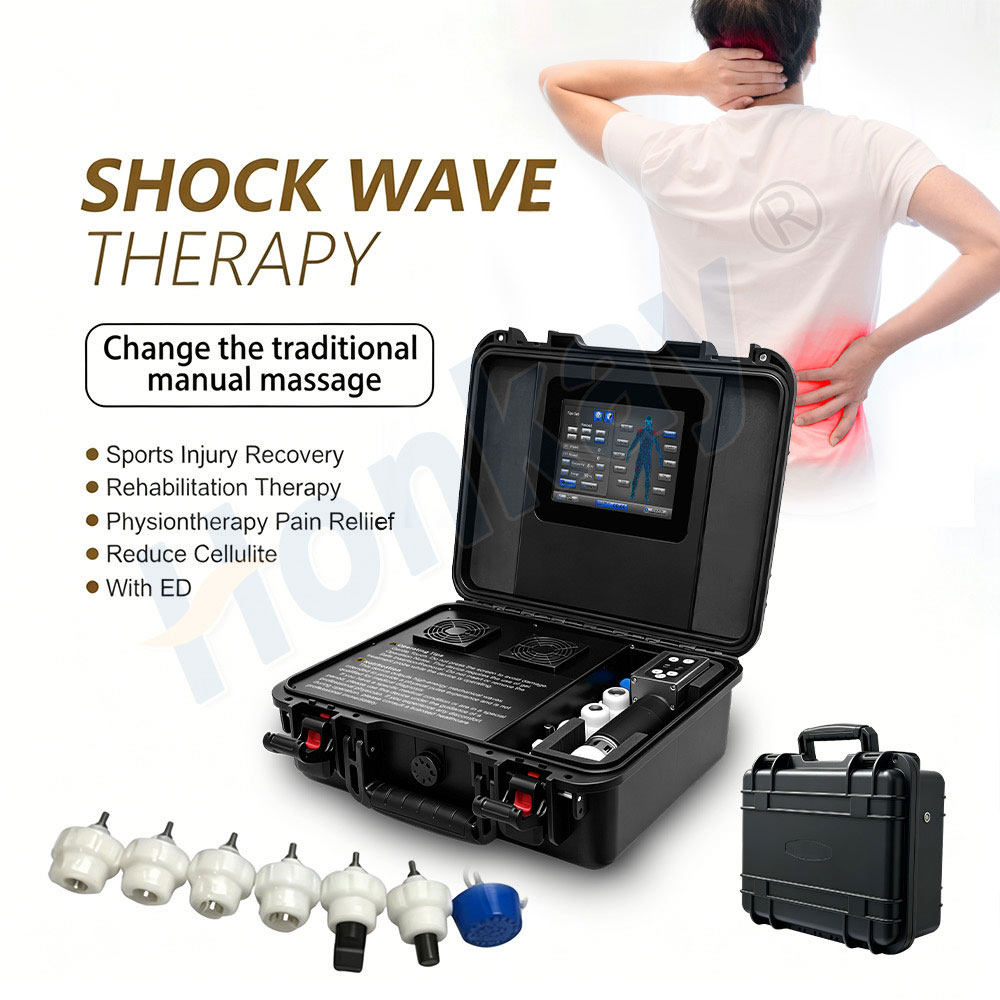
For a buyer, the two service facts to note are the consumable cycle and the running limits. The bullet is expected to be replaced at approximately 1,000,000 impacts and the air tube at approximately 5,000,000 impacts, which gives you a predictable way to forecast parts cost per treatment once you know your average impacts per session. On duty cycle, the manual is unusually explicit: stop for five minutes every 20,000 impacts, and if the machine reaches 80 degrees Celsius, stop for 30 minutes. Both limits are scheduling information, not just maintenance information. If your therapists routinely run 2,500-impact protocols, the five-minute rule shapes how you build a day list, and it is a good argument for keeping a second unit in a busy two-therapist clinic.
Assume, for a moment, that the purchase budget is fixed and you can have one platform. The decision then reduces to four questions about your own practice, and you can answer them without any supplier in the room. First, what share of your current bookings are superficial musculoskeletal cases, such as plantar fasciitis, tennis elbow, patellar tendinitis, muscle strain and recovery or body-contouring programmes? If that is the bulk of your list, the radial / electromagnetic machine is the higher-value purchase because it covers the widest range of routine indications, it travels if you need it to, and its consumable cost is predictable and small per treatment.
Second, how many of your referrals are referrals of last resort, the chronic, calcified or deep-seated cases that other clinics have already treated and not resolved? Those patients justify a focused shockwave machine, and they are also the patients who will pay a premium price, which is why focused platforms tend to sit in orthopaedic, sports-medicine and pain-management settings rather than in general wellness rooms. Third, how many therapists will share the machine? A single-handle focused unit has a different throughput profile from a seven-head radial unit, and the duty-cycle rules on the radial machine have to be built into the roster rather than discovered on a busy Saturday. Fourth, what does the room look like? The suitcase machine can be stored on a shelf and wheeled or carried to the patient; the focused unit needs 30 cm of clearance around its body so that heat can dissipate.
If you cannot answer those four questions yet, buy the radial machine first. It is the safer first platform for a new clinic, it generates revenue across the broadest patient base, and it teaches your team the coupling, head-selection and energy-escalation habits that they will later apply to focused work. If your list is already dominated by chronic deep-tissue referrals, the focused platform is the better first purchase, and the radial unit becomes the second machine you add for volume and recovery work.
Buyers tend to compare purchase prices and forget the ten years that follow. The two technologies have genuinely different cost shapes, and the difference favours each of them in a different scenario. The radial machine has a small number of wearing parts with stated lives, which means a real but modest recurring parts cost that you can forecast accurately. The focused machine is sold as a no-consumables design, which removes the projectile and air-tube line from your budget altogether and replaces it with a water-service routine that your own staff perform.
| Cost or service item | Radial / electromagnetic | Focused platform |
|---|---|---|
| Projectile (bullet) | Approximately 1,000,000 impacts of service life | Not applicable; the manual describes a no-consumables design |
| Air tube | Approximately 5,000,000 impacts of service life | Not applicable |
| Routine consumable service | Replace bullet and air tube at the end of their stated life | Change the water every 15 days in frequent use; drain the tank and handpiece if the unit is idle for more than 30 days |
| Continuous-run rule | Stop for 5 minutes every 20,000 impacts | The manual does not state a numeric impact cap or a fixed stop duration; it advises against long periods of high energy and high frequency |
| Thermal rule | Stop for 30 minutes if the machine reaches 80 degrees Celsius | The manual requires shutdown and rest after a heat-dissipation fault, but states no temperature threshold |
| Single-point impact rule | Do not raise energy blindly or impact one point for long periods; no more than 3 sessions per week on the same area | Fixed-point impact on the same area must not exceed 300 impacts |
| Heat management hardware | Twin fans built into the case | 30 cm clearance required around the body; the manual does not name a cooling method |
Two habits turn this table into a real number before you sign. Ask your supplier for the unit price of the bullet and air tube, and divide each by its stated impact life to get a cost per impact; multiply by your average impacts per session and you have a true running cost per treatment. Then ask the same supplier to confirm, in writing, the continuous-run and shutdown limits of the machine you are actually buying, because those limits decide how many patients you can physically fit into one day and they are the first thing an under-briefed team discovers the hard way. For the focused platform, ask for the recommended water-change interval in sessions as well as in days, and ask what the machine reports before it shuts itself down. None of that is on a typical price list, and all of it belongs on your quotation.
On the radial machine, head choice is a clinical decision, not an accessory decision, because the head geometry decides which body sites are reachable and how the energy is spread. The radial unit is supplied with seven interchangeable heads, and the manual pairs each one with a preferred working area. Match the head to the site before you touch the energy setting, and train the team to set up the head and the coupling gel before the patient is positioned. The manual also requires coupling gel: the machine must not be operated without it, and the treatment handle must not be unplugged while the machine is running.
| Treatment head | Recommended working area |
|---|---|
| Small round focused head | Calcaneus, plantar fascia, elbow, wrist, deep psoas |
| Standard head | Shoulder and neck, waist, general limb work |
| Large round diffuse head | Whole back, outer thigh, gluteus maximus |
| Flat head | Trapezius, latissimus dorsi, flat lumbar muscle groups |
| U-shaped head | Paraspinal muscles, shoulder blade, erector spinae; the hollow centre avoids pressing on the vertebral body |
| Conical head | Hand and foot joint spaces, tendon insertion points, small nodules |
| Curved soothing head | Axilla, waist and abdomen, flexor surfaces of the limbs |
Two of those seven heads have a second purpose. On the radial unit, the sixth and seventh heads are used for the ED function, so if erectile dysfunction treatment is part of your commercial plan, make sure the quotation states that both heads are included rather than sold separately. Head diameters are listed in the manual as a set, 9 mm, 15 mm, 20 mm, 35 mm and 35 mm, but the manual does not pair each diameter to a named head. Before you order spare heads, ask the supplier for the head-by-head size and use chart, because that pairing is what tells you which head a therapist should reach for and which one to re-order when it wears.
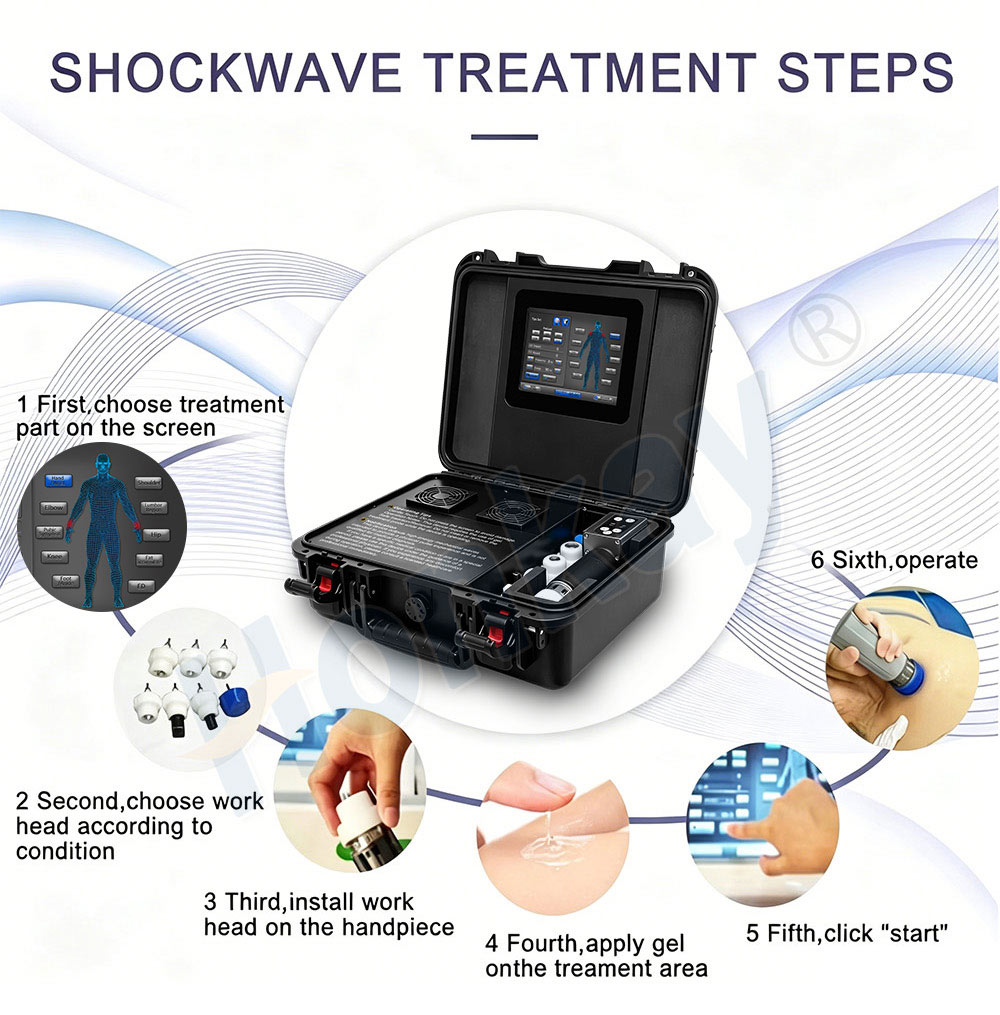
Energy levels are the second half of the decision, and the radial machine gives you the more useful starting point because its manual publishes a full recommendation table. Use it as your default protocol library and adjust upwards with clinical judgement rather than starting high.
| Body area | Frequency | Energy | Shock waves | Sessions | Interval |
|---|---|---|---|---|---|
| Elbow | 3 Hz | 50 mJ | 2500 | 5-10 | 5-7 days |
| Wrist | 1 Hz | 50 mJ | 2500 | 5-10 | 5-7 days |
| Synchondroses pubis | 4 Hz | 80 mJ | 2500 | 5-10 | 5-7 days |
| Knee | 3 Hz | 50 mJ | 2500 | 5-10 | 5-7 days |
| Ankle | 3 Hz | 50 mJ | 2500 | 5-10 | 5-7 days |
| Shoulder | 8 Hz | 100 mJ | 2500 | 5-10 | 5-7 days |
| Lumbar spine region | 9 Hz | 130 mJ | 2500 | 5-10 | 5-7 days |
| Hip | 11 Hz | 150 mJ | 2500 | 5-10 | 5-7 days |
| Fat accumulation | 11 Hz | 150 mJ | 2500 | 5-10 | 5-7 days |
| Erectile dysfunction | 3 Hz | 5 mJ | 1500 | 2-3 | Twice a week |
On the focused platform the logic is inverted. You do not choose between heads, because there is one handle; you choose a depth by adjusting the water level, then set the intensity. The manual publishes a single worked preset, the neck programme, at 40% intensity, frequency 4, 2000 shock waves, once a week for 4-5 sessions, and it notes that different body areas are preset to different energy values. It does not publish the remaining body-part presets. If your protocols depend on those numbers, ask the supplier to provide the full per-area preset table in writing, and treat the percentage slider as a within-machine dial rather than a specification you can compare with another brand. Ask for the millijoule value that each percentage corresponds to, and ask what the handpiece reports as actual energy during a pulse, because that is the only figure that lets you line two focused machines up side by side.
This is the section to read twice, and then to photocopy for the treatment room. The contraindication rules below apply to both technologies: they are about the patient, the site and the way the machine is operated, and they do not change with the price of the platform. Our manuals set them out in three groups, and a clinic that respects all three will avoid almost every avoidable incident. If a patient falls into any group in the first table, do not treat. If a planned treatment field crosses any region in the second table, move the field or do not treat. The third table is the one that protects your equipment and your team on a routine day.
| Group or condition | Detail |
|---|---|
| Coagulation and bleeding disorders | Coagulation disorders such as hemophilia, current anticoagulant medication, abnormal platelet function |
| Implanted electronic devices | Cardiac pacemakers, defibrillators, brain neurostimulators |
| Active disease in the treatment area | Malignancy, thrombosis, acute purulent infection, osteomyelitis, open skin lesions |
| Cardiovascular and neurological conditions | Uncontrolled severe hypertension, aortic aneurysm, severe cardiovascular or cerebrovascular disease, uncontrolled epilepsy, severe cognitive impairment that prevents cooperation |
| Pregnancy | Pregnancy, with the abdomen and the lumbosacral region strictly forbidden |
| Growing bone | Adolescents and children whose epiphyses are still open |
| Body region | Rule to follow |
|---|---|
| Brain | Never a treatment target |
| Upper cervical spine | Exclude from the treatment field |
| Eyeball | Exclude from the treatment field |
| Pharynx and trachea | Exclude from the treatment field |
| Major vessel trunks | Exclude from the treatment field |
| Cardiac region | Exclude from the treatment field |
| Lungs | Exclude from the treatment field |
| Spinal canal | Exclude from the treatment field |
| Reproductive organs | Exclude from the treatment field |
| Pregnant abdomen and lumbosacral region | Strictly forbidden |
| Acute red, swollen or ulcerated wounds | Wait until the skin has settled before treating near the area |
| Severe superficial varicose veins | Exclude from the treatment field |
| Epiphyseal growth areas in children | Exclude from the treatment field |
| Rule | What it means in the treatment room |
|---|---|
| Never operate without coupling gel | Apply gel to the treatment area and confirm good coupling before starting; the machine must not be run dry |
| Never unplug the treatment handle while the machine is running | Power down before changing or reseating the handpiece |
| Never raise energy blindly or work one point for a long time | Escalate gradually and keep the applicator moving; fixed-point work on the same area must not exceed 300 impacts on the focused platform |
| No more than 3 sessions per week on the same area | Space repeat treatments accordingly and record the field that was treated |
| Keep clear of nerve trunks, dense neurovascular areas and internal organs | Plan and mark the field before starting, particularly on the neck, back and limb flexor surfaces |
One more habit belongs on that list. Both machines must be operated by trained staff who understand the preset they have selected, and neither machine should be handed to an operator who has not been shown the coupling and shutdown procedures. A delivered machine with no training plan is a liability, which is why training and installation terms belong on your quotation alongside the price.
This is the section that separates a considered purchase from an expensive lesson. Marketing pages are written to make two very different machines look similar, and the fastest way to lose control of a purchase is to accept percentage sliders and a few photographs as a specification. The table below lists what our own manuals actually state, what the other platform does not state, and the question you should put in writing before you approve an order. Send it as a checklist; a supplier who can answer it in writing is a supplier who can support the machine after delivery.
| Request in writing | What the radial unit manual states | What the focused manual states | Why it matters to you |
|---|---|---|---|
| Energy calibrated in millijoules | 30-185 mJ, set directly in mJ | A 0-100% intensity slider with no mJ range stated | Percentages cannot be compared across machines, so without mJ you cannot verify the output or transfer a protocol from another clinic |
| Head-by-head geometry and size chart | Seven heads; diameters listed as 9 mm, 15 mm, 20 mm, 35 mm and 35 mm, with the sixth and seventh heads assigned to ED | A single handle; head sizes are not stated | Head geometry decides which anatomical sites are reachable and which head you will need to re-order |
| Continuous-run and thermal limits | Stop 5 minutes every 20,000 impacts; stop 30 minutes at 80 degrees Celsius | No numeric impact cap, stop duration or shutdown temperature stated | These limits set your daily patient capacity and protect the service life of the machine |
| Electrical rating, including the VA value | Input 220V / 50Hz and 110V / 60Hz; 200VA total power | AC 110V / 220V, 50/60Hz; 700W rated power, with no VA value stated | VA and W are not interchangeable, and the rating affects circuit loading and generator sizing for mobile use |
| Packing dimensions, materials and shipping weight | Aviation-case style packing, 53 x 42 x 25 cm | Not stated | Freight cost, courier limits and any damage claim all depend on these figures |
| Consumable life and spare part prices | Bullet approximately 1,000,000 impacts; air tube approximately 5,000,000 impacts | Stated as a no-consumables design, with a water-service interval | Turns running cost into a cost per treatment instead of a surprise in year two |
| Per-area preset or protocol table | A full recommendation table covering ten body areas | One worked preset only, the neck programme | Your therapists need a defensible starting protocol for every area you intend to sell |
| Train the trainer and installation support | Confirm what is included | Confirm what is included | A documented handover is what lets a second therapist use the machine correctly |
| Warranty and after-sales terms | 24-month warranty, counted from the date of shipment from the factory | 24-month warranty under the same terms | Uniform, written terms remove any argument about what is covered and when the clock starts |
If you take only one thing from this article, take the first row. Ask for energy in millijoules. A supplier who can give you a calibrated mJ figure, and who will confirm the continuous-run limits and the head geometry chart in the same document, is selling you a machine you can plan a clinic around. A supplier who answers only in percentages is asking you to take the most important number in the purchase on trust.
For most small clinics starting out, the radial / electromagnetic machine is the better first purchase. It covers the broadest range of everyday musculoskeletal indications, it is supplied with seven interchangeable heads, its consumable cost is predictable, and the suitcase format does not require dedicated floor space. A focused shockwave machine becomes the better first purchase when most of your referrals are chronic, deep-seated or already-treated cases that justify a premium treatment price.
Not on our platforms. Radial and focused are two different energy geometries rather than two settings of one machine. The radial platform is an electromagnetic unit with seven heads, and our focused shockwave platform is a single-handle unit whose energy is converged inside the handpiece. Clinics that need both usually run the two machines side by side, starting with the one that matches the larger share of current bookings.
It depends on your volume and your case mix. The focused platform is described as a no-consumables design, so the recurring cost is mainly water service: change the water every 15 days in frequent use and drain the tank and handpiece if the unit sits idle for more than 30 days. The radial unit uses a bullet rated at approximately 1,000,000 impacts and an air tube rated at approximately 5,000,000 impacts, which is a real but modest cost that you can forecast precisely by dividing each part price by its stated life.
Because a percentage slider is easier to display than a calibrated output. Our focused manual shows a 0-100% intensity slider and an actual-energy display in millijoules, but it does not publish a millijoule range for the slider. That is why you should ask for the mJ value that each percentage corresponds to before you buy, and why you should treat a percentage from one brand as incomparable with a percentage from another.
On our focused platform the depth is adjusted mechanically by raising or lowering the water level in the handpiece, and the intelligent zoom covers a range of 0-8 cm. A higher water level gives lower energy at a shallower depth, while a lower water level gives higher energy at a greater depth. Radial energy behaves differently: it is densest near the surface and spreads as it travels, so radial work suits superficial tendon, muscle and fascial targets.
The radial unit is supplied with seven interchangeable treatment heads, and the manual assigns the sixth and seventh heads to the ED function. The diameter set is listed as 9 mm, 15 mm, 20 mm, 35 mm and 35 mm. Because the manual does not pair each diameter with a named head, ask the supplier for the head-by-head size and use chart so that your team knows which head to fit for each area and which head to re-order when it wears.
Check that energy is stated in millijoules, that a head-by-head geometry chart is attached, that the continuous-run and shutdown limits are written down, that the electrical rating includes the VA value, that packing dimensions and shipping weight are given, that consumable life and spare part prices are listed, that the per-area protocol table is supplied, and that the warranty reads as a 24-month warranty counted from the date of shipment from the factory. Any gap in that list is a question you will be asking after delivery instead of before payment.
If you are weighing a radial and a focused machine for your clinic, or you distribute shockwave therapy equipment in your market, we can put both platforms side by side for you and answer the quotation checklist above in writing.


 English
 中文
中文