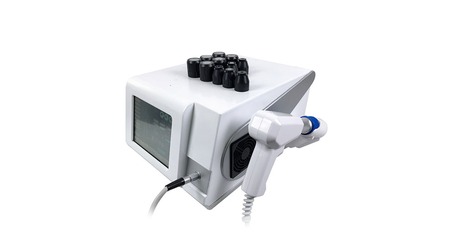
Two clinics buy the same shockwave unit, on the same day, at the same price. One is running again shortly after a handpiece fails. The other spends a month arguing about whether the fault is covered, who pays the courier, and whether the damage happened before or after the crate was opened. Nothing about the hardware separated them. Four sentences in the contract did: when the warranty starts, what it covers, how fast somebody must answer, and who owns the risk between the factory door and the treatment room.
This equipment is usually bought against a one-page quotation and a proforma invoice with a few lines of terms on the back. That works while everything functions and stops working the first time something does not. The cost of a failure is rarely the part; it is the sessions that do not happen, the therapist apologising to a client, the distributor absorbing freight they never priced, and the slow loss of confidence that follows a repair nobody can date.
What follows is a buyer's document. It takes the clauses that decide what a breakdown costs — warranty start date, coverage, response, spare-part lead times, remote diagnosis, liability, transport risk, payment against documents, acceptance — and sets out what each should say and what to write instead of the weak version. It is written for distributors signing annual agreements, clinic owners buying a first unit, and service managers who inherit a machine somebody else specified. One rule runs through it: a term is worth only what the paperwork behind it can prove.
The warranty on this equipment runs for 24 months from the factory shipment date. That is a clean sentence, and it is the one buyers skip. What matters is not the length but the anchor: the clock starts when the goods leave the factory, not when the crate is opened in the clinic. On an air shipment the difference is days. On sea freight with a transhipment, port congestion and a customs hold, the machine can sit in a container while a measurable slice of its cover is consumed.
That is not a trick, and it is not unusual, because no manufacturer can police a crate after it hands over to a forwarder. The buyer's answer is not to demand a longer term but to shorten the exposure: pick a faster routing for the first unit, book acceptance early, and hold one spare handpiece so a fault in the first weeks does not stop the room.
The second thing to fix is which document carries the date. "Shipment date" is only usable if the contract names the evidence: the export invoice, the bill of lading, or the air waybill. Those three can differ by days, and near the end of the term days are the entire argument. Have the warranty certificate print the same date as the shipping document, and check on arrival that they agree. The third thing is to resist a start date that floats: "warranty begins on installation" sounds generous and behaves badly, because it depends on a signature a busy clinic may not give for months.
| Wording you may meet | Date the clock really starts | Who absorbs transit time | Where the argument lands | What to do with it |
|---|---|---|---|---|
| 24 months from the factory shipment date | The date on the export invoice or bill of lading | The buyer, by the length of the route | Only if the shipping date was never recorded | Accept, and match the certificate to the shipping document |
| 24 months from the invoice date | The commercial invoice, which may precede dispatch | The buyer, plus the gap before dispatch | Which invoice, when a deposit and a balance exist | Ask which invoice governs; get it in the order confirmation |
| 24 months from arrival at destination port | Arrival, which needs a document to prove it | The supplier, in principle | "Arrival" is undefined: port, forwarder, customs or door | If offered, name the arrival point and the proof on the same page |
| 24 months from installation or commissioning | The acceptance signature | Nobody, until somebody signs | A term that never starts, or starts invisibly | Usable only with an outside date written beside it |
| "Warranty begins on delivery", no date named | Unknown | Whoever holds the weaker file | Coverage, response and parts pricing together | Replace the sentence before signing |
Two related points belong in the same clause. When a part is replaced, the workable answer is the remainder of the original 24 months, tied to the same shipment date and recorded on a service note quoting the original serial number. And because distributors resell and clinics trade units in, ask for the certificate to be transferable inside the term on written notice, and keep the shipping documents with the unit.

The word "warranty" on a quotation covers, in most buyers' imagination, everything that could go wrong with the box. In most contracts it covers defects in materials and workmanship in the parts the supplier made, for 24 months from the factory shipment date, with repair or replacement at the supplier's discretion. The gap between those readings is where nearly every dispute begins, and it closes only one way: by naming both sides of the line in the agreement.
On the covered side, name the expensive and invisible items: main board, power supply, display and controller, wiring harness, handpiece body and its drive, foot switch, enclosure hardware. A clause that lists these removes the supplier's ability to argue that a particular board was "a component" rather than "the machine". On the excluded side, the honest list is short: consumables and wear parts, liquid ingress, dropped handpieces, incorrect supply voltage, unauthorised repair or modification, operation outside the manual's duty cycle, cosmetic wear. Naming them is not the supplier escaping responsibility; it is what makes the covered list credible.
Two exclusions are often blurred and should not be. Transit damage belongs in the shipping clause, not the warranty clause, and faults caused by the room's own supply belong under a precise exclusion for voltage outside the manual's range rather than a vague one for "electrical faults" — the precise version tells the buyer what to fix before it happens.
| Item or event | Inside the 24-month warranty? | What the buyer must show | Why the line sits there |
|---|---|---|---|
| Main board, power supply, display | Yes — defect in materials or workmanship | Serial number, dated fault report, video of an intermittent symptom | These stop the room and cost most to replace |
| Handpiece body, drive, connector | Yes, where the failure is internal | The head's own record: counts, cleaning routine, date of issue | A head is handled more than any other part, so cause must be evidenced |
| Membrane, tip, impact body, gel, fuses | No — wear and consumables | Nothing; these are bought as spares at the agreed price | Service life is predictable, so they belong in the running budget |
| Liquid ingress into the housing | No | A service report naming the residue or corrosion found | Cleaning method is under the operator's control |
| Impact damage to a handpiece | No | Photographs of the impact point and the cable gland | Impact marks separate handling damage from a manufacturing fault |
| Supply voltage outside the manual's range | No | A measurement at the socket, and the room's supply arrangement | A surge-damaged board cannot be told apart from one that failed alone |
| Unauthorised repair or modification | No, for the affected assembly | The service history: who opened the unit and when | Once a third party has worked inside, cause cannot be established |
| Transit damage or a short shipment | Handled by the shipping clause | Photographs taken before full unpacking, and the carrier's report | Risk passes at a defined point; mixing it in blurs liability |
Two procedural points decide whether any of that coverage can be used. The serial label must stay on the machine — a removed or over-labelled serial gives a supplier a legitimate reason to refuse a claim. And the buyer must report a fault before attempting a repair, keeping the failed part available for inspection. A supplier told "we replaced the board ourselves and it still does not work" cannot establish whether the board was ever faulty.
"Fast after-sales support" is the most common sentence in a shockwave quotation and the least useful. It cannot be measured, breached or claimed against. What a buyer needs is a sequence with an owner and a deadline at each step: a channel to report through, an acknowledgement that the report arrived, a diagnosis, a coverage decision, and a plan for the part or the visit. Each step can carry a window that is negotiable and recorded in writing at order stage, and each can be attached to a named person rather than a general mailbox.
This matters more than the headline warranty because downtime, not repair cost, is the expensive part. A room with a full appointment book loses revenue for every day a unit is out, and a distributor with units on demo or under a service agreement loses credibility no free part restores. A 24-month warranty that takes an unmeasured period to activate is worth less to a working clinic than a shorter, sharper obligation.
Start with the channel. Name one service address and one number, the language in which claims may be submitted, and require a ticket number or written acknowledgement for every report. Without a ticket number the buyer has no evidence of when the clock started and the supplier has no proof it responded; email beats a messaging app here simply because it is searchable and dates itself. Then define what a valid report contains — serial label, photograph or short video of the symptom, the programme in use, the room's supply arrangement, what the operator already tried — and put that list in the contract as the buyer's obligation. It sounds bureaucratic; in practice it turns a week of questions into one exchange.
Then the timings, which is where the negotiation happens. A workable structure has three windows rather than one: acknowledgement, diagnostic conclusion, and resolution once a part is confirmed. Each is negotiable and should be agreed in writing, and each should carry a consequence if missed — an escalation contact, a freight upgrade, a credit against the next order. A window with no consequence is a target, not a commitment.
| Clause element | What it should say | Wording that commits to nothing | Evidence to attach | Who owns the step |
|---|---|---|---|---|
| Reporting route | One address, one number, a ticket number on receipt | "Contact our after-sales team at any time" | The sent email with the ticket quoted in the reply | Buyer reports, supplier acknowledges |
| Acknowledgement window | A window to be agreed in writing, with a named backup contact | "We reply promptly" | Timestamps of report and reply | Supplier |
| Diagnosis | A remote session or written conclusion with the cause and the test that confirmed it | "Our engineers will help you solve it" | Photographs, video, error display, supply measurement | Supplier's engineer, buyer's technician onsite |
| Coverage decision | A written decision, in or out, with the clause it rests on and the cost if it is out | "We will see what we can do" | Warranty certificate and its shipment date | Supplier, within an agreed window |
| Part or visit | Which applies, the freight method, and who books and pays the courier | "Parts are available" | The parts list line with its agreed lead time, and tracking | Supplier ships, buyer receives |
| Escalation | A second named contact and a priced consequence for a missed window | "We take service very seriously" | The ticket thread, unedited, with dates | Both sides; only real if priced |
A note on scope, because this is where distributors get caught: response obligations are written for the party that bought the machine, not the one that owns it. If you resell, the clause you sign has to be at least as strong as the one you offer your own customers, with the same ticketing and evidence requirements so their expectation lands inside what you can meet.
A spare-parts commitment is the part of a contract a clinic actually experiences: nobody reads the liability clause during a session, everybody experiences the wait for a membrane. It has to be built from three things that are rarely on the same page — a list of parts with prices, a lead time against each line, and a statement of where the part ships from. Remove any one and the other two are decoration.
The list should cover the failures that stop a room and be specific enough to order by name: handpieces, membranes or exit windows, tips and impact bodies, cables, foot switches, fuses, cords, display, main board, power supply, fan filter. For each line the buyer needs a unit price at signing, a currency, a validity period and a lead time. "Please contact us for pricing" is not a commitment; it is an invitation to negotiate at the worst possible moment.
State lead times per line rather than one figure for "spare parts", because the lines behave differently. A membrane or a cable is usually held and moves quickly; a main board may be built in a batch; a handpiece may depend on a sub-assembly run. One number for all three means the fastest item is quoted at the speed of the slowest and the buyer's stock plan is built on the wrong assumption. The wording matters as much as the figure: a range with a clear starting point — from receipt of a purchase order, from confirmation of payment, from a documented coverage decision — is enforceable, and one without a starting point is not.
| Part group | What its absence stops | Hold as stock? | Lead-time wording to require | Fallback if the line is long |
|---|---|---|---|---|
| Complete handpiece | The whole room, if the unit ships with one head | Yes — one per unit in daily use | A stated lead time per part number, counted from a named trigger | Buy the second head with the machine |
| Membrane or exit window | Output quality, then the head itself | Yes — one per head in rotation | Lead time and unit price on the same line | Confirm it is field-replaceable before ordering |
| Cable and connector | Everything downstream of the console | Yes — one per site | Same wording as the head, with the connector type named | Small and light; hold two |
| Main board and power supply | The console, entirely | Rarely; expensive to hold | Lead time to be agreed in writing, plus the in-term price | Agree a swap-unit arrangement instead |
| Display and controller | Settings entry and any programmed session | Only for a fleet of five or more | A list line, noting whether it ships with firmware loaded | Ask whether the screen is matched to the board |
| Foot switch, fuses, filter, cord | A session, for want of a part worth very little | Yes — a small consumables box | Price only; these should never need a lead time | Buy a handful with the machine |
One sentence buyers forget: the price of a part after the term ends. A supplier who will not state post-term pricing at signing has reserved the right to set it when the buyer has no alternative. And for a stock plan, no failure rates are needed: count the parts whose absence stops a room, then hold enough of each to cover that line's lead time.
Most faults on a shockwave console are resolved without a part leaving the factory. The console reports its state on a display, the handpiece announces its condition through sound and feel, and the room's supply is measurable with a socket tester — which makes remote diagnosis the cheapest route for both sides, and the reason it should be an obligation rather than a favour.
The obligation has two halves, and both need writing. The supplier's half is engineer time: a named channel, a stated language, a first-session window that is negotiable and agreed in writing, and a commitment that the session ends with a written conclusion rather than a suggestion to try again. The buyer's half is access: a technician in front of the machine, a phone or tablet that can hold a steady image of the screen while buttons are pressed, the manual to hand, and a way to measure the supply at the socket. A call in which nobody can see the display produces nothing.
What the diagnosis must produce is a decision, not a conversation. Three outcomes cover almost every case: a setting the operator can correct at the machine, a part that must be replaced, or a return for workshop repair. Require the engineer to state which applies and, where a part is involved, to quote its number and price immediately, so the buyer can decide on the spot. Then require a short written summary — symptom, tests, conclusion, action — filed against the serial number. That history is what turns a disputed claim into a routine one at the end of the term.
| Item to agree | What the contract should require | What it costs to leave out | How to evidence it later |
|---|---|---|---|
| Channel and language | A named video or voice channel, the working language, and staffed hours | Days lost to messages crossing time zones | Call log kept with the ticket number |
| First-session window | A window to be agreed in writing, negotiable at order stage | A machine idle while a slot is found | The request and the reply that proposes a time |
| Buyer preparation | A competent person, power, manual and socket measurement available | Sessions that restart from the same question | The summary naming what was checked onsite |
| Written conclusion | One of three outcomes, with a part number where relevant | A fault that drifts for weeks without a decision | The email stating outcome and part number |
| Link to the parts process | The diagnosis opens a parts order at the agreed price and lead time | The same delay twice: diagnose, then quote | Parts order dated the day of the conclusion |
| Cost of remote support | Free within the 24-month warranty, on a stated rate afterwards | Uncertainty that stops a clinic from calling at all | The invoice, or its absence, against the summary |
A limit worth naming: remote support diagnoses, it does not certify. If output is the complaint, the answer is a comparison against a baseline recorded when the unit was new, plus a check of the coupling and the head — which is why the acceptance record described below is a service document as much as a delivery form.

Every export contract contains a point at which the goods stop being the seller's problem. Most write it as a three-letter trade term, and in most disputes nobody can say precisely where that point fell. That ambiguity causes more bad feeling than any hardware failure, because a machine damaged in transit is nobody's fault and everybody's cost unless the contract has already decided which. The mechanics are simple: under a term that hands over at the carrier, risk passes on loading; under one that includes carriage and insurance, it passes later at a named destination. The code itself matters less than consistency — the same term on the quotation, proforma, commercial invoice and packing list. When those four disagree, an insurer reads them in whichever way costs it least.
The inspection window is a different thing from the acceptance window: require the receiver to inspect before signing, to note damage on the carrier's own document, and to photograph the crate before it is unpacked.
Liability caps deserve a plain reading. Most suppliers cap total liability at the invoice value and exclude consequential loss, loss of profit and loss of business. For a clinic the consequential loss is what hurts: cancelled appointments, refunded packages, a rented replacement. No supplier in this market will accept unlimited consequential liability, so asking wastes negotiating capital. Ask instead for a priced mechanism — a loaner, a priority freight upgrade, a credit against the next order — which addresses the same risk in a form that can actually be granted.
| Risk | Where it usually sits | What the contract must name | Step at handover | Document that settles it |
|---|---|---|---|---|
| Visible crate damage | Carrier, if noted at delivery | The handover point, and who files the claim | Write it on the carrier's sheet before signing | Signed delivery document with damage noted |
| Hidden damage in an intact crate | Contested, which is why it is expensive | A report window after delivery, and the evidence required | Photograph crate, packaging and unit before discarding | Dated photographs sent the day of unpacking |
| Short shipment or wrong accessory | Supplier, if the list is checked on arrival | That the packing list is the reference, line by line | Count before the crate leaves receiving | Annotated packing list, signed and dated |
| Total loss in transit | Whoever holds risk when the loss occurs | Who insures, at what declared value, and whether the premium is included | Check the declared value covers freight and duty | Insurance certificate naming the insured party |
| Damage during installation | Whoever installed | Who installs, and whether third-party installation affects cover | Record who unpacked, mounted and first powered it | Acceptance sheet signed by the installing party |
| Cap on total liability | Supplier, usually at invoice value | The cap figure, and what sits outside it | Cost a stoppage per day in your own market first | The clause, with a figure rather than a formula |
There is one more handover point, and it is internal rather than contractual. The moment the crate is opened is the last moment the buyer has leverage over transport damage, so a twenty-minute receiving routine — photograph, count, check the serial label, keep the packaging until the unit powers on cleanly — produces evidence that can be used months later, and costs nothing to implement.
Payment terms are usually quoted as a deposit to start production and a balance before shipment, and buyers spend most of their energy on the percentages. That is the less important half. The half that decides whether the machine can be run, maintained and repaired is what arrives before the balance leaves: a unit paid in full and delivered with no wiring diagram, no parts list and a manual nobody on site can read is not a commissioning problem but a contract that was never finished.
The file itself is short: the manual in the market's language, covering controls, programmes, cleaning and fault indications; the packing list, which doubles as the acceptance reference; the parts list with numbers and prices; a wiring or interconnection diagram, which is the first thing a biomedical technician asks for; and an exploded view of the handpiece, the part most likely to be opened in the field. Two more are worth naming — a one-page programme summary in plain language, and the factory test record for the specific serial number, which gives a baseline for any later performance question and reinforces the shipment date.
Tie delivery to the payment schedule rather than to goodwill: a deposit against the order, the document set supplied at pre-shipment with the balance against the shipping documents, and a retention held until the acceptance sheet is signed. The retention need not be large; its function is to keep the acceptance conversation alive after arrival, when the buyer's attention has moved on and the supplier's has too. Where a retention is unacceptable, make the final document set a condition of the balance rather than a promise to follow.
| Document | Why it is needed before the balance | Format to ask for | What "delivered" should mean |
|---|---|---|---|
| User manual | Without it nobody can operate or clean the unit as the warranty assumes | Printed copy in the crate plus a searchable PDF | PDF received by email, not a book promised with the shipment |
| Packing list | The only document proving what was meant to be in the crate | Itemised with quantities, including heads and accessories | Matches the crate line by line on unpacking |
| Spare-parts list with prices | It turns the lead-time clause into an orderable document | Numbers, descriptions, prices, currency, validity | Emailed before the balance, matching the order confirmation |
| Wiring or interconnection diagram | Every technician working inside the unit will ask for it | PDF, legible at A3, with connector references | Sent with the manual, not on request after a failure |
| Handpiece assembly view | Decides whether a head is serviceable in the field or replaced whole | Exploded view with replaceable items marked | Sent with the parts list, readable together |
| Programme summary and test record | Operators inherit unexplained abbreviations; buyers inherit a baseline | One page each, dated, serial number printed | Filed with the warranty certificate in one folder |
One habit carries into this clause: ask for the document set as a numbered list in the order confirmation, so that when the balance falls due the conversation is a count against a list rather than an argument about what was promised.
Acceptance is the moment the machine stops being goods and becomes equipment, and it is the moment the buyer's leverage is highest and their attention lowest. A written acceptance period — a fixed number of working days from delivery, negotiable at order stage — with a defined list of checks and a defined consequence for failure turns that moment into something useful.
The list should be short enough that a busy clinic completes it and specific enough that each line produces evidence: count the crate against the packing list, photograph the serial label, power on and check the display and language, fit each handpiece in turn and listen for a change in tone, operate the foot switch and any interlock, and record the counters as the starting point for the head's service life.
The consequence matters more than the list. If a check fails, the buyer should be able to require correction before the window closes, and the window should pause rather than run out while a part is in transit. That one sentence prevents the most common bad outcome in this trade: a fault reported on day one, a part promised, the window closing, and the claim reclassified as a warranty matter with a freight bill attached. Pausing the clock is a reasonable ask and normally granted when it is written into the order rather than raised afterwards.
| Check | How to perform it | Pass criterion | If it fails | Record |
|---|---|---|---|---|
| Crate and packaging | Inspect and photograph all six faces before opening | No crush, puncture or water marking | Note it on the carrier's sheet, then photograph the interior | Dated photographs, signed sheet |
| Contents | Lay everything out and tick the packing list | Every line matches in description and quantity | Report inside the window with a photograph of what arrived | Annotated packing list |
| Serial and documents | Compare label with invoice, certificate and test record | All agree, and the shipment date is printed | Ask for a corrected certificate; refuse a blank date | Photograph of label beside certificate |
| Power-on and display | Switch on from a measured socket and step through screens | No error, no flicker, correct language | Record a video of the symptom rather than describing it | Video and socket measurement |
| Handpieces | Fit, run briefly, listen and feel at the tip | Consistent tone, no rattle, no cut-out when the cable moves | Number the head and quarantine it | Head identifier and first counter reading |
| Controls and sign-off | Operate foot switch, stop and interlock; complete one page signed by the operator | Each control behaves as the manual states | Leave the sheet open until defects are corrected | Signed sheet filed with the certificate |
The page compressed into something that can be taken into a meeting. It is written as questions rather than statements, because a question produces an answer that can be written down and a statement produces a nod. Work through it in order; the early items change the meaning of the later ones.
Sixteen items is more than most buyers will get in full, and that is not the point: the point is to know which ones you gave away. Mark each line as agreed, refused or amended, and keep the marked copy as the reference for the next order as well as this one.
It runs for 24 months from the factory shipment date, which is the date on the export shipping document and should be the date printed on the warranty certificate. Transit time therefore sits inside the term. Plan for it with a faster route on the first unit, an early acceptance, and one spare handpiece rather than with a request to move the start date.
The head body and its internal drive are covered for defects in materials and workmanship inside the same 24 months; the wear items inside it — membrane or exit window, tip, impact body — are not, because their service life is consumed by use. Confirm which of those are field-replaceable and at what price, so the head can be maintained rather than replaced whole.
They are negotiable and should be agreed in writing at order stage rather than taken from a brochure. Insist on the structure rather than a single figure: acknowledgement, written diagnosis, and resolution once a part is confirmed, each with an owner and a consequence. A supplier who discusses windows in that shape has a process; one who answers with an adjective has a sales line.
This is the commonest gap in a warranty clause and should be settled before the order. The usual arrangement is the supplier covering outbound freight on an accepted warranty replacement and the buyer covering the return of the failed part, where a return is required. Whatever applies, name the freight method and who books the courier; a free part held at a port over unpaid clearance is not a free part.
Transit damage is handled under the shipping clause, not the warranty, and is decided by what the receiver does in the first hour: inspect before signing, note damage on the carrier's document, photograph the crate before unpacking, and send the photographs the same day. A claim backed by a signed delivery note and dated images is routine; the same claim made a fortnight later is usually unwinnable.
The manual in the language of the market where the unit will be used, the itemised packing list, the spare-parts list with prices, and the wiring diagram. Add the handpiece assembly view and the factory test record if you intend to service the unit rather than return it. These are working documents, cheap to send and slow to reconstruct.
The length is negotiable and should be a fixed number of working days from a documented delivery event. More important is the pause: if a defect is reported inside the window, the window stops while it is corrected and resumes on confirmation. Without that sentence a part in transit can consume the whole period.
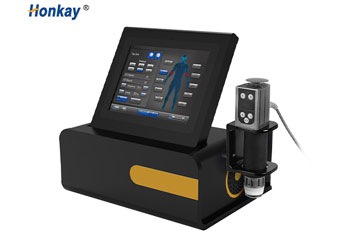
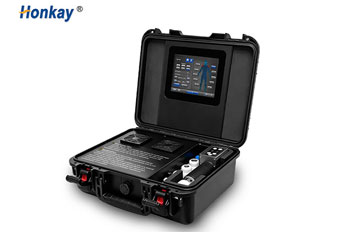
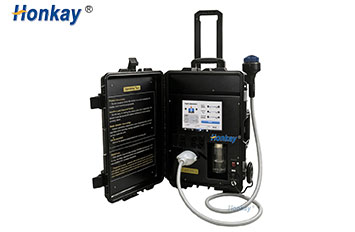
The equipment described on this page is made and supplied by Honkay, the brand of Guangzhou Huang-Kai Technology Co., Ltd., an OEM and ODM manufacturer of physiotherapy and wellness equipment. Our factory and offices cover more than 1,000 square metres and employ more than 50 people, including an in-house research and development team of eight to ten engineers working alongside the production floor.
Because the consoles, the handpieces and the wear parts are built in one operation rather than sourced separately, the commercial documents can be settled as a single package: the 24-month warranty certificate with its shipment date, the parts list with prices and lead times, the manual in the buyer's language, the wiring diagram, and the packing list the receiving team will count against. Distributors who sell under their own badge order the same units under private label, with serial numbers travelling with the order so a repeat shipment can be matched to the first.
Honkay exports to South America, South Asia, South-East Asia, Western Europe, Northern Europe, Southern Europe, Eastern Europe, Oceania and North America, so most questions on this page have already been asked by buyers in those markets. More background is on our about page, and the checklist above can go straight to the team as the starting point for a quotation.
Honkay supplies professional wellness and physiotherapy equipment to clinics and distributors. The information on this page is product and purchasing guidance, not medical advice. This device is intended for adjunctive use alongside professional care, not as a replacement for diagnosis or treatment. For any specific condition, consult a qualified clinician; individual experience varies.
Send your contract checklist to the Honkay team on WhatsApp: +86 13751821215


 English
 中文