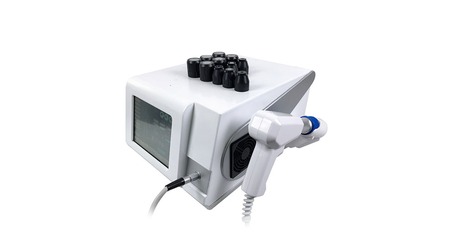
A shockwave machine is quoted in one currency and paid for in another, but it is delivered in a wooden box that nobody has seen yet. Between the proforma invoice and the first session there is a crate, a waybill, a customs entry, a delivery note signed by a receptionist who was not told anything was arriving, and a set of stairs. Most of the difficulty in an international equipment purchase lives in that gap, and almost none of it is technical. It is paperwork, dimensions and the timing of a phone call.
This page is written for the two people who carry that gap between them: the buyer who has signed the order and now has to get a unit from a factory gate into a treatment room, and the distributor who is doing it repeatedly and wants the process to stop being a series of surprises. It covers how the equipment is crated and what the crate dimensions mean for freight, how the load is held and dried inside the case, how air, sea and courier differ in practice, why the volumetric weight rather than the machine weight decides the bill, what duty and documentation the buyer carries, how to inspect a delivery before signing for it, and what to prepare on site — floor, door, lift, power — so the unit can be commissioned on the day it lands.
Two caveats before anything else, because they shape everything below. Freight rates, transit times, duty rates and carrier surcharges move constantly and differ between routes, so every figure here is indicative and must be replaced by a live quote from your forwarder and your customs broker. And the physical specification of a shipment — crate size, gross weight, number of packages — is only valid once it is printed on a packing list for your actual configuration. Treat this page as the list of questions to ask, not as the answer sheet.
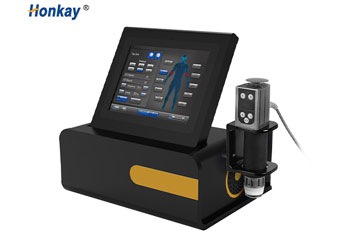
A floor-standing shockwave unit does not travel as a machine. It travels as a machine plus two or more handpieces, a handpiece cradle or support arm, a footswitch, a mains cable, a box of applicator tips or transmit discs, a bottle of coupling gel, a fuse set, a manual and, on many orders, a spare-parts kit. The handpieces are the awkward part: they are dense, they have cables that do not like being bent tightly, and they project from the housing unless they are removed and packed separately. Whether they travel fitted or boxed is a decision the factory makes, and it changes the crate dimensions.
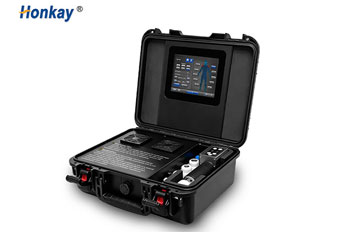
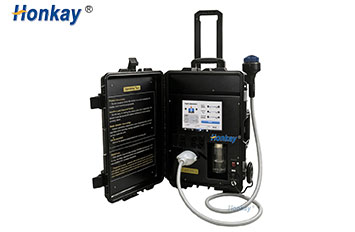
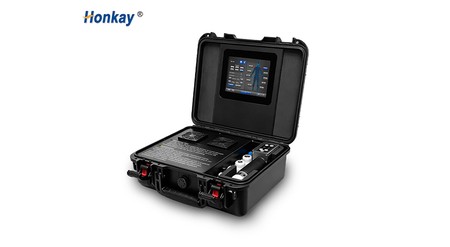
That is why the crate is a specification rather than packaging. Export plywood cases for this class of equipment are commonly built to roughly 1150 by 750 by 1350 millimetres for a trolley-mounted unit, with a gross weight somewhere in the 90 to 140 kilogram band depending on the configuration and the accessories included. A tabletop or portable configuration may travel in a single heavy carton at a fraction of that, and a multi-unit distributor order may be palletised as several cases on one base. None of these numbers should be assumed for your order; all of them need to be on the packing list before you book freight, because the difference between 1.1 and 1.6 cubic metres is the difference between one freight bracket and another.
Wood packaging crossing a border is also a regulated object in its own right. Most markets require solid-wood packing material to be treated and marked under the ISPM 15 standard, and plywood cases are usually exempt because the manufacturing process removes the pest risk — which is one reason suppliers use plywood. Ask for a photograph of the ISPM mark on the case if the shipment uses any solid wood at all, including dunnage and pallet feet. A container held at destination because a pallet foot carries no mark is an expensive way to learn this.
| Shipment form | What it typically is | Gross weight band | How it has to be moved | What to confirm on the packing list |
|---|---|---|---|---|
| Trolley unit in an export case | Plywood case on an integral base, handpieces boxed inside, unit strapped to the base | Commonly 90 to 140 kg | Pallet truck or forklift; two people cannot safely handle it on a slope or a step | Outside dimensions, gross and net weight, number of packages, whether the case is stackable |
| Portable or tabletop unit | Double-wall carton with foam end caps, handpiece in its own inner box | Often a small fraction of the trolley figure | One person with a trolley; courier-acceptable if the carton is rated for it | Whether the carton is strong enough for parcel networks, and the drop rating the factory packs to |
| Palletised multi-unit order | Several cases on one base, stretch-wrapped, corner-protected, marked per unit | Set by the number of units on the base | Forklift at both ends; tail-lift if the destination has no dock | Pallet footprint against standard 1200 by 800 and 1200 by 1000 bases, and the total pallet count |
| Spares, gel and consumables | Cartons inside the main case or shipped separately to stay under a weight limit | Light, but often volumetrically inefficient | Manual handling; gel is heavy per litre and should be upright | Whether consumables are inside the machine case or on a separate house bill |

A commercial invoice tells customs what the goods are worth. A packing list tells everyone else what is physically in the box, and it is the document that decides whether the freight forwarder can quote, whether the broker can classify, and whether the receiving clerk can check the delivery in ten minutes instead of an hour. Buyers who ask for a good packing list before shipment avoid most of the arguments that follow a damaged or short delivery, because the list is the baseline against which everything is counted.
The same list should name what is deliberately not in the case. Handpieces, footswitch, mains lead, fuse set, gel, tips, manual and any spare kit are separately countable items, and a shortage found at destination is hard to resolve once the case has been signed for and opened. Photograph the open case before removing anything, with the list beside it; that one photograph has settled more shortage claims than any email written afterwards. Freight is quoted per kilogram or per cubic metre with minimum charges, so a shipment declared at 1.2 cubic metres when it measures 1.6 will be re-measured and the difference invoiced to whoever holds the account, usually the consignee.
A crate protects a machine in three separate ways: it stops the unit moving inside the case, it absorbs the shocks a case receives when it is dropped or set down hard, and it keeps the air around the machine dry for the weeks it spends in a container or an aircraft hold. Those are different problems with different countermeasures, and a case that is well braced but not sealed against humidity still delivers a machine with a corroded connector.
Movement is controlled by fixing the unit to the base rather than by filling the case with loose material. On a trolley unit the castors are usually blocked or the frame is bolted or strapped to the base, with foam blocks cut to the housing profile so the unit cannot rock fore and aft. The handpieces are removed from their cradles and packed in their own foam-lined boxes, because a handpiece left hanging on a support arm becomes a lever during a drop. If a supplier ships handpieces fitted, ask them not to.
Impact is controlled by the foam, and the specification that matters is density and thickness rather than appearance. Cross-linked polyethylene foam blocks, moulded polyurethane end caps and corrugated corner protectors all do the job at different costs; what does not work is a thin layer of bubble wrap against a 100 kilogram mass, because it compresses flat on the first handling and leaves the machine bearing directly on the case wall. Ask what the pack is rated to survive, and ask for a photograph of a packed case from an actual order rather than a marketing image.
Moisture is the quiet one. A steel frame, a plated connector and an electronic board inside an unventilated plywood case crossing a humid route will collect condensation as the container heats and cools through the day. Desiccant bags sized to the internal volume, a sealed moisture-barrier liner and, where the route justifies it, volatile corrosion inhibitor film are the standard answers. Add a shock and tilt indicator to the outside of the case if the value justifies it: an indicator that has tripped is the clearest possible evidence at the moment of delivery, while a dented corner is arguable.
| Layer of protection | What it is made of | What it is actually for | What goes wrong without it | What the buyer can check |
|---|---|---|---|---|
| Base fixing | Bolts, banding or blocked castors on a plywood base | Stops the mass travelling inside the case under braking or tilt | The unit shifts, the housing takes the load, the case wall splits | Banding intact and no witness marks on the base when the case is opened |
| Cushioning | Moulded foam blocks, end caps, corner protectors | Absorbs the deceleration of a drop or a hard set-down | Cracked display bezel, deformed chassis, handpiece knocked out of alignment | Foam still full thickness and still contacting the housing on all faces |
| Handpiece boxing | Separate foam-lined inner box per handpiece, cable loosely coiled | Keeps a dense, cable-connected object from swinging on its own lead | Cable broken inside the gland, connector bent, contact face chipped | Each handpiece in its own box, cable coil diameter generous rather than tight |
| Moisture control | Desiccant bags, sealed barrier liner, inhibitor film | Keeps relative humidity inside the case low across a long sea leg | Corrosion on connectors and fasteners, misted optics, condensation on cold boards | Desiccant present and still granular, not a saturated slab; liner not torn |
| Handling evidence | Shock and tilt indicators, security seals, clear marking | Turns a suspicion into a documented event at the moment of delivery | Damage becomes a matter of opinion between two parties with no evidence | Indicator state, seal number against the delivery note, photographs before opening |
Three modes are realistically available and they trade time against money in a fairly predictable way. Air freight is fast and priced per chargeable kilogram, which punishes a bulky crate. Sea freight is slow and priced per cubic metre, which suits a heavy and bulky unit but hands the buyer a long window of uncertainty at both ends. Express courier is fast, door-to-door and simple, but the per-kilogram rate becomes unreasonable above a certain size, so it is usually the mode for spares, gel and accessories rather than for the machine.
For a single machine bound for a market with an impatient clinic, air freight commonly lands in something like five to ten days door to door once the shipment has actually left, while an LCL sea consignment on a comparable route more often takes five to seven weeks including consolidation, sailing, discharge and the destination agent's handling. On some routes sea is faster than the stereotype; on others a transhipment adds a fortnight without warning. Both figures move with the season, the port and the carrier, so treat them as planning ranges and get the current transit from the forwarder in writing.
Whichever mode you choose, three things need settling before the shipment leaves. Who is the consignee of record and do they have an importer number or tax identifier; who clears customs at destination, your own broker or the forwarder's; and who pays the destination charges, because a shipment sent on a prepaid basis that actually arrives freight-collect will sit in a warehouse accruing storage while two offices exchange emails. Incoterms answer these questions, so agree them on the invoice rather than in conversation.
| Mode | Indicative door-to-door window | What it suits | What it costs you in practice | What to arrange before booking |
|---|---|---|---|---|
| Air freight | Commonly a week to ten days once uplifted | One or two units on a deadline; a show unit; a replacement for a machine already out of service | Priced on chargeable weight, so the crate's volume is expensive; screening and security rules apply | Confirmation that the case is airline-acceptable, and a broker nominated at destination |
| Sea freight, LCL | Often five to seven weeks including both ends | One pallet up to a part container; restocking; buyers who can plan a month ahead | Consolidation delays, co-loading damage, destination handling and storage charges | A forwarder who will confirm the co-load, and clarity on who pays destination fees |
| Sea freight, FCL | Broadly similar sailing time, less handling risk | Distributor orders of several units; anything approaching a container load | You pay for the container, not the cargo, so a light load is poor value | Loading plan, container inspection record, and a seal number on the bill |
| Express courier | Usually a few working days | Handpieces, tips, seals, gel, documents; a portable unit in a rated carton | Rate per kilogram rises steeply; size and weight caps per piece; remote-area surcharges | Declared value for customs, and confirmation of who handles the duty bill at the door |

Everyone expects freight to be priced on weight, and for this kind of equipment that expectation is wrong most of the time. Carriers price on whichever is greater, the actual weight or a notional weight derived from the volume, because a light and bulky cargo occupies space that could otherwise carry revenue. The conversion factor differs by mode: air freight commonly divides the cubic centimetre volume by six thousand, express networks often divide by five thousand, and sea LCL prices on a revenue ton where one cubic metre is treated as equivalent to one thousand kilograms.
The consequence is easy to state and easy to forget. A trolley unit that weighs 120 kilograms in a case measuring roughly 1.15 by 0.75 by 1.35 metres displaces about 1.16 cubic metres. On the air factor that is a chargeable weight in the region of 190 kilograms, so the freight is calculated on 190, not on 120 — a premium of more than half again on the billable figure. On a sea LCL basis the same shipment is charged as 1.16 revenue tons, and at that point the weight has almost no influence at all.
This is where a conversation with the factory pays for itself. Shaving ten centimetres from the height of a case, or shipping the handpieces in a smaller inner box instead of a deep cradle, can move a shipment into a lower bracket without touching the machine. It also explains why two suppliers quoting apparently similar equipment can differ sharply on landed cost: the crate dimensions behind the quotation are different. Ask for the packed dimensions as a condition of the quote, not after the order, and ask whether the case is designed for air or for sea.
| Basis | How it is calculated | Worked on a typical trolley case | What drives the number up | What the buyer controls |
|---|---|---|---|---|
| Actual gross weight | Weighed at the terminal, including the case, foam and accessories | Commonly 90 to 140 kg for a trolley configuration | Dense accessory kits, spare handpieces, gel in the same case | Nothing meaningful — the machine weighs what it weighs |
| Air volumetric weight | Length times width times height in centimetres, divided by 6,000 | Around 1.16 cbm becomes roughly 190 kg chargeable | Case height, cradle depth, pallet height under a case | Crate design; asking for the smallest case the unit fits |
| Express volumetric weight | Same measurement, divided by 5,000 in most networks | The same carton prices noticeably higher than on air freight | Inner boxes that are oversized for the content | Consolidating small items; requesting tight inner packing |
| Sea LCL revenue ton | One cubic metre treated as one thousand kilograms; the greater of the two applies | A 1.16 cbm case bills as about 1.16 revenue tons | Minimum charges per shipment, regardless of how small the load | Combining shipments to clear a minimum, or waiting for a full container |
| Terminal and handling fees | Charged per shipment or per kilogram by the ground handler at each end | Often a fixed minimum that dominates a one-unit shipment | Special handling for heavy pieces; storage after free days expire | Clearing customs quickly so the free storage window is not exceeded |
The duty on a physiotherapy device is a destination-country question, not a supplier question. Two buyers can import identical equipment and pay very different amounts because their countries apply different tariff schedules, different trade agreements and different rates of value-added tax or goods and services tax on top. Ask your own customs broker what the classification attracts before the order is placed, and ask them in writing, because the answer determines the landed cost you are about to commit to.
What can be said usefully is the shape of the bill. Import duty on this class of equipment usually sits in the low single digits to the mid teens as a percentage of the customs value, and many markets then apply a consumption tax — VAT, GST or an equivalent — on the duty-inclusive value. Some countries also levy an advance income tax, a social surcharge, a stamp duty on the entry or a fixed customs processing fee. None of those figures should be taken from a supplier's estimate; they should come from a broker licensed in your jurisdiction, and they change with budget cycles.
Three documents carry almost all of the weight in a routine clearance: the commercial invoice, the packing list and the transport document. A certificate of origin is the fourth, and it matters because it can reduce or eliminate duty under a trade agreement, but only if it is the correct form for that agreement and is issued by an authorised body rather than typed by the shipper. A certificate that names the wrong tariff line or the wrong consignee is worse than no certificate, because it invites a query and a delay at the border.
| Document | Who produces it | What it must match | Usual mistake | What it costs when it is wrong |
|---|---|---|---|---|
| Commercial invoice | Supplier | The proforma, the order and the payment record, line by line | Accessories bundled into one price with no breakdown | Re-assessment of value, extra duty, and a hold while the broker queries it |
| Packing list | Supplier | The physical packages, weights and dimensions actually shipped | Stating net weight only, or omitting volume | Re-weighing charges and a short-delivery claim that cannot be substantiated |
| Bill of lading or air waybill | Carrier or forwarder | Consignee name, notify party, port pair, package count, marks | Consignee that does not match the importer of record | Cargo released to the wrong party, or an amendment telex at your expense |
| Certificate of origin | Chamber of commerce or authorised issuer in the export country | The invoice, the tariff line and the trade agreement being claimed | Wrong form for the agreement, or goods described differently from the invoice | Preference refused, duty paid in full, and a retrospective claim that may not succeed |
| Insurance certificate | Supplier's insurer or the buyer's own marine policy | The invoice value, the voyage and the coverage clauses | Cover starting after the goods leave the warehouse, or covering only total loss | A repair bill with no recovery, on a shipment that was otherwise routine |
| Product documents | Supplier | The model and serial numbers on the unit, and the manual language for your market | Serial numbers on the box that do not match the machine inside | A warranty claim that cannot be linked to a shipment, and a manual nobody can read |
Two further points belong in this section because they are cheap to arrange and expensive to discover late. First, confirm whether your market requires any import registration, licence or pre-shipment inspection for this category of equipment, and if so whether the supplier has the documents that process asks for. Second, check the payment route against the paperwork: a bank releasing documents against a letter of credit will reject a set of shipping documents over a single spelling difference, and the amendment costs both time and money. The buyer comparing whole machines before getting this far will find the wider decision set in our shockwave machine buying guide for clinics.
The most common failure on arrival has nothing to do with the supplier. A case arrives on a vehicle with no tail lift, at a building with no loading dock, at a time when the only person on site is a receptionist with a trolley rated for parcels. The driver is on a schedule, the case weighs more than two people can safely lower from a tailgate, and someone decides to slide it down a ramp. That decision is how most transit damage actually happens, and it is entirely preventable with a phone call and a tape measure.
Start from the crate dimensions and work inwards. Measure the narrowest door on the route from the vehicle to the treatment room, the width and depth of the lift if there is one, the width and turning radius of any corridor with a corner, and the height of any bulkhead or cable tray that a case on a pallet truck has to pass under. A case that is 750 millimetres wide passes a standard 800 millimetre door only if the frame and the door furniture leave clearance, and a case that will not go into the lift has to be opened in the lobby and carried in pieces — which is a plan, not an accident, if it is decided in advance.
| Point on the route | What to measure or confirm | Typical constraint | Equipment and people needed | Fallback if it does not fit |
|---|---|---|---|---|
| Vehicle and kerb | Whether a tail lift is booked, and whether the vehicle can stop legally at the door | No dock, a kerb, a pedestrian entrance, a parking restriction | Tail-lift van plus pallet truck, or a forklift arranged locally | Ask the carrier to hold the piece and rebook with the right vehicle |
| Entrance door | Clear opening width and height against the case dimensions plus pallet | Door furniture, a raised threshold, a glass leaf that must be removed | Two people on a pallet truck; door removal arranged in advance | Unpack outside and carry the machine in, keeping the case flat and dry |
| Lift | Internal width, depth, door width and rated load | A case that fits the lift only diagonally, or not at all | Two people; a lift mat to protect the floor and the sill | Unpack in the lobby and move the unit and handpieces separately |
| Stairs | Number of flights, tread depth, landing space, handrail | A turn at the top that a long case cannot negotiate | Three or four people with straps; a stair-climbing truck if the crew has one | Ground-floor room, or a different delivery address for this shipment |
| Treatment room | Floor loading, socket type, circuit capacity, earth, and clearance on both sides | A shared circuit already loaded by other equipment; no earth in an older install | An electrician to confirm the supply before the unit is plugged in | A different room, or a dedicated circuit installed before commissioning |

The signature on a delivery note is the single most consequential act in the whole shipment. In most jurisdictions a clean signature is prima facie evidence that the goods were received in apparent good order, and a claim raised two days later has to overcome that presumption. The remedy costs nothing: inspect the outside of every package before signing, note any damage, dent, wet patch, re-taping or missing seal on the delivery document in your own words, and photograph the case from four sides with the label visible. The claim window itself is short and differs by mode — ask the forwarder for the deadline on this specific shipment rather than relying on a general rule, and notify both carrier and supplier on the day of delivery.
| Stage | What to do | What to record | Why it matters later |
|---|---|---|---|
| Before signing | Walk around the vehicle and the case; check seals, straps and indicator labels | Photographs of all four sides, the label, the seal number and any indicator | Establishes condition at the moment the carrier's responsibility ends |
| At signing | Write the damage in your own words on the delivery document; refuse or accept as damaged | The exact wording used, the driver's name, the time, and a copy of the note | A notation defeats the clean-receipt presumption; a clean signature creates it |
| On unpacking | Open layer by layer with the packing list beside the case; count every item | A photograph per layer and a short video of the first full view of the unit | Separates concealed damage from damage caused after delivery |
| Same day | Notify the carrier and the supplier in writing with the same evidence set | The claim reference, the serial numbers and a list of what is missing or broken | Keeps the claim inside the window, which is short and mode-specific |
| Before power-on | Do not energise a unit with visible transit damage; ask for written clearance first | The condition of the unit as received, and who authorised the first start | Prevents a dispute about whether the damage pre-dated the first use |
The first start of a new unit is a small event with a large downside if it is done carelessly. The sequence worth following is unpacking, acclimatisation, a physical inspection, then power. Acclimatisation is the one most often skipped: a case that has spent a week in an unheated hold arrives cold, and a cold board brought into a warm humid room collects condensation on surfaces that were dry ten minutes earlier. Leave the unit in its packaging, in the room where it will be used, until it has reached room temperature — overnight is a sensible default on a long cold route.
The physical inspection has a specific order. Remove every piece of transit packing, including the foam blocks under the chassis, the tie wraps round the support arms, the protective film on a display, and the desiccant bag taped inside the case. Check that the handpiece connectors seat fully and that the cables are not kinked where they leave the gland. Check that the voltage selector, if there is one, matches the local supply, and that the fuse rating is the one stated for that voltage. Then confirm the supply itself: correct voltage and frequency, a circuit with capacity to spare, and a protective earth that is genuinely connected rather than assumed.
Finally, the commercial bookkeeping that belongs with commissioning. The 24-month warranty runs from the factory shipment date, not from the day the unit is switched on, so every week spent in a container or in customs is a week of cover consumed. That is an argument for moving a shipment briskly through clearance, and for commissioning promptly once it lands. It is also why the arrival date should be written into the order file next to the shipment date, so the cover can be tracked rather than guessed.
| Step | Check | Pass condition | If it fails |
|---|---|---|---|
| Acclimatisation | Unit left boxed in the treatment room until it reaches room temperature | No visible condensation when the case is opened | Close the case again and wait; do not wipe a cold board and switch it on |
| Transit packing removed | Foam blocks, tie wraps, protective film, desiccant, any bolt or bracket holding the chassis | Nothing left that restricts the castors, arms or airflow | Stop and ask the supplier for the unpacking instructions for that model |
| Handpieces and cables | Each connector seats fully; no kink at the gland; no mark on the contact face | Positive lock, straight cable run, clean face | Photograph and report before use; do not straighten a bent connector by hand |
| Voltage and fuse | Rating plate against the local supply; fuse value against the manual | The two match, and a spare fuse of the same rating is in the kit | Do not energise; a voltage mismatch is a supply problem, not a machine problem |
| Supply and earth | Socket type, circuit capacity, and a protective earth verified by an electrician | Dedicated or lightly loaded circuit, earth continuity confirmed | Have a circuit installed before commissioning rather than sharing a loaded one |
| First start | Display, self-check, then a low-output test with a handpiece coupled | Steady display, no fault code, a consistent pulse at the head | Record the fault code and the serial number, and stop; do not open the housing |
| Records | Serial numbers, shipment date, arrival date, first power-on date, packing list | One file that answers a warranty question without an inbox search | Build it now, while the documents are still in the same envelope |
Read together, the sections above reduce to a list of questions to send a supplier before the order is confirmed: the packed dimensions and gross weight of the exact configuration; the number of packages and what sits in each; whether the handpieces travel boxed; whether the case carries an ISPM 15 mark; the tariff heading the supplier will declare and whether they will follow the one your broker nominates; whether a certificate of origin is available; the Incoterm and precisely which charges it excludes; and the serial numbers that will appear on the invoice.

Air is the right default for one unit going to a clinic that is waiting for it, because the freight premium is usually smaller than the cost of a room standing idle for a month. Sea is the right default for a distributor restocking, for a shipment of several units, or for a buyer who genuinely can plan six weeks ahead. The deciding figure is not the freight rate but what a week of delay costs you — put a number on that first, then compare.
Because carriers bill on the greater of actual weight and volumetric weight, and a crated unit is bulky relative to its mass. On air the volume in cubic centimetres is commonly divided by six thousand, which can turn a 120 kilogram shipment into a billable figure well above 180 kilograms. The lever available to a buyer is the crate itself: ask for packed dimensions before ordering, and ask whether a smaller case design exists for the same unit.
Under most terms used for equipment of this kind the buyer, as importer of record, pays duty and destination taxes, even when freight was prepaid by the supplier. Rates vary by country and by classification and change with budget cycles, so the figure has to come from a broker licensed in your market, quoted against the tariff heading and the customs value on your invoice. Treat any supplier estimate as a placeholder only.
Note the damage on the delivery document before signing, photograph the case, and report it the same day to the carrier and the supplier even though the unit appears serviceable. Damage that shows up later — a bent chassis, a handpiece fault, a display that flickers — is much harder to claim once a clean receipt exists. An early notification costs an email; a late one costs the repair.
No, and it should not be asked for. The customs value has to reflect the transaction, and an under-declaration exposes the importer — not the exporter — to reassessment, penalties and delays, and it voids most cargo insurance because the insured value no longer matches the declared one. Ask instead about legitimate routes to a lower rate: the correct tariff classification, a certificate of origin under a trade agreement, and a clean separation of goods, freight and insurance on the invoice.
The 24-month warranty runs from the factory shipment date, which is why the shipment date belongs in your order file alongside the arrival date. A long sea leg and a slow clearance both consume cover before the unit has been switched on, so it is worth tracking the two dates together and commissioning promptly. Keep the packing list, the invoice and the serial numbers in the same file; they are what a claim is assessed against.
Check what the agreed Incoterm includes before assuming either way. Many shipments arrive with cover arranged by the supplier, but it may be narrow in scope or start later than you expect, and a policy taken out by the buyer is usually easier to claim on. Confirm the insured value, the clauses and the notification deadline in writing, because a claim is decided on the paperwork rather than on the damage.
The equipment described on this page is made and supplied by Honkay, the brand of Guangzhou Huang-Kai Technology Co., Ltd., an OEM and ODM manufacturer of physiotherapy equipment. The company runs an in-house research and development team alongside its production floor, and builds both the platforms and the handpieces that go with them.
Because the unit and its accessories are built together rather than sourced separately, the shipping paperwork can be settled at the order stage: the packed dimensions and gross weight of the configuration being bought, the packing list by package, the handpieces boxed separately, the export documents in the names the buyer's broker nominates, and the manual in the language the operators will read. Distributors ordering under their own badge receive the same shipment documentation under private label, so a repeat order can be matched to the original consignment.
Honkay exports to South America, South Asia, South-East Asia, Western Europe, Northern Europe, Southern Europe, Eastern Europe, Oceania and North America, so most of the routing and documentation questions behind this page have already been asked by buyers working in those markets. More background is on our about page, and the question list above can go straight to the team.
Honkay supplies professional wellness and physiotherapy equipment to clinics and distributors. The information on this page is product and purchasing guidance, not medical advice. This device is intended for adjunctive use alongside professional care, not as a replacement for diagnosis or treatment. For any specific condition, consult a qualified clinician; individual experience varies.
Send the packing list and dimensions question to the Honkay team on WhatsApp: +86 13751821215
Email the Honkay team for crate dimensions and export documents: hk6@huang-kai.com


 English
 中文