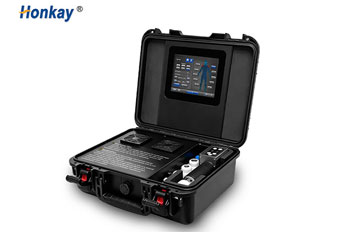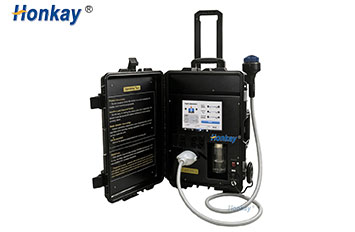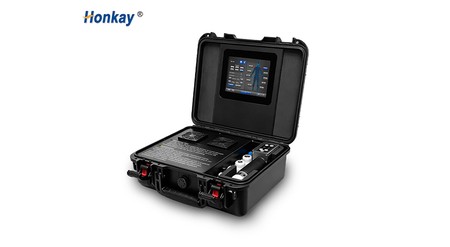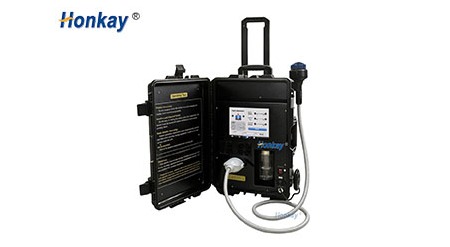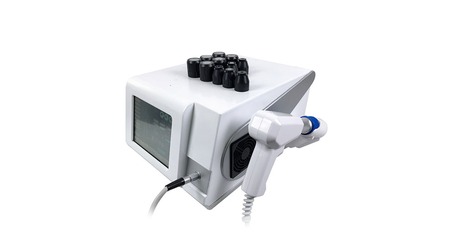
A used shockwave unit is usually offered with three facts attached: the year it was bought, the price being asked, and a shot count read off the screen. None of those three decides whether the purchase is a good one. The year tells you which generation of electronics you are getting, the price tells you what the seller thinks the market will bear, and the shot count tells you what somebody chose to show you. What actually decides the outcome is the condition of four things that are expensive to replace and easy to hide: the handpiece, the cable that feeds it, the compressor if the unit is pneumatic, and the availability of spare parts for that exact build.
This page is written for the buyer standing in front of a machine that is already switched on, with a seller nearby and a decision to make before the money leaves the account. That buyer is usually one of three people: a clinic owner adding a second treatment room without a second full budget, a distributor taking in a trade-in or a demonstration fleet, or an operator whose existing unit has failed and who needs a working platform this month rather than in twelve weeks. The situation is different in each case, but the inspection is the same, because the failure modes are the same.

The page stays on hardware, paperwork and arithmetic. It does not cover which client should be on the couch or which settings a session should use; those belong to the trained operator working under the clinic's protocol. It does cover the order in which to inspect a second-hand platform, what each check is telling you, how to read a refurbished machine honestly, how to price the parts you will certainly need, and the point at which the total cost of the used unit crosses the price of a new one. That last calculation is where most of these purchases go wrong: the asking price gets compared with the new price, when it should be compared with the new price plus two years of ownership.
Second-hand shockwave equipment moves through three quite different channels, and the price band tells you which one you are in before you have touched anything. The first is the genuine trade-in: a clinic upgraded, the old platform still works, it comes with its handpiece set, its foot pedal, its manual and a service folder. The second is the ex-demonstration or ex-rental unit: it has travelled, been set up and packed away dozens of times, been used by people who did not own it, and usually has cosmetic damage disproportionate to its hours. The third is the trader's unit: bought at auction or in a lot, cleaned, sometimes painted, and offered with no history at all. Prices fall in that order, and so does the amount of information you can verify.
Depreciation in this category does not behave like depreciation on a scanner or a laser. The console itself ages slowly: a well-built unit with a sealed electronics bay and a filtered intake can run for years with nothing but dusting. The value walks out of the door through the accessories. Handpieces are handled, dropped, cleaned and cycled, and each one has a finite working life; cables fatigue at the strain relief; compressors on pneumatic units fill with condensate if nobody drains them. So a nine-year-old console with two fresh handpieces and a documented cable replacement can be a better buy than a three-year-old console with one tired handpiece and no spares channel. The calendar is a weak signal. The accessories are the real signal.
The other thing that sets price is what the trade calls the parts tail: whether the model is still supported. A platform two generations old but still carrying handpieces, cables and boards on the shelf is worth more than a newer one whose manufacturer has moved on, because the newer one becomes a donor the first time something small fails. That is why the same machine is advertised at very different prices in different markets. Before negotiating on price, establish whether what you are buying can still be repaired locally, and by whom.

Those four ownership types matter because they produce different wear patterns. A sports clinic that runs back-to-back sessions wears handpieces and cables and barely touches the cabinet. A chiropractic practice that uses the unit intermittently but moves it between rooms wears the casters, the column lock and the cable, and leaves the compressor with long idle periods that are worse for condensate than steady use. A spa or wellness studio may put very few shots on the platform but leave it in a humid room with the covers off for cleaning. Ask what the previous owner did with it, then look for the wear that matches the answer. When the wear and the story disagree, the story is the part that is wrong.
Bring four things and the inspection becomes evidence rather than impression: a bright torch, a phone with a camera, a tube of coupling gel, and a notebook. If the unit is vertical, also bring a tape measure, because column height and base footprint decide whether it fits the room you have. Ask for ninety minutes and ask to be left alone with the machine for at least half of it; a seller who will not leave the room is telling you something. Work in a fixed order — cold cosmetics, then covers off if permitted, then power-on and menus, then a sustained load run — because each stage destroys evidence the next one needs. Once the unit is warm, you cannot see where dust has settled, and once the panels are back on, you cannot see the date codes on the boards.
| Stage | Time | What you are checking | Pass | Walk away |
|---|---|---|---|---|
| Cold cosmetic pass | 15 min | Corners, base, column, casters, handles, screen bezel, labels, fasteners | Scuffs and edge wear consistent with normal use; all labels present and legible | Bent base plate, cracked column weld, missing serial label, fresh paint over a dent |
| Covers off, if allowed | 20 min | Dust pattern, corrosion, cable routing, board date codes, compressor mounting, filter state | Even light dust, dry interior, intact loom, no smell of burnt varnish | Water staining, rust on fixings, spliced wiring, scorched connector shells, a filter that has clearly never been changed |
| Power-on and menus | 15 min | Boot behaviour, screen condition, counter pages, error log, language and unit settings | Clean boot, no stored faults, counters readable, clock plausible | Error log wiped to blank on an old machine, counters at a round number, date reset to a factory default |
| Handpiece and cable | 15 min | Drop damage, collar play, connector pins, cable flex along its whole length | No dropouts while flexing, even cable jacket, bright connector pins | Firing stops when the cable is bent at one point, blackened pins, a soft or taped section near the gland |
| Sustained load run | 20 min | Heat build-up, sound change, output stability, compressor recovery, fault trips | Output steady for the whole run, fan note constant, no trip | Output fades after ten minutes, a fault appears only when hot, compressor runs continuously and never catches up |
| Paperwork | 10 min | Invoice trail, service records, handpiece history, remaining warranty transfer | Named service entries with dates, original purchase invoice, matching serial numbers | No serial number anywhere, no invoice, "the file was lost" on a five-year-old unit |
The sustained load run is the step buyers skip, and it is the only step that finds the failures that matter. A shockwave platform that fires correctly for thirty seconds can still be unusable for a clinic, because the interesting faults are thermal: a fan that has lost a bearing, a heatsink clogged with three years of dust, a compressor that cannot keep up once the duty cycle is real, a power stage that trips only when the enclosure is warm. Run it the way the clinic will run it — continuous firing at a mid-range setting, handpiece in the air or on a gel pad, not a single test shot — and watch the numbers on the screen and the sound of the machine at minute one, minute ten and minute twenty. If the seller will not permit a twenty-minute run, price that refusal into the offer.
Photograph every stage, especially the interior, the serial label, the counter pages and any damage. It is the only way to have a conversation about a defect two weeks later, and it is what a distributor needs when the unit is resold onward. Twelve dated photographs beat a verbal promise, and take four minutes.
Shockwave consoles are heavy at the bottom and top-heavy in the column, which is why the damage worth finding is almost never in the middle of a panel. Look at the four lower corners of the cabinet, the base plate where the casters bolt through, and the joint between the column and the chassis. A unit that has been dropped on its side in transit shows a flattened corner, cracked gelcoat or powder coat radiating from one point, and often a slight twist that shows up as a base that rocks on a flat floor. Put it on the floor and push one top corner gently; a cabinet that shifts before the casters do has a bent base, and a bent base means the column is loaded unevenly every time somebody leans on it.
On a vertical platform, the column and its lock are the second thing to check. Raise the head to working height, lock it, and lean on it the way an operator leans during a session. A column that creeps down under load has a worn brake or a gas strut that is finished; both are replaceable, but on an older build the strut may be a matched part that is no longer stocked. Check the casters for flat spots and for tread worn through to the hub, and check that the brakes actually hold. Casters are cheap one at a time, but four plus a base plate is not a trivial budget line.
Covers and paint carry the most information per minute of inspection, because cosmetic repair is cheap and structural repair is not, so sellers do the cheap one. Look along every panel edge for a lip of paint where a mask was pulled, look inside the vents for overspray, look at the gaskets for paint bridging them, and look at the screw heads. A machine that has been opened repeatedly has chewed or mismatched fasteners; a machine that has been repainted often has new screws in old plastic bosses, and the bosses crack. Check whether the model and serial plate is present, straight and legible, and whether the digits on it agree with the invoice and with any label inside the electronics bay. A missing plate is not automatically disqualifying, but it removes your ability to order the right parts, and it removes the resale value of the unit at the end of its life.
| What you see | Benign explanation | Serious explanation | How to tell them apart |
|---|---|---|---|
| Scuffed lower corners | Doorways, lifts, van loading | A drop that also stressed the chassis | Rub marks follow one direction on a scuff; a drop leaves a single crushed point with radiating cracks |
| Fresh paint on one panel | Cosmetic refurbishment before sale | Concealment of impact or corrosion | Overspray inside vents or on gaskets, filler visible as a soft edge under the paint |
| Mismatched screws | Panels opened for service | Parts swapped between machines | Two or three odd screws is service; twelve is a rebuild, and the interior story must match |
| Column creeps under load | Worn brake pad | Bent column or failed strut with no spare available | Measure the gap between column and collar at top and bottom; an uneven gap is a bent column |
| Base rocks on a flat floor | One caster adjusted wrong | Twisted chassis from a drop | Swap the suspect caster to another corner; if the rock moves with the caster it is the caster |
One frame item gets overlooked: the screen mount and arm. A knocked screen often still works but has a cracked hinge boss or a separated bezel, and the assembly may be specific to that generation. Move the arm through its full range and watch the mount, not the panel. A display that flickers as the arm moves has a fault in the loom through the hinge, which means the arm comes apart.
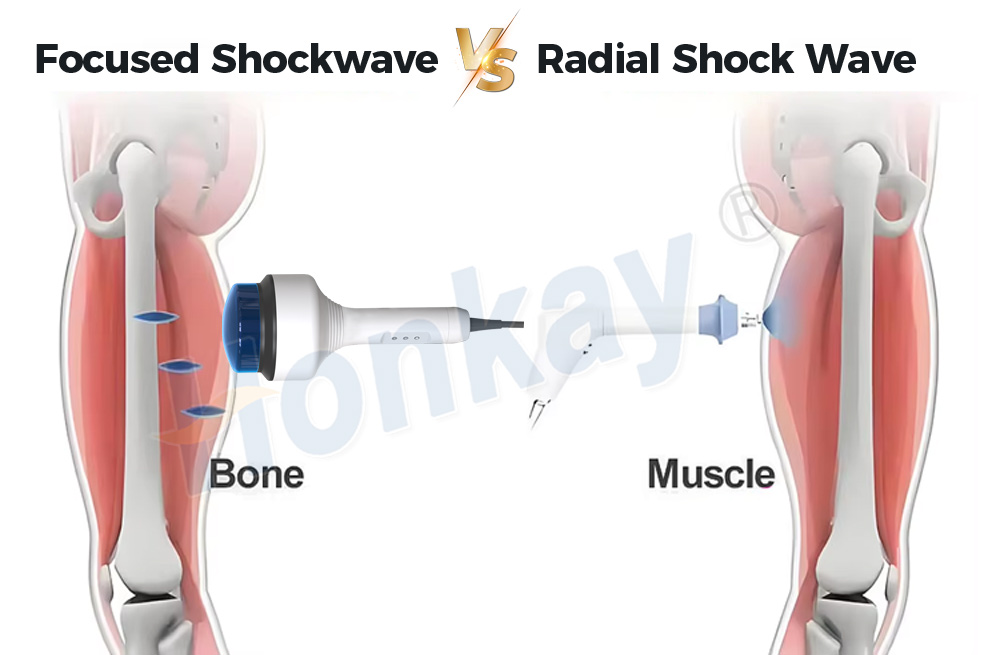
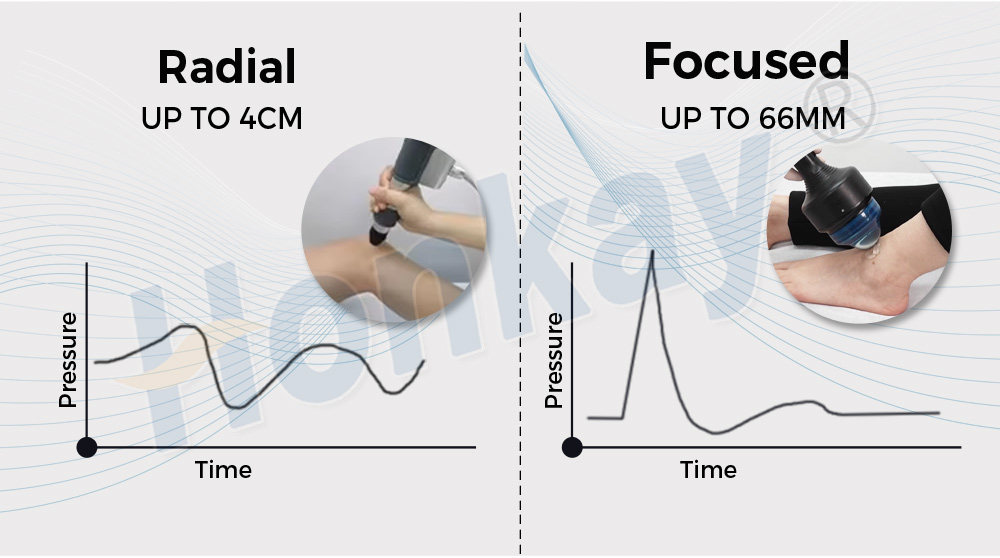
Two families of handpiece are found on this class of platform, and they wear differently. A pneumatic, or radial, head contains a projectile driven by air against an impact body, so its wear parts are internal and its life is measured in shots. An electromagnetic, or focused, head drives a plate with a coil and delivers the pulse through a fluid column to the tip, so it has no projectile but it does have a coil, seals and a contact face handled every session. In both cases the head is the most expensive accessory on the machine, and the part a seller is most likely to have swapped, replaced with a compatible copy, or kept back to sell separately.
Start with the cable, because it fails first and it fails honestly. The conductor bundle inside a handpiece cable bends thousands of times at two fixed points: where it leaves the handpiece body through the strain relief, and where it enters the connector that plugs into the console. Insulation breaks down at those two points, strands work-harden and snap one at a time, and the result is a fault that appears only at certain angles. Test it properly: set the unit firing at a low output, then flex the cable by hand along its whole length in ten-centimetre sections, holding each bend for a few seconds while somebody watches the output indicator and listens for the pulse. A cable with a broken strand will drop out at one specific bend and behave perfectly everywhere else, which is exactly why a thirty-second demonstration never finds it.
Then look at the connector. Pull it out, shine the torch into the shell and inspect the pins or the contact rings. Bright, even metal is fine; blackening, pitting or a melted witness mark on the plastic around one pin means arcing, and arcing means either a loose fit or a cable that has been carrying current through a bad joint for a long time. Check the locking collar for cracks and check that it actually latches — a connector that can be pulled out with two fingers will eventually interrupt a session, and the repair is usually the whole cable, not the shell.
The handpiece body itself is a drop test written in plastic and metal. Look for a flat spot or a gouge on the tail cap, a crack at the collar where the cable enters, and a nose that has been deformed by being rested against a couch edge. Shake it gently next to your ear: a rattle in a pneumatic head is the projectile or its guide out of tolerance, and a rattle in an electromagnetic head is a loose internal fixing, and neither is a user-serviceable condition. Feel the barrel after ten minutes of firing; a handpiece that becomes uncomfortable to hold has a heat path problem, which usually means the drive is working harder than it should. Then look at the tip: a contact face that is chewed, chipped or discoloured at the rim has been dropped or rested on hard surfaces, and that is a handling history you can price.
| Symptom on the day | Most likely cause | Field remedy | Effect on the offer |
|---|---|---|---|
| Fires, then stops when the cable is bent | Broken strands at the strain relief | Replace the cable assembly if it is separable | Deduct the cable plus labour; if the cable is moulded to the head, deduct a handpiece |
| Intermittent "no handpiece" error | Connector pins arced or collar not latching | Clean and re-seat; replace connector or cable | Small deduction, but confirm the socket on the console is not damaged too |
| Output falls away over ten minutes | Head at end of life, or drive stage overheating | Test with a second known head before concluding | If a second head behaves the same, treat the console as faulty |
| Rattle when shaken | Loose internal mass or fixing after a drop | Not field-serviceable on most builds | Treat the head as scrap and price a replacement into the deal |
| Chewed or chipped contact face | Dropped, or rested on hard surfaces | Replace the head; handling training for staff | Cosmetic only if the face is intact and flat; a chip at the rim is a replacement |
Two structural questions sit above all of this. How many handpieces come with the unit, and are they the ones the console was calibrated for? One head is a working machine; two heads of different sizes is a working clinic; one head plus a compatible copy from a different supply chain is a machine with an unknown in it. And are heads still obtainable for this build? A platform whose handpieces cannot be reordered is a platform with a fixed and shrinking life, no matter how well the console tests. Ask for the part reference of the head, write it down, and check that reference against a current catalogue before you commit — that single check has saved more buyers than any amount of listening to the motor.
If the platform is pneumatic, it has a compressor inside it, and that compressor has a life of its own that runs independently of the electronics. Most of these are oil-free piston or diaphragm pumps feeding a small receiver, sized for intermittent work with a duty cycle the manufacturer assumed. That assumption is the weak point: a clinic that runs back-to-back sessions can push a budget compressor past its duty cycle for months without noticing, and the first symptom is not a failure but a slow loss of pressure recovery, which shows up as a weaker pulse at the end of a long session rather than at the start of a short one.
Test it cold, then test it hot. On a cold start, listen to the pump from switch-on to cut-out and time it; a healthy unit reaches cut-out briskly and then goes quiet. Then fire twenty shots in quick succession and watch the gauge and listen again. A pump that starts cycling immediately after twenty shots, and keeps running between shots, is either worn, leaking, or fighting a restriction. Run the same sequence after the twenty-minute load test, when everything is warm; a pump that behaved when cold and labours when hot is on its way out, and the parts to rebuild it may or may not exist for that model.
Then look for water and oil, both cheap to find and expensive to ignore. Drain the receiver onto a white paper towel: a few droplets is normal in a humid room, a steady trickle means nobody has drained it in years, and rusty water means it is corroding from the inside. Check the intake filter for a mat of dust, the tubing for hardness and a white bloom at the joints, and the couplers for a hiss with the pump off. Oil mist on an oil-free pump means a failed seal; oil on a lubricated pump means the level was never checked.
| Tell-tale | What it indicates | Cost band | Decision |
|---|---|---|---|
| Pump runs continuously between shots | Worn rings or valves, or a leak in the line | Low to medium | Negotiate; a serviceable pump is a small win, not a reason to walk |
| Rusty water from the drain | Receiver corroding; condensate never removed | Medium to high | Inspect the receiver wall; if it is pitted, replace the pump assembly or walk |
| Hiss with the pump off | Check valve or coupler leak | Very low | Fix on the spot; use it as evidence of general neglect when pricing |
| Intake filter packed with dust | No preventive maintenance for a long period | Low | Assume other filters and fans were also ignored; inspect the console intake |
| Labours when hot, fine when cold | Clearance opened up by heat; pump near end of life | Medium | Price a replacement pump before agreeing a figure |
| Pump is integrated and the model is out of support | No drop-in replacement exists | High | Walk unless the price reflects a disposable platform |
Compressors are one of the few sub-assemblies that can be replaced without touching the drive electronics, and on many builds an industrial pump of the same duty rating will do the job with a little plumbing. That makes a tired pump a negotiation item rather than a deal-breaker — provided you can get it out of the cabinet. Some builds bury it behind the power module, and a two-hour teardown changes the economics. If it is accessible, budget for it and move on; if not, treat it as a console-level repair.
Every platform in this category keeps a shot counter, and most keep more than the buyer ever asks to see. The counter is an odometer, and like an odometer it can be reset, replaced or simply never read. So treat the number as one data point among several rather than as the truth. Write down three figures before anything else: the total shot count, the number of stored sessions or treatment records if the software keeps them, and the shots logged since the last service if there is a separate counter for that. Then divide the total shots by the session count. The average shots per session is the most informative number on the screen, because it tells you what kind of life the machine had.
A high average — several thousand shots per session — points to a workhorse clinic using large single-session volumes. A low average — a few hundred — points to either short sessions or a demonstration unit that was fired briefly at many events. Both are legitimate histories, but they wear different parts: the workhorse wears handpieces, cables and the drive stage; the demonstration unit wears the cabinet, the casters, the connectors and the packing, and often has a surprisingly low shot count for its age. When the counter says low and the cabinet says hard life, believe the cabinet. When the counter says high and the handpiece looks new, ask when it was replaced, because a fresh head on a high-hour console is normal, and a fresh head with no invoice is a question.
Then cross-check the number against evidence a menu cannot overwrite: worn pedal tread and a polished hinge, a soft spot on the screen where a finger always lands, a set curve in the cable that matches a particular cradle, caster tread, filter state, and the date codes printed on the boards and the pump. Date codes are the hardest thing to falsify, because they sit on parts nobody repaints. A board dated five years ago in a machine described as two years old settles the argument. Photograph them; they are the receipt for its real age.
The settings history is worth ten minutes because it shows how the machine was actually used. Open the preset list and the parameter history if the software exposes it. Custom presets with clinic-specific names mean the unit was in real clinical service and somebody configured it deliberately; a machine still carrying only factory presets and a factory language setting has probably been a shelf unit or a demonstration. Check the error log, if there is one, and read the fault codes rather than just clearing them — a log with three over-temperature events in the last month is telling you about a fan or a filter. A completely empty log on a machine with thousands of shots is not a clean bill of health; it is a sign that somebody cleared it, and clearing is itself information.
| Reading | What it usually means | What to do next |
|---|---|---|
| High total, high shots per session | Busy clinic; handpieces and cable heavily used | Value the handpiece set as half-worn and price a spare into the deal |
| Low total, high age | Shelf or demonstration unit; seals and capacitors aged by time | Run the long load test; check for a bulging capacitor smell and stiff tubing |
| Counter at a round number | Possibly reset, or a replaced control board | Check board date codes and ask for the board replacement invoice |
| Empty error log on an old unit | Log cleared before sale | Rely on the thermal load test instead of the log |
| Custom presets with clinic names | Genuine clinical service history | Ask the outgoing owner what they changed and why; keep the presets in the handover |
| Clock reset to a default date | Battery or board work, or a deliberate wipe | Compare with the service record; an unexplained wipe is a reason to discount |
Refurbished is not a regulated word, and on a second-hand listing it means whatever the seller wants it to mean. A real refurbishment has a parts list: what was replaced, with which references, on what date, and by whom. A cosmetic flip has a paint code. Ask for the list before you look at the machine, because it tells you where to inspect. If the seller cannot produce one, assume nothing was replaced except the cover that was scratched, and price the rest yourself.
The physical tells are consistent across makes. Paint on a gasket means the panel was sprayed while fitted. Overspray inside a vent means the interior was masked badly, which usually means nobody removed the boards. Fresh heat-shrink on one section of cable means a splice, so the cable is neither original nor properly replaced. New feet under a scuffed base, new screws in old cracked bosses, white silicone beside two-year-old dust — each is small, and together they describe how the previous owner treated what you cannot see.
| Trace | What it suggests | Question to put in writing |
|---|---|---|
| Paint bridging gaskets or vents | Sprayed assembled; interior probably not serviced | Which panels were removed, and what was replaced underneath them? |
| Splice or tape on the handpiece cable | Repair, not replacement; a fatigue fault is still present | Is this the original cable, and is a new assembly in stock? |
| New fasteners on old plastic | Repeated opening; bosses may be cracked | How many times has the unit been opened, and for what? |
| Bright silicone beside old dust | Recent seal work, possibly a leak repair | What leaked, and was the pressure path tested afterwards? |
| No serial plate, or a plate screwed over an old one | Parts mixed between machines; traceability gone | Which serial number will appear on the invoice and the warranty? |
Before you discuss money, run one test that settles more than any inspection: ask for the price and the lead time of four parts. Pick the handpiece assembly, the cable if it is separable, the foot pedal, and one electronic module — the control board or the power stage. A supported platform gets four answers within a day. An unsupported one gets two answers and two silences, and the silences are the answer. Run it even when the machine is local and the seller is a friend; the parts channel is the machine's future.

Write the references down exactly as given, including any suffix, and check them against the part. Compatible copies exist for the common handpiece families and some work acceptably; the problem is that a copy is often indistinguishable at the connector and behaves differently at the tip. If the unit comes with a non-original head, ask which one, and match the next purchase to the console's drive type rather than to the shape of the plug.
| Part | Why it fails first | Risk if unobtainable |
|---|---|---|
| Handpiece assembly | Handling, drops, finite shot life | Machine becomes a console with no output |
| Cable or coiled lead | Bending fatigue at gland and connector | Intermittent faults that make sessions unreliable |
| Foot pedal | Switch wear, cable crush, spilled gel | Usually substitutable, but connector pinout varies |
| Control or power module | Heat, dust, aged capacitors | Unit is written off unless a donor exists |
| Compressor pump | Duty cycle and condensate | Often replaceable with an industrial equivalent of the same rating |
A used unit and a new unit are never compared on the same line of the same page, which is why the wrong one gets bought. The used price is a number on a listing; the new price is a quote with freight and, often, accessories already inside it. To compare them, push both to a twenty-four-month total: purchase, transport and import, inspection and commissioning, the parts you will certainly replace, an allowance for one unexpected failure, and the cost of the days the room cannot be used.
Here is that arithmetic with planning figures, not quotations. The used platform is offered at 4,300 with one handpiece. The new platform is quoted at 7,900 with two handpieces. Both need the same freight and both will be run in the same room.
| Twenty-four-month line | Used platform | New platform | Note |
|---|---|---|---|
| Purchase | 4,300 | 7,900 | The only line most buyers compare |
| Freight, import, delivery to room | 520 | 520 | Identical on both paths |
| Inspection, commissioning, baseline record | 260 | 0 | A used unit needs an output baseline before it earns anything |
| Second handpiece | 1,180 | 0 | Two heads is the working minimum for a busy room |
| Cable, seals, filters, pump service | 450 | 240 | Consumables and couplant sit on both sides |
| One unexpected module failure | 480 | 0 | Covered by the 24-month warranty from factory shipment date on the new path |
| Two lost trading days | 440 | 0 | A used unit sits idle while a part ships; a new one rarely does in year one |
| Total | 7,630 | 8,660 | A 3,600 price gap becomes a 1,030 gap |
The rule that follows is simple enough to use at a viewing. Add the used price, shipping, commissioning, the parts you already know are needed and a contingency equal to one module. If that total reaches about three quarters of the delivered price of a new platform, the used one has lost its advantage, because every hour on it depreciates a shorter remaining life while carrying the same risk. Below roughly half, it is usually the better commercial decision, provided the parts channel exists. Between those lines it comes down to the accessories: how many heads, how fresh, and whether a spare is included.
Two costs stay off the invoice and belong in the decision anyway. The first is operator confidence: staff who are unsure whether the unit will fire change how they schedule, and a room that cannot be promised reliably loses repeat bookings. The second is peak-season timing — a part that takes three weeks costs nothing in a quiet month and a great deal before a busy one. Neither is real until it happens, which is why buyers leave them out and then remember them.
There is no universal number, because rated life depends on the drive type and on how the head was handled. Ask the supplier for the rated figure for that head, then compare it with the counter and the physical condition. A head at half its rated life with an intact cable and a clean contact face is a reasonable buy; one at a third of its life with a rattle is not, whatever the counter says.
Yes, on most platforms, either through a service menu or by replacing the control board. That is why the counter should never be the only evidence you accept. Board date codes, cable set, pedal wear, caster tread and the interior dust pattern are harder to reset than a number, and they usually agree with each other.
It can be, if the shot count is genuinely low and the cabinet damage is cosmetic. Demonstration units are moved constantly, so check casters, the column lock, connector shells and the packing case. A clinic trade-in usually has more shots but a calmer life and a service folder, which is often worth more than a lower counter.
No. A video of a machine firing proves very little, because the faults that matter appear under sustained load and at particular cable angles. Insist on a live twenty-minute run, or buy through an arrangement where payment is released after a commissioning check. If neither is possible, treat the price as though the handpiece is already dead.
The original invoice if it exists, the serial number as it appears on the machine, the service record, the handpiece references, the manual in a language your operators read, and the warranty terms with the start date stated. If the unit is still inside its warranty period, confirm in writing whether the remaining term transfers and from which date it is counted.
Sometimes, if the drive type and connector match and the console does not verify the head electronically. The risk is a mismatch that fires but delivers differently from the head the console was set up with, which quietly changes every session. If the unit arrives with a non-original head, get the reference and confirm it against the console's specification before you rely on it.
When the used price plus known repairs approaches three quarters of the delivered new price, when the handpieces for that build can no longer be ordered, or when the unit cannot be run under load before payment. In those three situations the discount is paying for risk rather than for hardware, and the arithmetic in this page stops working in the buyer's favour.
The equipment described on this page is made and supplied by Honkay, the brand of Guangzhou Huang-Kai Technology Co., Ltd., an OEM and ODM manufacturer of physiotherapy and beauty equipment. Our factories and offices cover more than 1,000 square metres, and we have more than 50 staff members, including an in-house research and development team of 8 to 10 people.
Because the platforms, handpieces and cables are built together rather than sourced separately, the questions in this page can be answered before an order rather than after one: the number and profile of the heads in a set, the cable assembly reference, the pump specification, the manual language for the operators who will use the unit, and a written statement of what the 24-month warranty covers and from which date it runs. Buyers who resell under their own badge order the same hardware under private label, and the references travel with the order so a repeat can be matched to the original build.
Honkay exports to South America, South Asia, South-East Asia, Western Europe, Northern Europe, Southern Europe, Eastern Europe, Oceania and North America, so most of the questions behind this page have already been asked by buyers working in those markets. More background is on our about page, and the request list above can go straight to the team.
Honkay supplies professional wellness and physiotherapy equipment to clinics and distributors. The information on this page is product and purchasing guidance, not medical advice. This device is intended for adjunctive use alongside professional care, not as a replacement for diagnosis or treatment. For any specific condition, consult a qualified clinician; individual experience varies.


 English
 中文