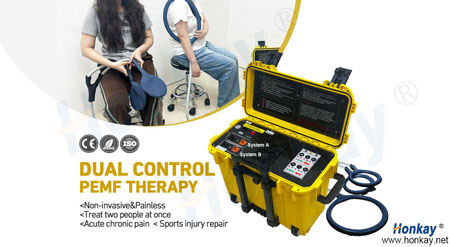
You are fitting out a treatment room, or adding a second energy to one you already run, and the same two machines keep arriving in the same conversation: a 448 kHz radiofrequency platform and a shockwave unit. Both are sold for the same rooms and roughly the same case list, both are quoted to clinics your size, and both suppliers describe their product with the same vocabulary. That is exactly why the choice feels harder than it should be.
This article is written from the buyer's side of the table. Each heading below is a question a purchasing decision maker actually puts to us, and every figure in it is taken from our own platform documentation rather than from general industry talk. If you are still working out what the radiofrequency modality itself is, start with the companion piece on how 448 kHz, CET and RET work in a clinic; if you already own a platform and the open question is which coupling to set, the guide to choosing the right mode for each treatment area goes deeper than this page does.
One sentence covers it. A 448 kHz platform passes an alternating electrical current through the tissue, and the tissue's own resistance turns that current into heat; a shockwave unit fires a short acoustic pressure wave into the tissue and uses no electrical circuit through the client at all. Everything else that separates the two machines follows from that single difference, and almost every argument between suppliers can be traced back to it.
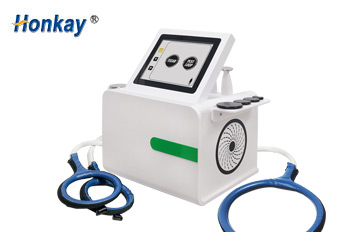
On the radiofrequency side the carrier is fixed at 448 kHz. That is the output of the platform itself, not a setting that moves with the mode: the capacitive and the resistive coupling on the same machine both run on the same 448 kHz carrier, each coupling is rated at 400 W, and the machine overall is rated at 600 W. What the operator changes is the coupling, the applicator face and the intensity, which is why the applicator set, and not the frequency, is the part of the specification that actually decides how the machine is used in the room.

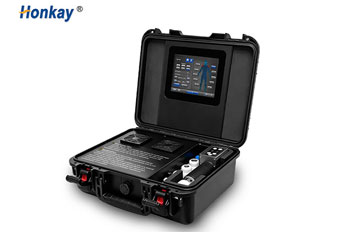
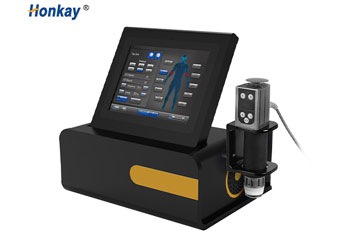
On the shockwave side there are two families, and they are not interchangeable. A radial unit drives a pressure wave out through a head that is moved across the surface, and is commonly specified at 1–22 Hz, 30–185 mJ, with 7 treatment heads and an 8-inch screen. A focused platform, which is an electromagnetic design, concentrates the wave at a point inside the tissue; the unit we build runs at 700 W, with a 10.4-inch screen, a 0–10 Hz repetition rate and a water bladder that is adjusted across 0–8 cm of depth. Neither family sends a current through the client, and neither produces the resistive heating that gives the 448 kHz platform its character.
The practical consequence is that the two machines occupy different jobs in the same clinic rather than competing for one job. A buyer who understands that sentence stops asking which one is stronger and starts asking which one answers the bookings they actually take.
The table below is the one we suggest a buyer fill in with real supplier answers rather than brochure adjectives. It is deliberately written from the operator's side, because the differences that matter on a quotation sheet are the ones a therapist meets on the couch a week after delivery.
| What you compare | 448 kHz radiofrequency (TECAR) | Shockwave |
|---|---|---|
| Energy type | An alternating electrical current at a fixed 448 kHz that meets the tissue's resistance and becomes heat inside the tissue | A short acoustic pressure wave delivered from a handpiece, with no electrical circuit through the client |
| Penetration profile | Depth follows the coupling and the tissue: the capacitive coupling spreads through water-rich tissue, the resistive coupling concentrates in denser tissue, and the pad set covers firmer tissue within about 5 cm | Depth follows the head and the source: a radial unit works the near layers, while a focused unit is adjusted through its water bladder across 0–8 cm |
| Hand and client feedback | Operators commonly describe a warmth that builds under the applicator and spreads past the edge of the tip | Operators commonly describe a tapping or knocking rhythm felt as pressure, not as heat |
| Typical session length | About 20 to 40 minutes for a facial area and 30 to 60 minutes for a body area on this platform | Driven by the number of pulses planned for the area rather than by a fixed clock time, so the block is planned head by head |
| Applicator form | Hand-held capacitive and resistive tips in a range of face diameters, plus 4 pad handles at 14 × 8.5 cm and a flexible return plate | A single handpiece with interchangeable heads: a radial unit ships with 7 treatment heads, a focused unit uses a water-coupled head |
| Coupling medium | A coupling gel is used for the hand-held passes, and the resistive coupling also depends on the return path being properly in place | A coupling gel is applied to the area before the head is placed, and the head must stay coupled with no air gap under it |
| Learning curve | The learning sits in reading the tissue and then choosing coupling, tip diameter and intensity pass by pass | The learning sits in head selection, keeping the head coupled, and moving it between pulses instead of holding it still |
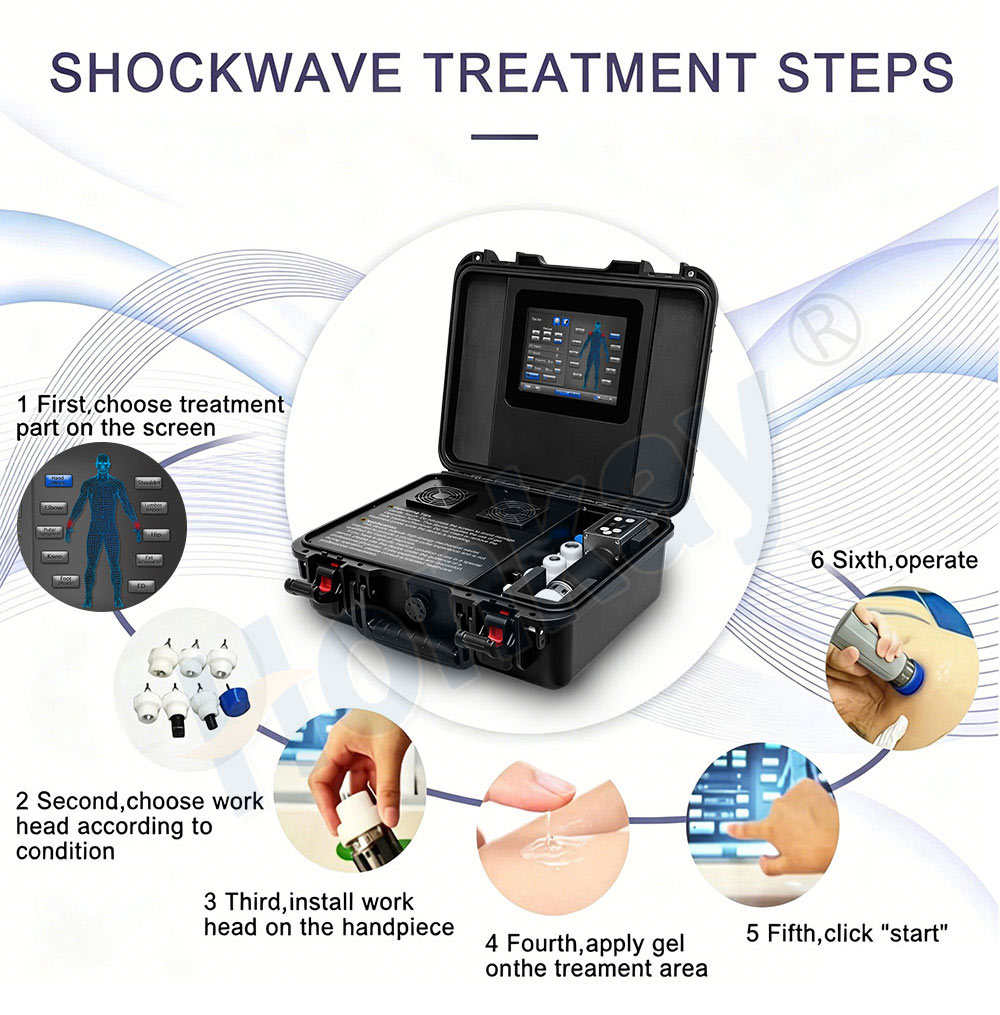
Read the coupling-medium row and the penetration row together and two buying questions fall out of them. First, the consumable question is different in each case: the radiofrequency side needs gel and, for the resistive coupling, a return path that was ordered with the machine, while the shockwave side needs gel plus heads that are chosen for the depth rather than for the tissue type. Second, the depth question is answered in two different languages, one talking about coupling and tissue, the other about heads and bladder setting, which is why a specification sheet for one modality will never let you judge the other.
If a supplier answers the whole table with a single sentence such as "deep and effective", treat that as an unanswered row rather than a satisfied one. The table is only useful when both columns are filled in with numbers and with operator habits a trainer could actually teach.
Once the physics is clear, the fit question becomes a room question rather than a machine question. The table below maps the settings we are asked about most often, and the last two columns are the ones that usually decide the order in which a clinic buys: the modality that gets a client through the door first is rarely the same one that anchors a programme.
| Client or setting | What the 448 kHz platform contributes | What the shockwave unit contributes | Which is usually booked first | What settles the decision |
|---|---|---|---|---|
| Sports-recovery and post-training clients | Broad, hands-on passes over large muscle groups, with the pad set available when the region is wide | A short, localized block aimed at one specific point the client can name | Usually the radiofrequency pass, because it covers the whole region in one appointment | Whether the booking is a full-region session or a single named point |
| A chronic tendon or attachment problem | The resistive coupling, worked over the denser tissue at the attachment with a narrower face | Repeated pulses on a fixed target, with the head chosen for the depth being worked | Depends entirely on the practitioner's plan and on what the client has already tried | The professional judgement of the treating clinician, not the equipment list |
| A large body-surface or firm-tissue case | The pad handles strapped over the area, freeing both hands while the pads stay in place | Less comfortable here, because a single handpiece has to cover the area point by point | The radiofrequency platform, decisively | How much surface area one appointment has to cover |
| A small room with one couch and one operator | One console, one trolley, and a treatment that the operator performs by hand throughout | One console and a carry case, with a short block that leaves the operator free sooner | Whatever the room's main booking already is | Floor and bench space, and how many hands the treatment needs |
| A clinic that already sells a recovery package | A hands-on layer that fills a longer appointment and is delivered by a therapist | A short add-on block that can be slotted into the same visit | Both are booked, in sequence, on the same visit | How the package is timed and priced, not which machine is newer |

Two habits keep this table useful. First, decide the modality from the appointment that is actually being booked, not from the condition on the referral, because the same condition can arrive as either a wide-region visit or a short focal visit. Second, keep the clinical decision with the treating clinician: the table describes how each machine is used and where it fits into a schedule, and says nothing about whether either modality is appropriate for a particular client.
This section is about how a clinic organises its menu, not about which modality performs better. When we ask clinics that own both why they kept the second machine, the answer is almost never clinical; it is structural. The two modalities sit at different points in a service menu, they take different amounts of operator time, and they therefore end up priced and sold differently, which is what allows both to survive in the same room.
| Layer in the menu | What it is positioned as | Why it holds its own place | Who usually books it |
|---|---|---|---|
| Assessment and hands-on work | The entry appointment, delivered by a practitioner | It sets the plan that the equipment then supports, so it is not substitutable by a machine | A new client, before any device is chosen |
| The 448 kHz programme | A longer, hands-on course of appointments across a region | It consumes operator time by design, which is what makes it a premium layer rather than an add-on | A client committed to a course, not a single visit |
| The shockwave programme | A short, focal block that slots into an existing visit | It uses a small slice of the appointment, so it raises the value of a visit without lengthening the diary slot | A client with one named point to work on, often alongside something else |
| A recovery membership or package | A fixed number of visits combining both energies | It needs more than one modality to justify a repeating commitment rather than a one-off purchase | A regular client, or an athlete on a training cycle |

Look at the third column and the operating logic becomes plain. The two modalities do not compete for the same slot in the diary; one fills the appointment and the other tops it up. That is why a clinic that buys only for the head term on a keyword list often ends up with one busy machine and one idle one, while a clinic that buys for a full menu plan ends up with two machines that are both in use on the same day.
This is the question that decides the order of the whole project, and it is a cash-flow question before it is a technical one. There are four routes we see buyers take, and each one trades a different kind of risk against a different kind of commitment. None of them is wrong on paper; the wrong one is the route chosen without the second column being read out loud.
| Route | What you commit to on day one | How the cash flow behaves | The main risk |
|---|---|---|---|
| One modality first | A single platform, its complete applicator set, and training for the team | One capital outlay, then revenue from the bookings that machine can take | Bookings that need the other modality have to be turned away or referred out |
| Both at once | Two single-modality units, two complete accessory sets, two training blocks | The largest single outlay, spread over a longer break-even | Paying for capacity before the diary has proved it can fill both machines |
| A combined platform | One console that carries more than one energy, with one training block and one installation | A middle outlay now, with less to add later | The console ties two revenue streams to one service call and one spare-part route |
| A staged purchase with a written plan | The first unit now, plus a documented second phase the supplier has priced and confirmed | Two smaller outlays against a forecast, sized to the bookings the first unit has actually generated | The second phase drifts if the price and the lead time were only discussed verbally |
One piece of discipline makes all four routes safer. Ask for the second-phase price and lead time in writing at the time of the first order, even if you have no intention of placing it for a year. A staged purchase only behaves like a cash-flow tool if the second stage has a firm number attached to it; without that, the second machine quietly becomes a second project with a second budget cycle.
The two single-modality routes above are not the only shape this decision takes. A clinic that wants radiofrequency work and a second, non-electrical layer in the same room often ends up looking at one console that carries both, usually a combined TECAR and PEMF platform. The question is not whether combined machines exist; it is which of the factors below actually bind in your building.
| What you compare | Two single-modality units | One combined platform | What it changes for a small room |
|---|---|---|---|
| Floor and bench footprint | Two trolleys or carts, two sets of leads and two places to store applicators | One console and one storage point, with a single power connection | It decides whether one couch and one operator can still work cleanly in the room |
| Staff training | Two training blocks, and a therapist is only productive once both are completed | One handover on one interface, covering both energies in the same session flow | It shortens the gap between delivery and the first billable appointment |
| Service and spare parts | Two service calls, two spare-part lists and two units that can fail independently | One service call and one spare-part list, but both energies stop if the console stops | It trades a smaller support burden for a larger single point of failure |
| Budget line | Two separate capital requests, each one justifiable on its own bookings | One capital request that has to be justified on both energies at once | It can clear approval in one cycle, or stall because neither energy alone carries it |
| Growth path | A second machine can be added to a second room later without touching the first | Capacity is set when you order, and the next step is another console rather than another energy | It suits a room that will stay a single-room service for the next few years |

The pattern in the third column is consistent: a combined platform wins on footprint, on the number of hands needed at handover, on the number of service visits and on the number of training days, and it loses on redundancy. That trade is worth taking when the second energy is being added mainly to round out a menu in a room that will not grow. It is the wrong trade when both energies are expected to run close to capacity, because then a single service call takes two revenue streams offline at the same time.
One question separates the two cases cleanly. Ask whether the second energy is there to fill gaps in an existing diary or to open a second stream of its own. Gaps point to a combined console; a stream of its own points to two independent units, even if the second one is bought a year later.
Whatever route you choose, the same checklist applies to every quotation you compare, including ours. The middle column below is what a complete answer looks like; the third column is the question that turns a brochure line into a verifiable statement. Send it to every supplier on your list and compare the answers side by side rather than one at a time.
| Requirement | What a good answer looks like | Question to put to the supplier |
|---|---|---|
| Output frequency | A single fixed figure, 448 kHz, stated once for the radiofrequency platform rather than a different frequency for each mode | Is 448 kHz the output of the machine itself, or does it change with the mode? |
| Power ratings | Each coupling stated separately at 400 W and the machine stated at 600 W overall; the shockwave units stated as a focused platform at 700 W | Are these figures rated, and are the mode ratings given separately from the machine rating? |
| Shockwave energy specification | The radial unit given as 1–22 Hz and 30–185 mJ with 7 treatment heads and an 8-inch screen; the focused platform as 700 W, a 10.4-inch screen, 0–10 Hz and a water bladder covering 0–8 cm | Which heads ship with it, and what depth range does each one cover? |
| Complete applicator set | Every item counted with its face dimensions, including the capacitive and resistive tips, the pad handles and the flexible return plate | Is the return plate and the full tip range included in the quoted price, or ordered separately? |
| Coupling medium and consumables | A written list of what is consumed in normal use and what is not, so the running cost can be estimated before the order | What has to be re-ordered during a normal year of use, and where is it supplied from? |
| Documentation and language | An operator manual and a service manual in the language your team will actually read, supplied with the machine | Can I see the manual before I order, in my language? |
| Installation and training | A written statement of what installation and staff training is included, and whether it is on site or remote | Who trains my therapists, over how many sessions, and at whose cost? |
| Warranty | A 24-month warranty confirmed in writing and counted from the date of shipment from the factory | From which date does the warranty run, and does it cover the applicators? |
| Packing and freight data | Carton dimensions and gross weight stated for the platform, for example 50 × 45 × 42 cm and 29 kg | Can I have the packed dimensions and weight so I can quote freight before I commit? |

If you take one row from the list, take the applicator set. A quotation that lists a machine and a price but not the individual heads and their diameters cannot be compared with any other quotation, because the accessory list is where two apparently similar offers actually diverge. Ask for the counts and the dimensions in writing, then check them against the areas you already know you will book.
Only on a marketing page. Physically they are unrelated: a 448 kHz platform heats tissue by passing an alternating current through it, while a shockwave unit delivers an acoustic pressure wave with no electrical circuit at all. In daily use that means they occupy different slots in the diary rather than substituting for one another. The competition, if there is one, is between the supplier of one machine and the supplier of the other for the same capital budget.
At that size the binding constraint is usually hands and floor space rather than capital. If the room will hold one couch and one operator, the machine that the operator works by hand for the longer appointment, the 448 kHz platform, is the one that fills the diary first; a shockwave unit is then added as a short block inside the same visits. If the main bookings are single-point visits, the order reverses. Either way, the decision belongs to the practitioner who will set the treatment plan, not to the equipment list alone.
A single console can carry more than one energy output, and combined platforms are built exactly that way, but they combine the outputs the manufacturer chose to put into that console rather than any two modalities at will. If a supplier offers one box that does "everything", ask for the output list in writing and match it against the two energies you actually plan to sell. What no machine does is deliver electrical radiofrequency and an acoustic shockwave from the same head at the same moment, because they are different physical quantities.
It depends entirely on whether the combined console carries the same ratings and the same applicator set as the standalone version. Compare the two quotations row by row on the checklist above rather than on the price line, because a combined console that ships with fewer tips or a lower-rated mode is a different machine even when the brochure headline matches. Where the ratings and the accessory lists are identical, the clinical use is identical; the difference is in redundancy and in service exposure, not in output.
Yes, and the two training agendas are genuinely different. The radiofrequency side is taught as tissue reading, coupling choice, applicator diameter and intensity control at the handle. The shockwave side is taught as head selection, coupling of the head to the skin, pulse planning for an area and keeping the head moving between pulses. A combined console shortens the logistics, because there is one handover and one interface, but it does not merge the two skills.
This is a clinical decision and not an equipment one, so it belongs to the treating clinician and to that client's own assessment. What the equipment side can say is limited but useful: the two modalities use different coupling media and are applied in separate blocks, so from an operational point of view they can be scheduled back to back without sharing a head or a circuit. Whether they should be combined for a particular client, in a particular order, is a professional judgement that the practitioner makes with the client in front of them.
The two are specified differently, and the specification is the honest starting point. A radial unit is commonly quoted at 1–22 Hz and 30–185 mJ with 7 treatment heads and an 8-inch screen, and it works the near layers while the head moves across the surface. A focused platform is an electromagnetic design, quoted here at 700 W with a 10.4-inch screen, a 0–10 Hz repetition rate and a water bladder covering 0–8 cm, and it concentrates the wave at a point. Which one suits your list depends on the depth and the kind of target your bookings contain; ask the supplier to map each head to a depth before you choose.
If you are fitting out a treatment room, deciding whether to add a second energy, or building either modality into a distribution range, we can walk your team through the two specifications, the applicator lists and the checklist above, and confirm every figure in writing.


 English
 中文