There is no single price for a TECAR therapy machine. A 448 kHz system is sold as a set — a generator, a pair of handles with their electrode discs, a return plate, the cables that join them, and the terms that travel with the unit — and the number on the quotation moves with every one of those parts. Two buyers who both describe what they want as "a 448 kHz platform" can end up with quotes that differ by several thousand, and both quotes can be correct, because they are not quoting the same set.
This page is written for the clinic owner, physiotherapy practice manager or distributor who has already decided to look seriously at the modality and now has to work out what it costs to buy and what it costs to run. It sets out the layers that make up a quotation, the published market bands you are shopping in, the parts that wear and have to be replaced, the training and freight that sit outside the headline price, the warranty position, and a payback calculation you can run with your own fee and your own booking sheet. Every band quoted here is a published market reference, not this manufacturer's price list, and no return is promised to any clinic: the result of the arithmetic depends entirely on your fees, your utilisation and your running costs.
Strip the brochure away and a TECAR quotation is built from six layers. The first is the generator and the way it delivers energy at 448 kHz through a capacitive or a resistive circuit; that architecture decides the class of the unit and is the single largest line on the quote. The second is the applicator set — the handles, the interchangeable electrode discs of different diameters, and the flat pads that let an operator work hands-free over a larger area. The third is the return plate and the cabling that completes the circuit. The fourth is the control interface and the programme library the operator actually works from. The fifth is the housing, the trolley and the packing. The sixth is everything that travels with the unit rather than inside it: the manual in your language, the training, the spare-part list and the warranty statement.
Most of the difference between a cheap quote and an expensive one hides in layers two and six, not in the generator. A unit supplied with two handles and four discs is not the same product as one supplied with two handles, twelve discs, a set of pads and a spare return plate, even when both are described as a 448 kHz system. The table below is the checklist to hold against any quotation: if a layer is not written down, it has either been left out or priced somewhere you cannot see.
| Layer | What it covers | How it moves the price | Where it hides in a quotation | What to ask for |
|---|---|---|---|---|
| Generator and energy delivery | The 448 kHz output stage and its capacitive and resistive circuits | The largest single lever between tiers | Described in one line, with no detail on how the two circuits are selected | Which modes the unit offers and how the operator switches between them |
| Handles and electrode discs | Capacitive and resistive handles, plus the disc sizes supplied with each | A second handle and a fuller disc set add cost and remove a mid-session stop | "Complete set of applicators" with no count and no diameters | A written count of every handle, disc and pad in the case |
| Return plate and cabling | The large flexible plate that closes the circuit, plus the leads and connectors | A small share of the price, a large share of the downtime when it fails | Mentioned as an accessory, not priced as a replaceable part | The part price and lead time for a spare plate and a spare lead |
| Interface and programmes | Screen, menu language, stored programmes and whether settings can be locked | Raises the price and shortens the training curve for a team | A screen photograph in the brochure with no mention of what is stored in it | The programme list and the languages loaded on delivery |
| Housing and packing | Bench-top or trolley format, the case, and the internal protection for transit | Robust packing costs more up front and less in transit damage | Freight weight and packed dimensions left off the quotation entirely | Packed weight, packed dimensions and the shipping terms |
| Documents, training and terms | Manual language, training, spare-part list and the warranty statement | The layer most often trimmed to make a headline price look lower | "Training included" with no statement of format, length or language | The warranty term, what it is counted from, and how training is delivered |

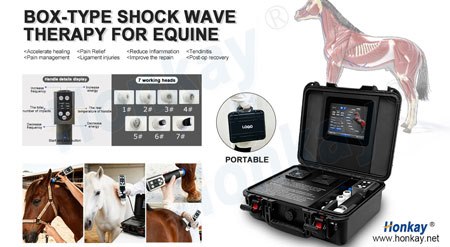
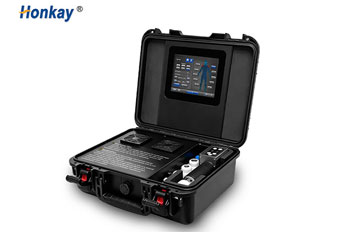
The photograph above is a useful way to read a quotation, because it shows the parts that are counted separately once you look closely: the console and screen, the two cable handles, the applicator on its lead, and the four callouts that mark which of those parts a buyer can specify for their own brand. When a supplier says the platform is "customisable", these are the pieces being discussed, and each one is either in the price or added to it.
Published buying guides for this category group 448 kHz platforms into three broad bands. The figures below are the ranges that appear in public market guides for TECAR equipment; they are industry-wide references, not a manufacturer quotation, and they are not this supplier's price list. Read them as the band you are shopping in, then add or subtract for the accessories and terms specific to your order.
| Tier | Published market band | What usually ships at this tier | Who it usually fits |
|---|---|---|---|
| Entry | roughly USD 2,000 - 4,000 | One handle of each type, a small disc set, basic programmes, single-language manual | A single-room practice adding the modality for the first time |
| Mid-range | roughly USD 4,000 - 7,000 | Two handles, a fuller disc and pad set, stored programmes, a spare lead | An established clinic where the modality carries a share of the appointment book |
| Premium | roughly USD 7,000 - 12,000 | A wide applicator set, a larger screen, an extended programme library, trolley format | A multi-therapist clinic or a distributor building a demonstration unit |
Two cautions when you use that table. The band describes the class of machine, not the quality of the supplier: there are carefully built entry-level units and poorly built premium ones. And a quotation that sits far below the band for the configuration it claims is usually paying for the difference somewhere else — fewer discs in the case, a shorter documented warranty, or wearing parts priced high in the second year. Ask which of those changed, and ask for the answer in writing rather than over the phone.
The applicator set is where a TECAR quotation becomes concrete. Operators work with a capacitive handle for one kind of session and a resistive handle for another, they change disc diameter to suit the area in front of them, and they use flat pads when the client needs to be left resting under a strap. Every one of those items is a separate part with its own part number, its own replacement price and its own wear pattern, and the case that ships with the unit sets how many of them you own before you buy your first spare.
Ask for the applicator list as a table, not as a photograph. The table below is the format to request: item, what it does in the session, how it wears, and what it costs to replace. A supplier who can fill it in has a spare-part system; a supplier who cannot has a brochure.
| Applicator | What it does in the session | How it wears | What to put in the order file |
|---|---|---|---|
| Capacitive handle with insulated discs | Work over a broader area where the operator moves the head continuously | Cable entry and the disc face take the handling; discs chip at the rim | Part numbers and prices for each disc diameter, plus one spare of the size used most |
| Resistive handle with metal electrodes | Work on a more defined area with firmer contact and less coupling medium | Electrode seats loosen and the cable connector is the first thing to fail | Whether the handle is serviceable or replaced as a whole unit |
| Flat pads | Hands-free work over a larger surface while the client rests | Straps stretch, the pad face loses contact and the lead entry cracks | How many pads ship in the case and whether a spare set can be added to the order |
| Return plate | Closes the circuit under the client for the whole session | The flexible edge and the socket take repeated handling and cleaning | The replacement price and the lead time for a second plate |
| Leads and connectors | Carry the current from the console to whichever applicator is in use | Fail at the plug after repeated connection and coiling | A spare of the lead you use every day, with its part number |
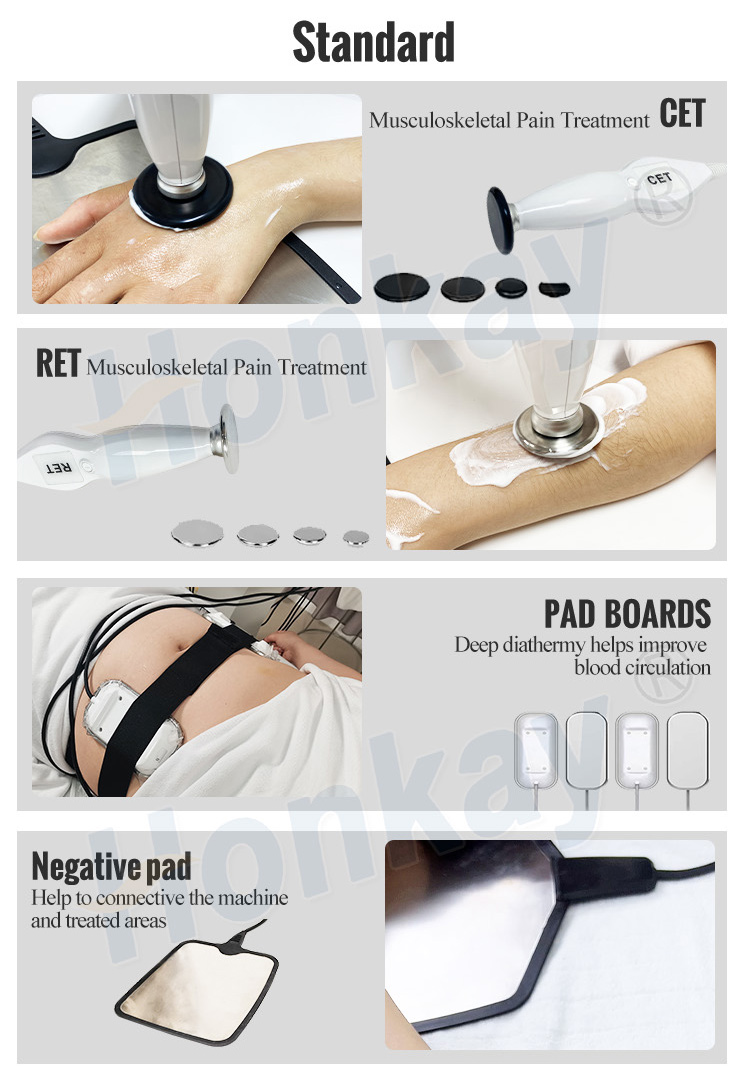
The board above shows the four applicator types a working set is built from, and it is worth counting them against your own quotation line by line: one handle with discs, one handle with metal electrodes, a pair of pads and their straps, and the return plate that sits under the client. A quotation that lists "handles and accessories" without this breakdown has left the counting to you, and the case that arrives will be the one the supplier decided to pack, not the one your operators described.
The running cost of a 448 kHz system is not a service contract; it is a series of small purchases that arrive when a part stops doing its job. Conductive cream or gel is used every session and thrown away. Pad faces lose their contact and straps stretch. A return plate that has been cleaned twice a day for two years will eventually need replacing, and a lead that has been coiled around a handle will fail at the plug. None of these is expensive on its own, and together they are the line most buyers forget when they compare two quotations on price alone.
The honest way to budget is to annualise them from your own session count rather than from a manufacturer's estimate. The table below gives the arithmetic for each item so you can substitute your own numbers; where a supplier has not published a life figure, the correct entry is "not stated" and a question to them, not a guess from us.
| Item | How it is used up | What drives the replacement | How to turn it into an annual figure | What to confirm with the supplier |
|---|---|---|---|---|
| Conductive gel or cream | Consumed every session and discarded | Sessions per week, and how much the operator applies | Cost per tube divided by sessions per tube, multiplied by sessions per year | Whether it is a standard product you can buy locally, or a specific one you must re-order |
| Pad faces and straps | Contact fades and straps lose elasticity | Number of hands-free sessions and how the pads are cleaned | Set price divided by the months a set lasts, multiplied by twelve | Whether pads and straps are sold as a set or separately |
| Electrode discs and seats | Rims chip; seats loosen with repeated fitting | Handling, storage and how often the disc is changed mid-session | Price per disc divided by its stated life, then multiplied by discs used per year | The price of the size you use most, and whether singles can be ordered |
| Return plate | Edge and socket degrade, then contact becomes unreliable | Cleaning routine and how the plate is stored between clients | Plate price divided by the replacement interval you plan, held as a reserve | How the plate is cleaned and whether a second one can ship with the order |
| Leads and connectors | Fail at the plug after repeated plugging and coiling | Clients per day and whether leads are coiled tightly at close | Lead price divided by the months it lasts, held as a small annual reserve | Part number and lead time for the lead you use daily |

The return plate above is the clearest example of why the consumable list belongs in the order file. It is a single part, it is handled at the start and end of every session, it is cleaned constantly, and it is the part most often left out of a spare-parts budget because it looks like a permanent fixture. The four smaller photographs show how it is positioned for different areas, which is also the reason it wears where it does: the edge that is folded and re-folded under a hand or a knee goes first.
The landed cost is the price on the invoice plus everything needed to get the unit working in your room. Three lines sit outside the headline figure and each of them can quietly decide whether the project starts on schedule: training that turns a console into a service your team can sell, freight and import charges that follow the packed weight and the shipping terms, and the installation and handover that confirm the unit is running the way the manual describes.
| Cost line | What it covers | Who normally carries it | How to pin it down |
|---|---|---|---|
| Training | Operator training on the handles, the modes and the programme library, in person or remotely | Often bundled into the unit price; sometimes quoted per session or per day | Ask for the format, the number of days or hours, the language, and whether a second training visit is chargeable |
| Freight and import charges | Air or sea carriage, insurance, customs duty and clearance in the destination market | Depends entirely on the shipping term you agree; a buyer-side cost under most terms | Ask for packed weight and dimensions, the shipping term, and a freight estimate to your port |
| Installation and handover | Unpacking, checking the parts against the packing list, first power-up and a walk-through | Usually the buyer's team, guided remotely, unless a dealer covers it locally | Ask who signs off the handover and what document confirms the unit was received complete |
| Documentation and translation | The operation manual and the control interface in the language your operators work in | Included by some suppliers, a paid option with others | Ask for the manual language list and a sample page before the order is confirmed |
A practical rule for the landed cost: add the training you actually need, the freight you have been quoted in writing, and a margin for clearance and local delivery, then compare that total against the other suppliers' totals rather than against their invoice prices. The supplier with the lower invoice and the higher landed cost is the more expensive supplier, and it is usually the one whose training was described as "included" without saying what included means.
The position on this platform is straightforward: a 24-month warranty, counted from the date of shipment from the factory. That start date matters more than the length of the term, because it runs while the unit is in transit and in customs, not from the day your first client lies on the couch. Record the shipment date and the serial number on the day the unit arrives, keep them with the order file, and you will always know how much of the term is left without having to reconstruct it from an inbox.
A warranty term is only as useful as the answers around it, so treat the following four questions as part of the commercial terms rather than as after-sales detail: what the term covers, who performs the repair, how long a replacement part takes to reach you, and what you are expected to do before a claim is accepted. A term that reads well but has no stated response time leaves your treatment room closed for an unknown number of weeks, and that closure — not the part price — is the real cost of a service event.
| Question | The answer you want in writing | Why it changes your cost |
|---|---|---|
| What the term covers | The 24-month term, counted from the factory shipment date, and whether it travels with the serial number | A term you cannot date is a term you cannot claim against |
| Who performs the repair | The factory, a regional dealer, or a local technician working from a supplied procedure | Decides whether a fault costs you a courier or a flight |
| Part availability | The lead time for a handle, a return plate and a lead into your market | A cheap part with a long lead time still closes the room |
| What you must do first | The information and photographs a claim needs, and who to send them to | Shortens the gap between a fault and a replacement |
Payback is arithmetic, not a promise. The method is always the same: take the landed cost of the system, subtract nothing, and divide it by what each session contributes after its own consumable cost. Contributions, not revenue, is the number that matters — a session that uses gel, a pad and twenty minutes of an operator's time earns less than its invoice suggests.
Sessions to recover the equipment = landed cost ÷ (fee per session − consumable cost per session). Then divide that figure by the sessions you can realistically fill each month to get the number of months, and add the annual service and spare-part reserve you calculated above to see how much longer the real recovery takes. Nothing in that formula is specific to this supplier, which is the point: the same arithmetic lets you compare two quotations honestly, and it shows immediately that a lower price with a higher consumable cost per session is not always the cheaper machine.
| Input | Symbol | Where the number comes from | What it changes in the result | Your figure |
|---|---|---|---|---|
| Landed cost | C | Invoice price plus freight, duty, clearance and training | The sum you have to recover | |
| Fee per session | F | Your own price list for the appointment length you sell | Gross revenue per appointment | |
| Consumables per session | V | Gel, pad wear and the spare-part reserve divided by sessions | The margin you actually keep | |
| Sessions to break even | C ÷ (F − V) | Calculated, not estimated | How many appointments the equipment has to carry | |
| Realistic fill rate | S per month | Your booking sheet, not the number of slots in the day | Turns the session count into a realistic number of months | |
| Months to recovery | C ÷ (F − V) ÷ S | Calculated from the two rows above | The payback period for your own clinic, not for an average clinic |
Run the calculation twice: once at the fee you would like to charge and once at the fee the market around you actually pays. If the second run produces a payback period you are not comfortable with, the problem is the pricing or the case mix, not the machine, and a cheaper quotation will only postpone the same conclusion. Results differ by clinic, by city and by the client base you already have, so the only figure worth acting on is the one built from your own numbers.
By this point the arithmetic is in place, so the last step is to turn it into written answers. Send the list below with your enquiry and ask for each line to be answered in the quotation or in an attached sheet; keep the replies with the order file. A supplier who answers it has shown you how the unit is built, packed and supported. A supplier who waves it away with an assurance that everything is standard has told you something equally useful, and you can act on it before rather than after the payment.
| Area to pin down | The written answer you want before payment |
|---|---|
| Configuration | The exact applicator list: how many handles, which disc diameters, how many pads, one return plate or two |
| Modes and programmes | Which modes the unit runs, how they are selected, and which programmes are stored at delivery |
| Spare parts | Part numbers and prices for a handle, a disc set, a pad set, a return plate and a lead, with lead times |
| Warranty | The 24-month term, counted from the factory shipment date, with the process for a claim |
| Training | Format, length, language and whether a follow-up session is included or chargeable |
| Freight data | Packed weight, packed dimensions, shipping term and the documents supplied for clearance |
| Power and plug | The supply the unit expects in your market and the plug standard fitted at the factory |
| Documents | The manual language, a sample page, and the packing list that will be in the case |
| Private label | Whether the panel, the interface and the manual can carry your brand, and what that adds to price and lead time |
| Payment and delivery | The deposit and balance terms, the production lead time and the date the unit leaves the factory |
It is a one-off purchase of hardware plus a small running cost. There is no mandatory subscription on this platform: what recurs is consumable — gel, pad faces, discs, a return plate and occasionally a lead. Budget those as a modest annual reserve rather than as a monthly fee, and the ownership cost becomes predictable.
Because they are rarely the same set. The differences sit in the applicator count, the disc diameters, whether a second return plate is included, how many programmes are loaded, the manual language, the training format and the freight term. Ask both suppliers for the same line-by-line configuration sheet and the gap usually explains itself within a few minutes.
It depends on handling and cleaning more than on the calendar, so ask for the supplier's own figures rather than accepting a general estimate. What you can do is standardise: one disc size per common area, one storage routine, one cleaning procedure, and one spare of the item you use most. A team that follows the same routine gets far more life out of a set than a team that improvises.
Often it includes training and rarely it includes installation, so confirm both in writing. Ask what "training included" means in hours, format and language, who signs off the handover, and whether a second visit after the team has used the unit for a month is chargeable. Those three answers decide whether the first month runs smoothly.
The warranty is 24 months, counted from the date of shipment from the factory. Record the shipment date and the serial number when the unit arrives, and ask in advance who performs a repair in your market, what the lead time is for a handle, a plate or a lead, and what information a claim needs.
Divide the landed cost by the contribution per session — the fee minus the consumable cost — then divide by the number of sessions you can realistically fill each week. The answer is specific to your fee and your booking sheet, not to an average clinic, which is why no supplier can give you a number that is meaningful for your practice.
Yes, the panel, the interface and the manual can be produced for a buyer's own brand, and that is an OEM/ODM conversation with its own tooling, minimum quantity and lead-time implications. Ask for the cost of the brand change separately from the cost of the machine, so you can decide whether to launch under your own name now or after the first order has proven the demand.
Buy the tier whose applicator set matches the sessions you actually plan to sell. If your operators need two handles and a full disc range to work across the areas your clients book, the entry set will cost more in add-on parts than the difference in list price. If the unit is one option in a wider menu, the entry tier plus a spare plate is usually the better fit.
The equipment described on this page is made and supplied by Honkay, the brand of Guangzhou Huang-Kai Technology Co., Ltd., an OEM and ODM manufacturer of physiotherapy equipment working from Guangzhou, China. Our factory and offices cover more than 1,000 square metres, and we run an in-house research and development team alongside the production floor.
Because the units are built rather than resold, the configuration on your quotation can be settled at the factory: the applicator set, the disc diameters, the programme library, the interface language, the manual language and the branding on the panel. A buyer who needs a different housing, a different plug standard or their own logo is ordering a variation of the same platform rather than a different product line, and the spare-part list travels with the unit so that a replacement handle in year two is a known part number rather than a search.
Honkay exports to South America, South Asia, South-East Asia, Western Europe, Northern Europe, Southern Europe, Eastern Europe, Oceania and North America, so most of the questions on this page come from buyers who have already run the numbers for their own market. More background is on our about page, and the request list above can go straight to the team.



 English
 中文