Short answer: for a horse, PEMF, shockwave and TECAR are three different tools rather than three versions of one treatment, and the right choice follows what you are working on, where on the animal it sits, and who will operate the device. PEMF is a magnetic-type modality, usually applied through a loop, a coil or a body sheet. Shockwave is an acoustic, pressure-wave modality, applied with a handpiece held at a chosen spot. TECAR is a radio-frequency modality, applied with capacitive and resistive electrode handpieces. None of the three replaces an assessment, and every decision about an individual horse belongs with a veterinarian. This guide compares the three side by side in equine use, looks at where each is commonly applied, how a session is usually run, the safety points that must be referred to a veterinarian, the operating mistakes that are easy to make in a stable, and what a buyer should confirm in writing before ordering.
Everything below is general product and procurement information, not veterinary advice. Results vary by animal, and any question about a symptom, a diagnosis or a course of care belongs with a qualified veterinarian. If you are new to magnetic-field equipment on horses, the site's equine magnetic-field guide is a useful starting point, while this article stays on the comparison itself.

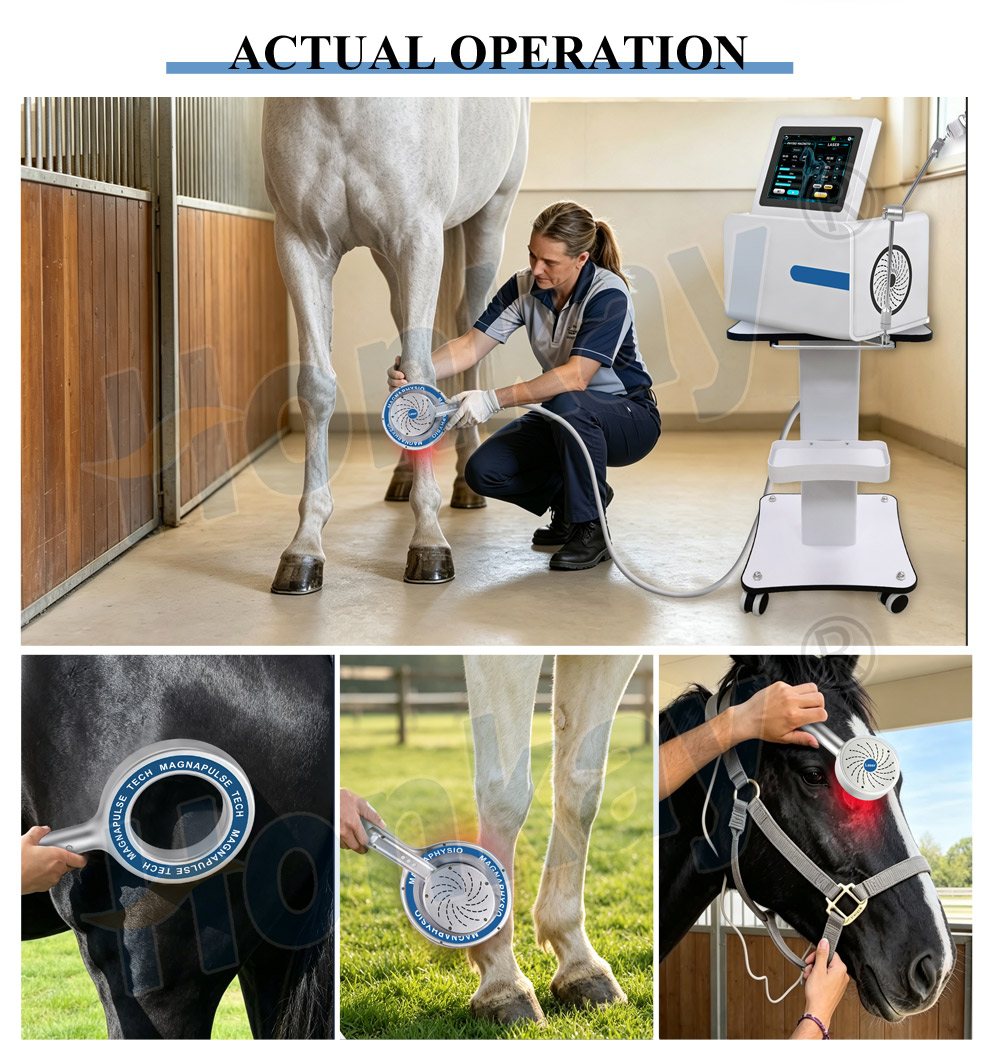
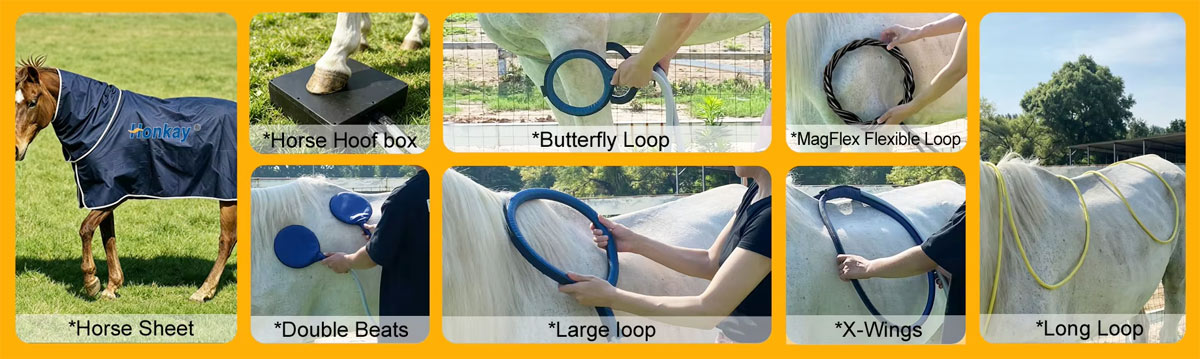
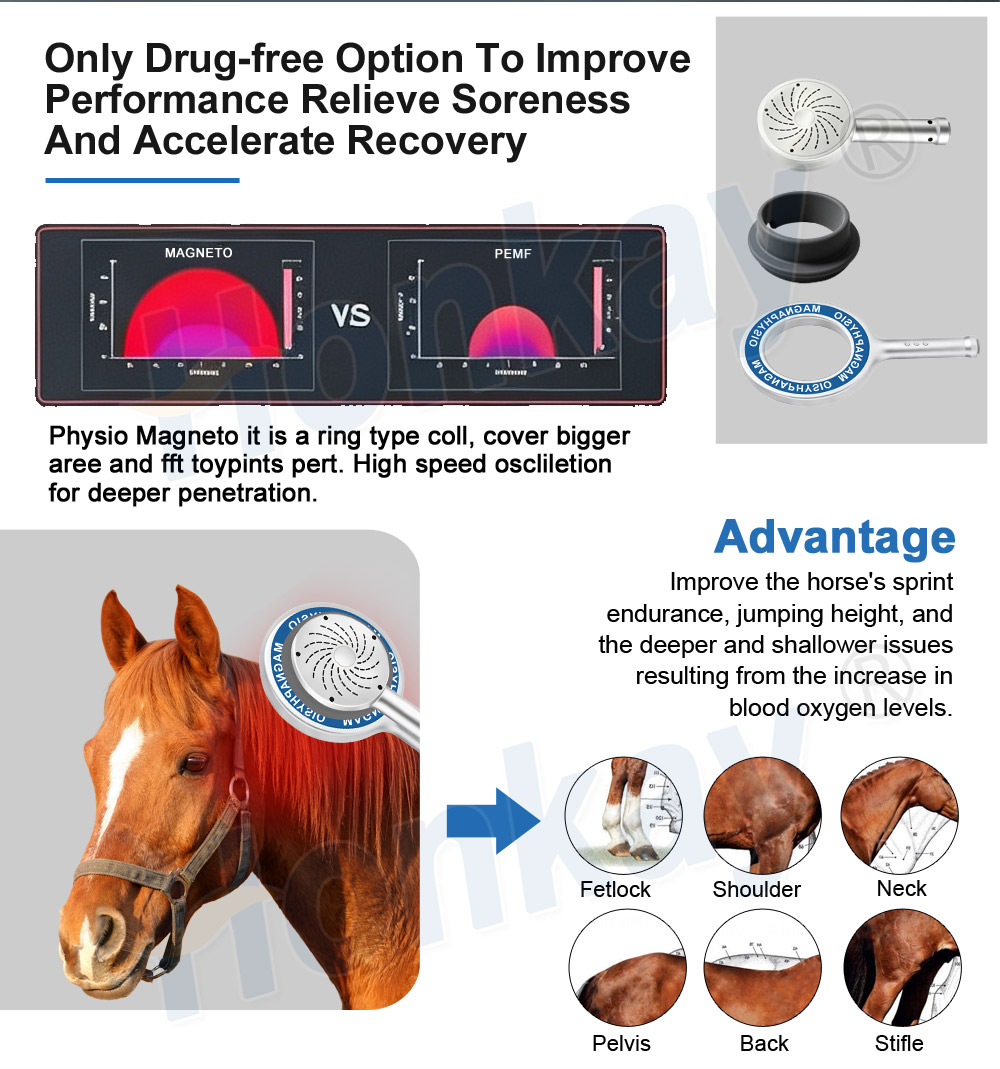
The honest version is short. PEMF delivers a pulsed magnetic field, so there is nothing to press against the skin and the field passes through the coat, the bandage and the tissue under it; that is why it is often applied with a loop slipped over a leg, a coil held over a back, or a sheet laid across the body. Shockwave delivers a mechanical pressure wave, so coupling matters, the handpiece is held against a specific spot and moved deliberately, and the effect is local to where the wave is aimed. TECAR delivers a radio-frequency current that warms tissue from the inside through a capacitive or resistive electrode, so it is applied with a handpiece that glides over the area with a coupling medium, much like a physiotherapy treatment on a person but sized and used for the horse. The three feel different to apply, need different accessories, and call for different levels of operator training.
The practical consequence is that the comparison is not about which one is stronger. It is about which one fits the job in front of you: a foot, a tendon, a back, a whole body, a single spot, a large area, or a horse that will not stand still for a handpiece. Keep that idea in mind, because it decides most of the later questions in this article.
The table below puts the three in the same frame for equine and veterinary use. It is written to be neutral: it describes how each is applied and how it is usually operated, not how well it works on any particular condition, because that judgement is a veterinary one.
| Modality | What carries the energy | How it is applied | How a session is usually run | Operator demand | Where it fits |
|---|---|---|---|---|---|
| PEMF | A pulsed magnetic field | A loop, coil or body sheet placed over or around the area; no contact pressure needed through the hair coat | The horse is usually tied or held quietly while the loop is positioned and left in place for the set time | Low; a handler can manage it once shown the placement | Whole-body, limb and stable-side routines; portable and quiet |
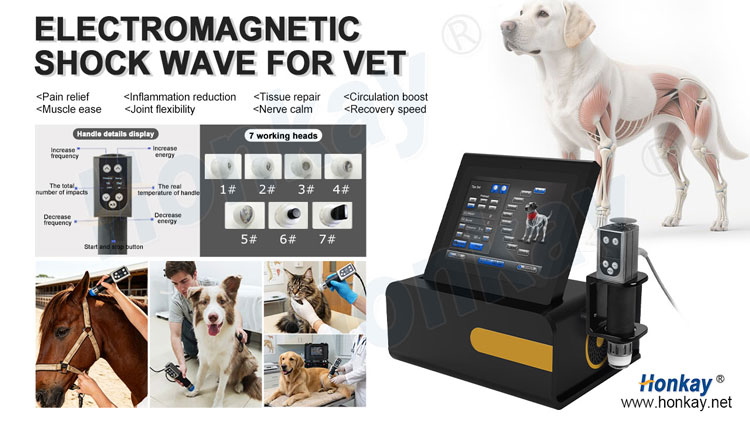
| Shockwave | An acoustic pressure wave | A handpiece held against a specific spot, with coupling medium, and moved in a set pattern | Shorter and more targeted; the operator works one defined area at a time and counts the passes | Higher; the aim and the technique are part of the treatment | A defined spot such as a tendon or a joint region, in a veterinary setting |
| TECAR | A radio-frequency current | Capacitive or resistive electrode handpieces glided over the area with a coupling medium | A moving pass over a region; the operator keeps the handpiece in contact and follows the area | Medium; technique matters but the area can be larger | Muscle and soft-tissue regions, in a clinic or a well-equipped stable |
The same three modalities sort themselves differently once you put them against the horse and the place you work. As a rule of thumb, the more the tool needs to be aimed at one defined spot, the more it belongs in the hands of a trained operator; the more it works around a shape, the easier it is to run in a stable routine. The matrix below is a starting frame for a conversation with a veterinarian, not a prescription.
| Situation on the yard | PEMF fits when | Shockwave fits when | TECAR fits when | Notes for the buyer |
|---|---|---|---|---|
| Routine stable-side recovery | Yes; loops and sheets are quick to place and quiet | Usually not the first choice for a routine pass | Possible where mains power and a trained hand are available | Portability and battery or mains options decide this one |
| A limb and a specific spot | A loop can be wrapped around the limb | Yes; aimed at a defined point on the limb | Yes, for a soft-tissue pass over the region | Check which loop sizes and which handpieces are supplied |
| Back and larger muscle groups | A sheet or a large loop covers the area | Possible but slow over a large area | Yes; a capacitive pass over a broad region | Ask for the real area each applicator can cover |
| A clipped, hairless or bandaged area | The field passes through hair and light bandage | Coupling and skin condition matter | Requires clean contact and a coupling medium | Confirm which is workable over a bandage at your yard |
| Two horses, or two areas, at once | A dual-channel unit can drive two loops together | Handpiece work is one spot per operator by nature | One operator per handpiece | Two channels help most when staff time is the limit |
| Serving both horses and people | A shared platform can be offered in human and equine versions | Human and veterinary ranges are usually separate | A combined PEMF-and-TECAR platform can cover both settings | Ask the supplier which version suits which side |
The cadence is not a single number, and anyone who quotes one figure for every horse is guessing. Frequency and session length are set by the veterinarian according to the horse, the area and the stage of work, and they should be written into the treatment plan rather than decided by whoever happens to be holding the loop. What a buyer should insist on is that the operating manual states a running limit at all, because a device with no stated limit cannot be used responsibly in a busy yard.
The questions worth writing down before the first session are therefore about limits, not about a headline number: how long the unit may run before it needs to rest, whether there is a shut-down temperature, how many times the same area may be worked in one week, and what the manual says about the gap between sessions. Where a published figure is not stated, ask for it in writing, and treat a vague answer as a gap you will be filling later. Good practice on nearly every device is also the same: start at the low end, keep sessions short at first, and let the horse's response at each step guide whether to continue.

This is the section that matters most, so it is deliberately plain. The situations below are not for a yard routine and not for a self-appointed operator; each one belongs to a veterinarian before any device is switched on. The list mirrors the cautions a responsible operating manual carries for equine and veterinary use. It is not a diagnosis and it does not replace one.
Involve a veterinarian first when: the problem came on suddenly or followed an accident; there is swelling, heat, a wound or a suspected fracture; the horse is lame at the walk, or the lameness is getting worse rather than settling; there is an open, infected or inflamed area of skin where the applicator would sit; the horse is in the acute stage of an injury; the mare is pregnant; the horse carries an implanted electronic device; there is a known bleeding disorder; there is a tumour or a metal implant in the treatment area; the horse has a history of tying-up or another condition that a professional has flagged; or the horse is being treated for a condition that is already under veterinary care. Where two approaches disagree, follow the more cautious one, and when in doubt, ask before you place an applicator.
Two further points belong here. First, the three modalities are not interchangeable in their cautions: an acoustic handpiece aimed at the wrong tissue and a magnetic loop left in the wrong place are two different mistakes, and a radio-frequency handpiece over a pocket of the wrong skin is a third. Second, none of this is meant to discourage everyday, professional use. It is meant to keep a clear line between the routine work a trained handler can carry out and the decision that only a veterinarian should make.
Most problems in equine use are not equipment failures; they are habits. The recurring ones are worth naming so that they can be designed out of the routine.
Starting at too high a setting is the most common, especially on a horse that is already sore. Keeping a shockwave handpiece parked on one spot instead of moving it, and losing the coupling medium so the wave reflects off the skin, both undo the work. Running a whole-body session for much longer than the plan allows, because the horse is standing quietly, is another. Leaving the same area to be treated more often than the plan states, or treating two different horses with the same handpiece and the same coupling without cleaning between them, are hygiene and scheduling mistakes. And the quietest one of all is treating by habit rather than by reassessment: continuing a routine that the horse's response no longer supports, instead of stopping and asking a veterinarian to look again.
For equine equipment, the specification sheet is only half the purchase. The other half is the written commercial and support terms, because a device that cannot be serviced or supplied with the right applicators will sit idle while an owner waits. Use the table below as a request list: ask each supplier for the same items in writing, in the same units, so the quotes can be compared line for line. If you are also considering private-label equipment for your own brand, the companion guide on MOQ and margins covers the commercial side in detail, and the shockwave supplier and OEM guide covers how to check the factory end.
| What to confirm in writing | Why it matters for horses | What to ask for |
|---|---|---|
| Applicator list and sizes | Loops have to fit a leg, a hoof or a body, so the sizes supplied decide what you can actually treat | An itemised list of every loop, coil, sheet or handpiece in the box, with its size |
| Channel and control layout | A dual-channel unit can work two loops at once, which changes how many horses one handler can manage | A plain diagram of what runs at the same time and what does not |
| Power and portability | A yard or a mobile visit rarely has the same power and space as a clinic | Operating voltage, whether a battery or mobile form is offered, and the storage case dimensions |
| Running limits | A device with no stated limit cannot be scheduled responsibly | The continuous-run limit, any shut-down temperature, and the recommended gap between sessions |
| Consumables and spare parts | It turns a purchase price into a running cost and decides how long a unit sits idle if a part wears | The consumable list, the replacement price of each item, and the spare-part lead time |
| Manual, training and support | An untrained operator is the largest single risk in equine use | The full manual in a language you read, plus what operator training and after-sales support are provided |
| Warranty terms | A duration without a start date is not a warranty term | The warranty length, its start date and what a claim requires; our platforms carry a 24-month warranty counted from the date of shipment from the factory |
There is no single winner, because the three do different jobs. PEMF is a magnetic modality usually placed as a loop, coil or sheet and is convenient for stable-side and whole-body routines; shockwave is an acoustic modality aimed at a defined spot and belongs with a trained operator; TECAR is a radio-frequency modality applied with electrode handpieces over muscle and soft tissue. The right choice follows what is being worked on, where it sits on the horse, and who will operate it, and that choice belongs with a veterinarian.
They can be combined in a plan, but the sequence and the timing are clinical decisions, not sales ones. Some yards use one modality as a routine and another for a specific spot, and some clinics combine a radio-frequency and a magnetic platform on the same horse on different days. Whether two modalities are used on the same horse and how far apart belongs with the veterinarian who knows the case, and it should be written into the plan rather than decided at the stable door.
Follow the plan the veterinarian sets, not a fixed public number, because frequency depends on the horse, the area and the stage of work. What should never be left open is the limit: every device should state how often the same area may be worked in a week and how long the unit may run before it must rest. A portable magnetic-field unit intended for two horses at once, for example, is scheduled around its two channels and its running limit, and those figures come from the manual, not from a marketing page.
It depends on the modality and the area, and it should be part of the written plan. A magnetic-field session is typically the longest and the quietest, with the loop or sheet left in place for the set time; a shockwave session is shorter and more targeted, working one defined area with a counted number of passes; a radio-frequency pass is a moving application over a region. The safe rule in every case is to start at the low end of the setting range, keep the first sessions short, and extend only as the horse's response allows.
Acceptance varies with the horse and the modality. Magnetic-field work is often the easiest for a horse to accept, because nothing is pressed hard against the skin and the unit is quiet; a handpiece that is held against a spot, as in shockwave or radio-frequency work, is more likely to be noticed, especially over a sensitive area. The practical answer is to introduce any new modality at a low setting, watch the horse's reaction rather than the screen, and stop if it is clearly uncomfortable. A horse that will not settle is a reason to pause and, if needed, to ask a veterinarian, not a reason to press on.
Any sudden or accident-related problem, swelling, heat, a wound or a suspected fracture, a lameness that is worsening, an open or infected area of skin, the acute stage of an injury, pregnancy, an implanted electronic device, a known bleeding disorder, or a tumour or metal implant in the treatment area. In every one of those cases the horse belongs to a veterinarian before any applicator is placed, and the more cautious of two opinions is the one to follow.
A dual-control unit can run two applicators at the same time, so two areas on one horse, or two horses, can be worked in the same window; a single-control unit runs one at a time. The difference is about how much the staff can get through in a session, not about which one works better. For a stable with limited handler time, or for mobile work where the setup is carried from yard to yard, the dual-control option is the one to weigh against the extra cost, and the supplier should confirm in writing exactly what runs simultaneously.
If you are equipping a stable, a veterinary practice or a mobile service, we can send you the specification sheets, the applicator and spare-part lists, the operating manual and the written commercial terms, so you can compare them against any other quote. Tell us whether the equipment is for horses, for a clinic, or for both, and we will point you to the right version.
For background on the magnetic-field side of equine recovery, see the equine magnetic-field guide, and for a closer look at applicator formats see the PEMF form-factor comparison.
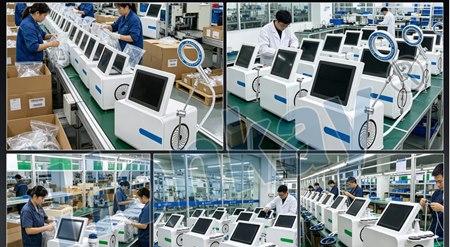
The equipment described on this page is made and supplied by Honkay, the brand of Guangzhou Huang-Kai Technology Co., Ltd., an OEM and ODM manufacturer of physiotherapy equipment working from Guangzhou, China. Our factory and offices cover more than 1,000 square metres, and we run an in-house research and development team alongside the production floor.
Equine and veterinary work is a configuration we build rather than an afterthought: the same platforms are supplied in equine versions, with the applicators, the housings and the programme sets that those buyers ask for, so the case you specify is the case we assemble. Buyers who need their own badge on the panel order under private label, and the training material, the spare-part list and the manual language travel with the order.
Honkay exports to South America, South Asia, South-East Asia, Western Europe, Northern Europe, Southern Europe, Eastern Europe, Oceania and North America, so most of the questions on this page come from buyers who have already run the numbers for their own market. More background is on our about page, and the confirmation list above can go straight to the team.



 English
 中文