You have a brand, a customer list and a market, and you want to put physiotherapy equipment on your own shelf rather than resell somebody else's name badge. The moment you ask a factory to build for you, four commercial questions arrive together: how the two of you actually work together, how much of the machine can carry your identity, what the smallest production run the factory will accept is, and what has to happen between the factory gate and your customer before the order makes any money. This page takes those four questions in order, because the answer to each one changes the shape of the next.
It is written for brand owners, importers and distributors rather than for clinicians, so the language stays commercial throughout. Where a figure could be read as a promise, the text says what to confirm in writing instead of quoting a number, because the right number depends on your specification, your volume and your market. Nothing here commits a manufacturer to a price, an exclusive territory or a delivery date on your behalf.
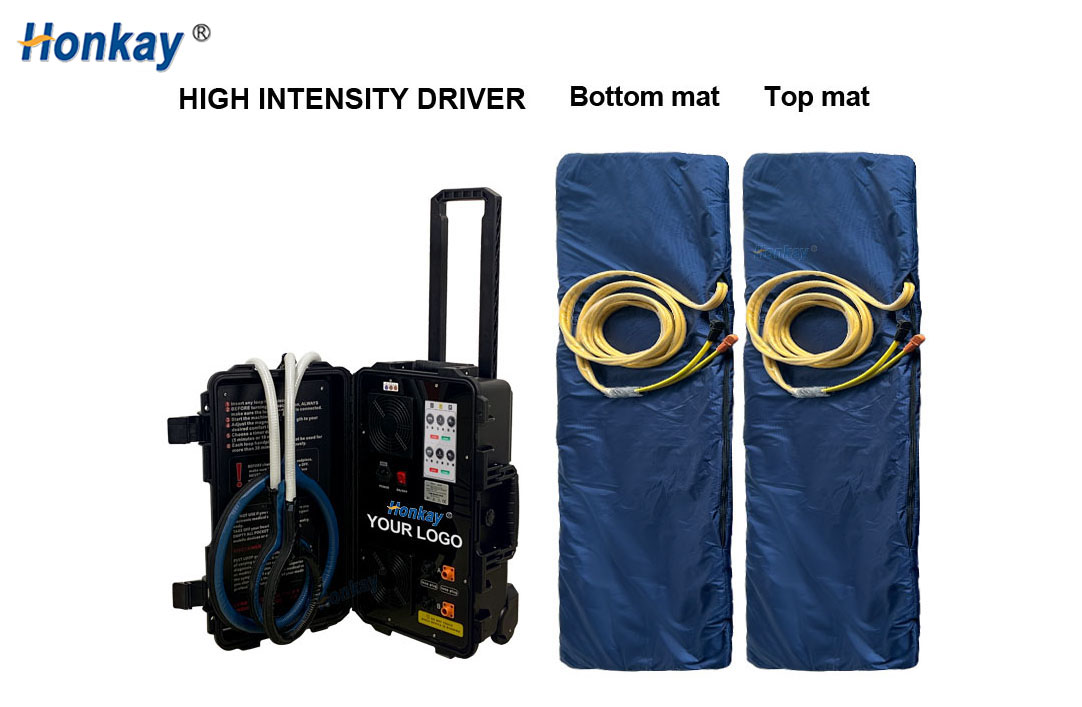
The three words are used loosely in this trade, so it is worth fixing the boundary before you negotiate. A white-label order is an existing catalogue model bought with your own branding applied to it: the platform stays exactly as the factory designed it, and what changes is the surface the customer sees. An OEM order is the same factory platform, but built to your specification: your enclosure colour, your interface wording, your accessory list and your packaging, on a product whose engineering already exists. An ODM order is a product that did not exist before you asked for it, where the industrial design, the tooling and the firmware are developed between you and the factory.
The practical difference is who carries which risk. In white-label the risk is the factory's and you buy speed; in OEM the platform risk stays with the factory while the market-positioning risk becomes yours; in ODM you share the development risk, the tooling cost and the timeline, and in exchange you can own a shape and an interface that no competitor can order from the same shelf. Most first private-label programmes start at the white-label or light-OEM end, prove the market, and move up the ladder on the second or third order.
| Cooperation model | What the factory already owns | What you bring to it | Where it fits |
|---|---|---|---|
| White-label | A finished platform, its engineering, its tooling and its firmware, exactly as catalogued | Your logo file, your label wording and your order | A first order where speed matters more than a unique product |
| OEM | The underlying platform and its engineering, which stay unchanged | A written specification: enclosure colour, interface wording, accessory list, packaging, plug standard | A brand that needs its own look without paying for new tooling |
| ODM | Its engineering team, its supply chain and its production lines, applied to a new brief | A product brief, a target price band for your market, and the willingness to share development cost | A distributor who wants a product competitors cannot simply order |
One caution that saves money later: a logo on the case does not by itself make an order an OEM order. If the housing, the interface and the accessory pack are all unchanged, you have bought a white-label unit with your name on it, and you should price it and market it on that basis rather than paying an OEM premium for a transferred file.
The three models also differ in what they ask of your cash. White-label is the lightest commitment, because you are buying a finished product and paying for stock; OEM adds the artwork, the proofs and a larger first quantity; ODM front-loads development and tooling, so most of the money leaves before the first unit is finished. Match the model to the cash you can leave in the project rather than to the brochure, because a well-designed product you cannot afford to repeat-order is a worse outcome than a plain one you can keep supplying.
All of this presumes you have already picked the factory, which is the decision one stage earlier. If you are still comparing manufacturers, work through our 8-point checklist for choosing a physiotherapy equipment manufacturer in China first, then come back to the commercial model on this page.
One clause is worth settling early whichever model you choose: what happens to your custom elements if the relationship ends. Confirm in writing who owns the artwork, whether the tooling is yours or the factory's, and whether the factory may use your design or your tooling for another customer. This is a short conversation at the start and an expensive one at the end.
Customisation is a ladder rather than a switch. Each rung changes more of the machine, asks more of the factory, and lifts the minimum quantity the factory can sensibly run. The seven rungs below are the ones buyers actually ask for, running from a printed logo on the housing you already own to a new structural mould. Knowing which rung you are standing on is the difference between a quotation you can budget against and a conversation that never lands on a number.
The rule that governs the whole ladder is simple: the higher you climb, the less you are buying a product and the more you are buying a production change. A silk-screened logo is an artwork file and an operator instruction; a new enclosure colour is a material order; a new structural mould is a tool, a trial and a first-article approval process. That is why two buyers can both say "we want custom branding" and receive minimum order quantities that differ by an order of magnitude.
| Customisation layer | What changes on the unit | What you have to supply | What the factory has to set up | How the threshold moves |
|---|---|---|---|---|
| Housing silk-screen logo | A printed mark on a surface the customer already sees | Vector artwork, colour reference and print position | A print screen or pad and an operator instruction | Lowest rung; usually the smallest run the factory will accept |
| Start-up screen | The image shown when the console powers on | The image file, its aspect ratio and its wording | A firmware build with your asset loaded and a re-flash step | Low, but it locks a firmware version to your order |
| Enclosure colour | The body colour of the housing and the case | A colour reference and the surfaces it must cover | A dedicated material or coating order and a line clean-down between colours | Middle rung; a colour batch must be bought whole |
| Panel layout and wording | The printed panel, its language and its control legends | A translated legend sheet and a proof you sign off | A new panel print and a proofing cycle before production | Middle rung, and it is the rung that decides whether the unit is usable in your market |
| Accessory pack contents | Which applicators, leads, consumables and inserts travel in the case | A pack list you are prepared to keep stable across reorders | A separate picking list and a case insert sized to it | Middle rung; every extra item multiplies the parts picked per unit |
| Functional parameters | The operating range, preset programmes or output limits the console offers | A written parameter brief and the clinical basis for it, reviewed by your own adviser | Firmware development, verification and a re-test of the finished unit | High rung; it turns a configuration change into an engineering project |
| Structural tooling | The shape of the housing, the case or an internal bracket | Industrial-design files, agreed drawings and approval of the first article | A mould, a trial shot and a dimensional and functional sign-off | Highest rung; the tool is the order, and the order is the tool |
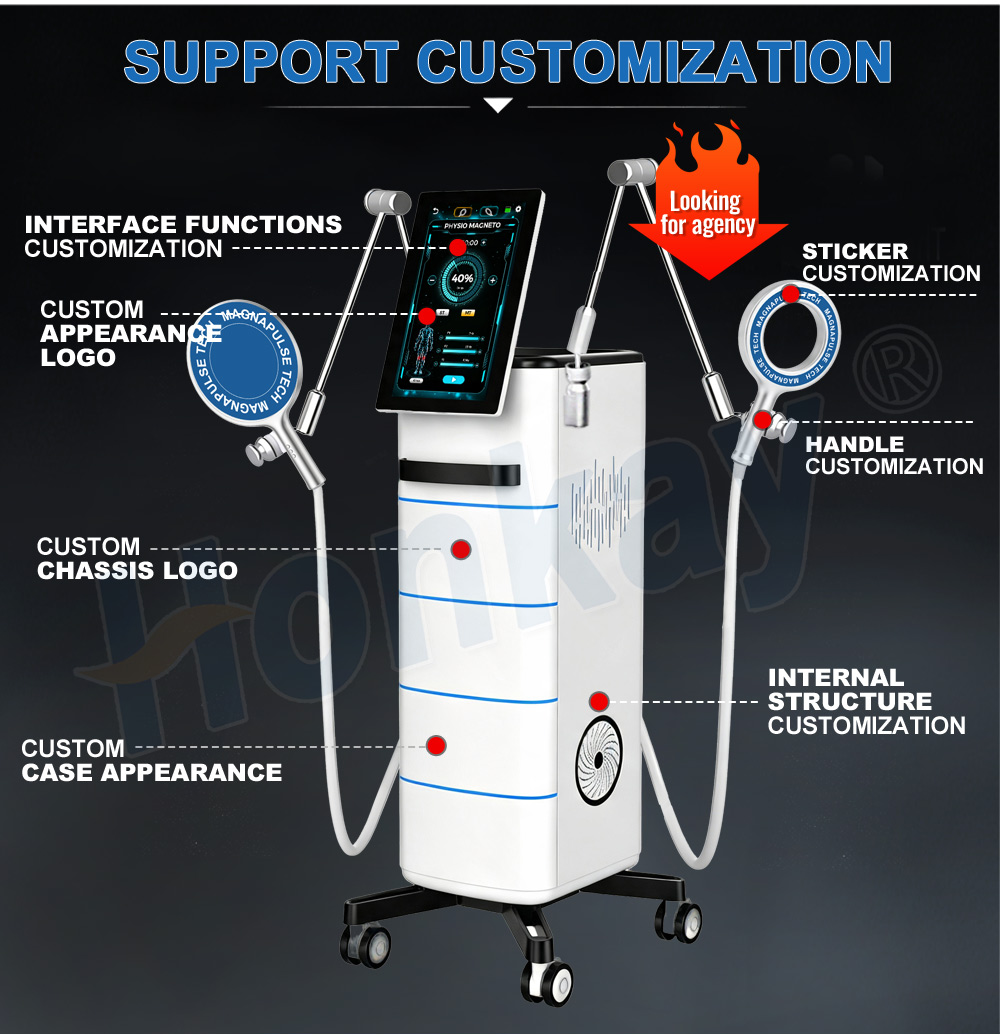
Read the ladder downwards and one habit emerges: decide your rung before you ask for a quotation, and tell the factory which rungs you intend to revisit later. Buyers who plan a colour change six months after the first order often find that the artwork has to be re-approved and the minimum re-set. Buyers who name the rungs at the start usually get a specification that can be reordered unchanged.
Not every rung is worth climbing for every brand. Customers notice the logo, the panel language and what is in the case far more than the exact shade of the housing, so a programme that spends its whole budget on a bespoke restyle and none of it on a translated manual has optimised the wrong layer. Sit with your own resellers and ask which surfaces they touch and which they have to explain to a customer, then spend the customisation budget on those rungs first.
A minimum order quantity is not a negotiating position, and it is not usually an arbitrary round number. It is the quantity at which three setup costs stop being absorbed by the factory and start being paid evenly across the units you order. Ask a supplier to break their minimum down into those three lines and the number stops looking like a gate and starts looking like a calculation you can influence.
| Cost item | Why it sets a floor under the quantity | What to confirm in writing | How it behaves as volume rises |
|---|---|---|---|
| Tooling and fixtures | A mould, a jig or a test fixture is paid for once, so it has to be amortised over the run that uses it | Which parts are tooled, who owns the tool, how it is maintained and whether it is quoted separately | The unit contribution falls the further the tool's cost is spread |
| Material purchase | A custom colour, a special housing or a non-standard component is bought in a whole batch, not by the piece | The smallest purchase lot for each bespoke item, and what happens to the unused balance | Purchasing rounds down to the batch size, so the true minimum often sits just above a round number |
| Production changeover | Stopping a line, resetting it for your configuration, loading your firmware and re-verifying takes the same time whether the run is long or short | The changeover time for your configuration, the minimum economic run the planner will accept, and whether it can be scheduled alongside a similar order | Changeover is fixed per run, so it rewards a slightly larger batch rather than a monthly trickle |
This is why a silk-screen logo and a new structural mould can sit at completely different minimums even when both are described as "customised". The logo touches none of the three lines above; the mould touches all three, because it is tooled, it consumes a material batch and it forces a verified changeover. When a supplier quotes a surprisingly low minimum for a structural change, ask which of the three lines has been quietly left out, because it usually reappears later as a sample charge, a tooling invoice or a re-approval step.
Do not write any of these three lines into a contract as a figure a competitor has quoted you. Confirm each one against your own specification, in writing, on your own quotation. A minimum that was calculated for a different configuration in a different market is not a benchmark; it is a number you would be holding your supplier to without knowing what produced it.
If the minimum looks too high for a first order, ask whether your configuration can be scheduled alongside a similar run, or whether two of your variants can share a single changeover. The tooling and material lines rarely move, but the changeover line sometimes can, and a supplier able to group your order with comparable work may accept a smaller first batch without changing the price logic behind it.
Sampling is the step that turns a specification into something you can hold, and it runs in four stages: a sample, your confirmation of it, a small batch built to that confirmed sample, and only then the full production run. Skipping any stage moves risk from the factory's bench to your warehouse, and the later in the sequence a problem is found, the more it costs to correct.
The first sample proves the specification, not the batch. Check it against every line of your requirement sheet: the housing and its finish, the panel language, the start-up screen, the accessory pack contents, the plug standard and the label wording. Then write down what you accepted, because the approved sample becomes the baseline that the small batch and the production run are measured against. Without that written acceptance you have no reference point when a later unit differs.
The small batch is not a formality. It is the first time the specification runs on the real line with the real fixtures, and it is the cheapest place to catch a configuration that works as one unit and fails as twenty. Approve it the same way you approved the sample, in writing, and keep one unit from it as your reference. Treat the sample cost as part of the order rather than as a favour, and ask in writing how the sample charge is treated if the bulk order follows.
Ask for the sequence on your quotation as dates against events rather than a single delivery promise: sample dispatch, sample approval, small-batch build, first-article sign-off, production start, pre-shipment inspection and dispatch. Those are the milestones you can actually hold a factory to, and they are the same milestones you will re-use when you reorder.
The fastest sampling cycles share one habit: the buyer arrives with the brief finished. Artwork in the right format, the wording of every label and every screen, the manual language and the accessory list, all settled before the sample is ordered. Every item left open becomes a round of proofs, and each round moves the first production date. Do the artwork yourself, in the formats the factory asks for, and the sample comes back close to right the first time.
If the sample is not right, resist the instinct to negotiate a discount and move on. Say plainly which lines failed, ask for a second sample built to the corrected brief, and repeat the same checks against the same written standard. A fault that is visible on one sample becomes a service case once it is spread across a batch, and a corrected sample is far cheaper than a corrected container.
A distributor price is a structure, not a percentage. Build it in three tiers, and keep each tier separate on your own sheet so that a change in one does not silently hide inside another. The first tier is the ex-works price the factory quotes for your configuration. The second is the landed cost, which is the ex-works price plus everything it takes to put the unit in your warehouse. The third is the recommended retail price you will ask your own resellers to hold. A margin is whatever survives between the second and the third tier; it is not the difference between the first and the third.
| Price tier | What it represents | What it includes | What it must not quietly absorb |
|---|---|---|---|
| Ex-works price | The factory's price for the unit you specified, at the factory | The platform, your customisation and the standard accessory pack | Freight, insurance, import charges, tooling billed separately, or the sample |
| Landed cost | What the unit has cost you by the time it is in your warehouse, cleared for your market | Freight, insurance, duties and taxes set by your destination, clearance fees, and the inland leg | Warehousing, rework, training time or the cost of the first spare parts |
| Recommended retail price | The shelf price you ask your own resellers to hold across the territory | The unit, the manual in the market language, the packaging and the standard launch assets | Your own overhead, the after-sales reserve or the cost of holding stock |
The tier most first-time brand owners forget is the second. Duty and tax are set by your destination country and cannot be quoted by a manufacturer, so bring your own freight forwarder into the conversation before you accept an Incoterm and let them price the landed figure with you. A supplier can prepare the commercial invoice, the packing list and the shipping documents and make sure they match what was packed; it cannot decide your import treatment, and any figure it offers for duty should be treated as an estimate and confirmed with your forwarder.
Then sit down with the indirect costs, because these are what turn a healthy-looking margin into a thin one after the first year. They are real costs even when no invoice arrives on the day you pay the factory.
| Indirect cost | Why it belongs in your model | Where it hides if you ignore it |
|---|---|---|
| Market-access documents | Your market sets what a device needs before it can be sold there, and the paperwork has a cost whether it is paid once or renewed | It appears late as a full stop on sales rather than as a line you planned for |
| Launch and marketing materials | Photography, video, translated literature and demo stock are what let a reseller sell the unit at all | It is absorbed into the first reseller's discount as an ad-hoc allowance |
| Spare parts | A distributor who cannot supply a replacement applicator cannot keep a customer in year two | It becomes a rush air shipment at your own expense the first time a unit is down |
| After-sales time | Every warranty case consumes technician hours, and those hours are a cost even when no part is replaced | It is paid in the working time of whoever in your team answers the case |
One deliberate omission in this section: no figure. A distributor margin is a conclusion you reach from your own landed cost, your own market's shelf price and your own cost of support, and any number published here would be someone else's conclusion applied to your business. Build the three tiers on your own sheet, put the indirect costs in the second tier where they belong, and the margin will appear on its own.
Treat the three tiers as a living sheet rather than a one-off calculation. Freight rates move, currencies move, and your destination's treatment of the goods is set by your own authorities and can change. Recheck the landed tier before every reorder, and keep the ex-works tier and the shelf tier visibly separate, so that a change in freight is not quietly absorbed into the headline margin until a year later, when the number no longer works at all.
Currency is the quietest cost of the three. If you buy in one currency and sell in another, the exchange rate is a live figure that sits between your landed tier and your shelf tier, and it can consume a margin that looked comfortable on the day you placed the order. Decide who carries that risk before you sign, and if you cannot hedge it, build a buffer into the landed tier rather than discovering the problem at the end of the season.
If your question is not the commercial structure but the mechanics of paying for and receiving the goods, that side is covered separately: our guide to verifying and importing physiotherapy equipment from China walks through factory verification, sample testing, EXW, FOB and CIF terms, payment triggers, pre-shipment inspection and clearance. This page stops at the commercial model; that page takes over at the moment money leaves your account.
Packaging is part of the product in this trade, not an afterthought, and it is one of the few customisation layers that costs little to change at the artwork stage and a great deal to change after the cartons are printed. Settle four things before the first production run: the instruction manual, the nameplate on the unit, the shipping marks on the carton, and the marketing assets you will hand to your resellers.
The manual is the item buyers most often under-specify. Ask for it in the language, or the set of languages, that your market actually reads, and treat a translated manual as a compliance requirement in the markets that expect it rather than as a nice extra. Confirm the panel wording at the same time so that the printed labels and the manual describe the same controls in the same words. If your territory carries more than one language, decide whether that means one printed manual per language inside every carton or a single multi-language booklet, and confirm which the factory will produce.
The nameplate and the carton marks carry your identity into the market and into the warehouse. Give the factory the exact wording, spelling and placement of the nameplate, and give it the shipping marks your freight forwarder needs so that the cartons can be matched to your order at the port. Approve both as proofs before production, alongside the panel and the manual, and keep the approved proofs with your order file.
Finally, ask early and in writing what the factory can supply for launch: product photography, short demonstration video, a logo file in the right formats and translated literature. Confirm what is included with the order, what is chargeable, and what licence you have to use it and to edit it. Getting the asset pack agreed at the same time as the order is far cheaper than commissioning photography after the units have arrived.
Packaging has a second job beyond the first sale: it has to survive the same journey every time you reorder. Approve not only the artwork but the internal protection and the case insert, and ask for them to stay identical between runs, because a carton that changes shape between orders is a shipping claim waiting to happen. If your destination expects particular marks or wording, settle them at the artwork stage and keep the approved proof in the order file.
Keep one approved master set. The panel proof, the manual and the carton marks should be signed off as a single package and stored together, because a reorder placed two years later is only as reliable as the proofs the factory still holds. Ask where they are kept, and whether they travel with your customer record so that a different account manager can find them.
The commercial model you choose on the first order becomes a relationship only when the repeat orders start, so it is worth writing down the terms that keep it working. Five clauses do most of the work: the territory you are selling into, whether exclusivity is on the table, the spare-parts commitment, how you will be told about product changes, and where the warranty sits.
On territory, agree in writing which markets are yours and which are not, so that neither side is surprised when the factory's other customers ask about your region. On exclusivity, treat it as a case-by-case commercial discussion rather than an entitlement: volume, demonstrated performance, a defined territory and a defined term are usually what turn a general agreement into an exclusive one, and the right answer for one distributor is not the right answer for another. A manufacturer that promises exclusivity to everyone has, in practice, promised it to no one.
On spares, agree which parts you may stock, at what lead time, and for how long after the model changes. On version changes, ask to be told before a running change reaches your stock, so that your documentation, your manual and your resellers' expectations stay aligned with what is actually shipping. On warranty, settle the start point and the reference early: our own warranty is stated as a 24-month warranty counted from the date of shipment from the factory, with the serial number as the reference, and that wording should appear in your agreement rather than in a chat message.
Write the agreement so that it can be reviewed rather than only signed. A defined territory, a defined term and a defined volume make the relationship reviewable at a fixed date, and a review clause is what turns a general distribution arrangement into a case for exclusivity on the strength of your actual sales. Keep the warranty wording, the spares list and the change-notification route in the same document, so that a question in year two can be answered by opening the agreement rather than by searching an inbox.
The three mistakes below account for most of the expensive first private-label programmes we are asked about. None of them is exotic, and each one is prevented by a document that costs little more than the time to write it.
| The mistake | What it usually costs you | Better practice |
|---|---|---|
| Paying for the tooling before the drawings are frozen | A mould cut to a shape that changes afterwards, and a tooling invoice you cannot recover | Approve the drawings and the industrial-design files in writing first, then release the tooling payment against that approved set |
| Leaving the acceptance standard undefined | A batch that meets the factory's idea of acceptable and not yours, argued over unit by unit | Write down what a pass looks like for the sample and the first article, and attach photographs so the standard travels with the order |
| Ignoring the multi-language manual until launch | Units that cannot be sold or handed over in your market because the paperwork is in the wrong language | Fix the manual language at the specification stage and confirm it again at the sample and first-article checks |
| Assuming a logo file turns a white-label order into OEM | An OEM premium paid for a unit whose housing, interface and accessory pack are unchanged | Match the price to the rung you actually bought on the customisation ladder, and say so on the specification |
Line the last three sections up and the logic of the whole programme is visible: the rung you choose on the customisation ladder decides the minimum the factory can run, the minimum and your specification decide the ex-works price, and the ex-works price plus the landed costs decide what margin you can hold at the shelf. Change any one of the three and the others move, which is why it pays to settle them in that order rather than negotiating a price before the specification exists.
Go OEM when your market needs the machine to look and behave like your product rather than like a catalogue item, and when you can fund the artwork, the proofing and a larger minimum to get there. Stay on white-label when speed and a low first quantity matter more than a distinct appearance, or when you have not yet proved that your market will buy the platform at all. A common path is one white-label order to test the demand, then an OEM order once you know which customisation your customers actually notice.
Three things: whether the change needs tooling, whether it requires a bespoke material to be bought in a whole batch, and how much line changeover your configuration adds. A printed logo touches none of them and sits at the lowest minimum; a new mould touches all three and sits at the highest. Ask the factory to break its minimum down into those three lines, and confirm each one in writing for your specification rather than assuming another buyer's number applies to you.
Yes, and it is the lowest rung of the customisation ladder. A silk-screened or pad-printed logo on the existing housing needs artwork and an operator instruction, not a new tool. If the start-up screen, the panel wording or the accessory pack are also on your list, they sit a step or two higher but still well below structural tooling. Only a change to the physical shape requires a mould, a trial and a first-article approval, which is why it is treated as an engineering project rather than a branding change.
It follows the rung you are on and how complete your brief is. A white-label or light-OEM sample is a build from an existing platform and moves relatively quickly once your artwork and wording are settled. OEM changes that touch the panel, the interface or the accessory pack add a proofing cycle, and a structural tooling change adds a mould trial and a first-article sign-off on top. The practical answer is to ask for the sequence as dates against events, from sample dispatch to first-article approval, and to treat delays in your own artwork and translations as the part of the timeline you control.
Build it in three tiers on your own sheet: the ex-works price for your configuration, the landed cost once freight, insurance, duties, clearance and the inland leg are added, and the recommended retail price you will ask your resellers to hold. Your margin is what survives between the landed cost and the shelf price, after the indirect costs — market-access documents, launch materials, spares and after-sales time — have been placed in the landed tier where they belong. No single percentage fits every product or market, which is why the structure matters more than a headline number.
Exclusivity is negotiated case by case, and it depends on the territory you want, the volume you can commit to and your record in the market; it is not granted by default with a first order. The usual starting point is a written territory agreement without exclusivity, then a review once you can show performance. Put any exclusive arrangement in writing with a defined territory and a defined term, and be wary of anyone who promises exclusivity to every distributor who asks.
Often yes, and it is worth asking for the asset pack at the same time as the quotation: product photography, short demonstration video and logo files in the formats your designer needs. Confirm in writing what is included with your order, what is chargeable, and what licence you have to use and edit the material, because the answer varies from factory to factory and from order to order. Agreeing it before production is far cheaper than commissioning fresh photography after the units arrive.
If you are planning a private-label or OEM programme and want the commercial model worked out against your own specification, send us your target market and the customisation rung you are aiming for, and we will come back with the configuration we propose, the customisation layers and their thresholds, the sampling sequence, the packaging and manual plan, a 24-month warranty statement counted from the date of shipment from the factory, and a quotation structure you can build your three tiers on.




 English
 中文