Short answer: you cannot judge a Chinese physiotherapy equipment manufacturer by its catalogue, its website or its price list. You judge it by how it answers eight specific questions — parameter sheets, model-numbered certificates, consumable pricing, warranty terms with a start date, protocol documentation, safety documentation, OEM scope in writing, and sample-unit performance. Suppliers that answer all eight are manufacturers. Suppliers that answer around them are resellers, and you will discover the difference after the container arrives.
| # | Ask for this | Why it decides the deal | What a weak answer sounds like |
|---|---|---|---|
| 1 | Full parameter sheet for the exact model | It is the only way to compare two quotations | "The specification is on our website" |
| 2 | Certificates bearing the matching model number | Certificates do not transfer between models | "All our products are CE certified" |
| 3 | Consumable intervals, unit prices, lead time | Determines the machine's lifetime cost and your customer's recurring spend | "Consumables are not usually needed" |
| 4 | Warranty term, plus the date it starts from | The start date decides when your cover actually begins | "Two years warranty" with no start date |
| 5 | Treatment protocol table by body area | You cannot train distributors or end users without it | "It is easy to use" |
| 6 | Full contraindication and safety section | Your buyer's compliance review reads this first | A paragraph about "no side effects" |
| 7 | OEM/ODM scope itemised in writing | Separates real customisation from a logo sticker | "OEM is supported" |
| 8 | A sample unit you can test across its full range | Reveals build quality you cannot see in photos | "No samples, only bulk orders" |
Ask for power rating, output range, frequency steps, applicator or head specification, fuse rating, ingress protection, packaging dimensions, gross weight and voltage options. A real manufacturer produces this in minutes because the data already exists for the manual.
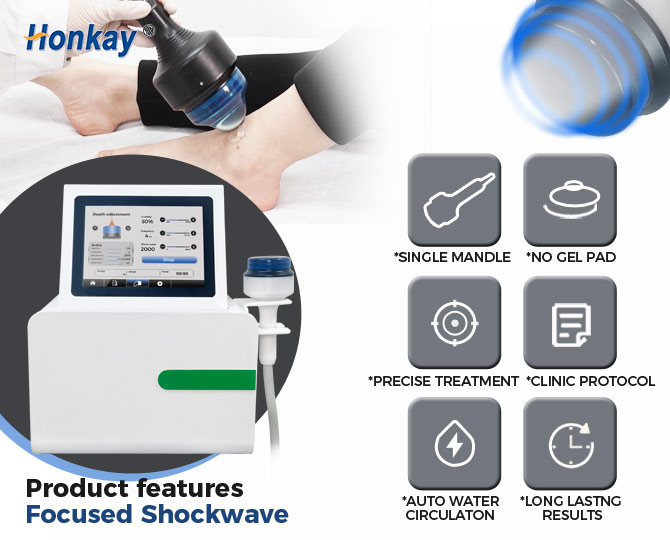
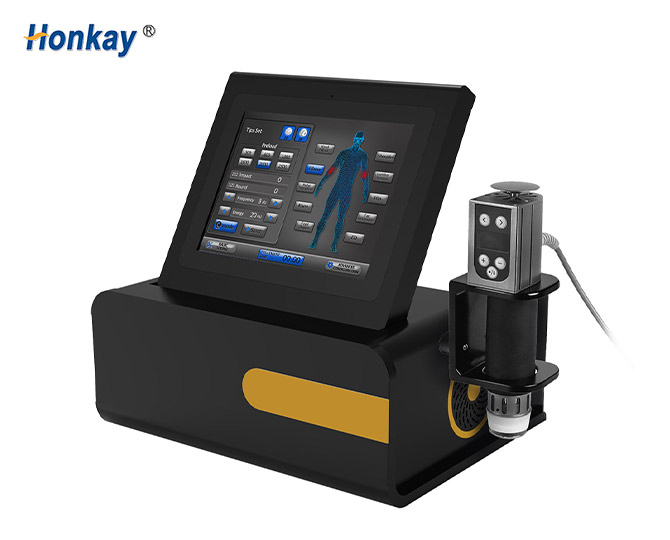
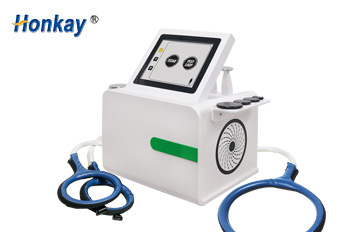
Two rows are worth more than the rest. First, frequency and energy range: on our box-type electromagnetic shockwave platform the range is 1–22 Hz and 30–185 mJ, which is what allows one unit to serve low-intensity relaxation work and higher-intensity orthopaedic-style protocols. Second, the number of distinct applicator geometries: seven heads of the same shape are worth less than five heads covering focused, diffuse, flat, spine-specific and fine trigger-point contact.
This is the single most common compliance failure in this trade. A supplier shows a certificate, the certificate is genuine, and it covers a different model than the one in your container. Ask for the document with the model number visible and confirm it matches the unit on your quotation.
For markets with their own device regulation, also confirm who is the legal manufacturer on the paperwork and whether they will support your registration — not just the shipment.
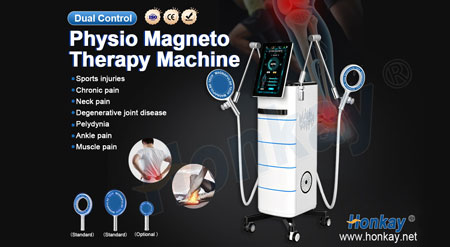
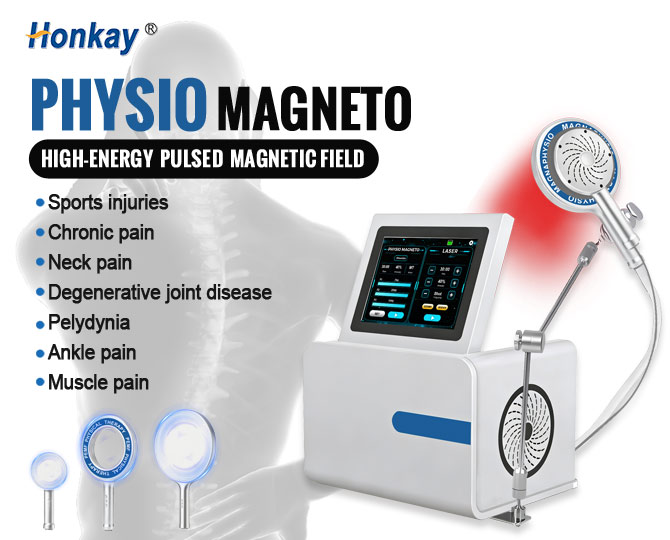
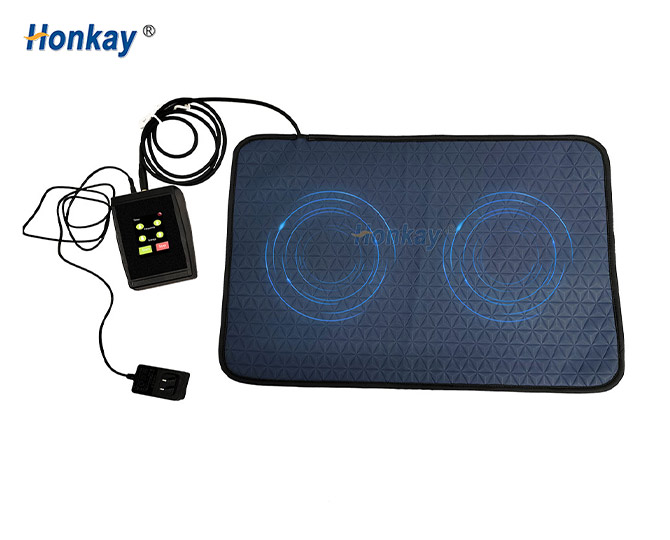
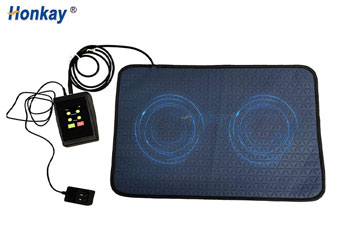
Two modality-specific examples of this checklist in practice: sourcing a PEMF machine for OEM/ODM programmes, and sourcing an electromagnetic shockwave machine.
Physiotherapy equipment is not consumable-free. On our shockwave platform the head and the bullet are consumables, with bullets replaced at approximately 1,000,000 impacts and the air pipe at approximately 5,000,000, and an operational stop of 5 minutes after every 20,000 impacts. On our PEMF loop platform, the loop applicators are the parts that wear or get damaged.
Ask three questions: what is the replacement interval, what does each part cost, and how long does delivery take. A supplier who cannot answer all three has not thought about your second year of ownership — and neither will your customer.
Do not accept a warranty figure on its own. On our E-20A platform, for example, the warranty is 24 months calculated from the factory shipment date, with claims supported by the device serial number and video evidence.
Be precise about three things: the warranty term, whether the clock starts at factory shipment or at delivery, and what evidence a claim requires. A supplier that is vague on any of the three is either simplifying because it is convenient, or has not read its own policy.
| Warranty question | Why it matters to you |
|---|---|
| Warranty term | Defines your exposure on the highest-value component |
| Start date | Factory shipment vs delivery can consume months of your cover |
| Claim evidence required | Serial number and video evidence are common; unrecorded serials cause rejections |
Ask for a starting protocol by body area — energy level, frequency, treatment time, number of sessions and interval. A manufacturer that publishes this is producing clinical-grade documentation. A manufacturer that supplies only a brochure is not.
As a concrete benchmark, our PEMF loop manual specifies per-area protocols such as elbow at energy 3 and 2 Hz for 15 minutes over 6–8 sessions, lumbar vertebra at energy 5 and 8 Hz for 20 minutes, and foot or ankle at energy 2 and 4 Hz — all at twice-weekly intervals. Our shockwave manual specifies lumbar spine region at 9 Hz / 130 mJ and shoulder at 8 Hz / 100 mJ, at 2500 shocks and 5–10 sessions with 5–7 day intervals. If a supplier cannot show you a table of this shape, you will be writing the training material yourself.
Contraindications, site restrictions and procedural rules must be in the manual that ships with the unit. Two examples of the required level of detail:
PEMF: do not apply over vascular disease or infection in the treatment area, near malignant or benign tumours, directly on cartilage surfaces or the small facet joints of the spine, or over implanted electronic devices such as pacemakers and analgesic pumps. Metal objects near the treatment site can heat or vibrate, and the field will damage ID cards, keys and wireless devices placed near the ring.
Shockwave: absolute contraindications include coagulation disorders and anticoagulant therapy, malignant tumours, thrombosis, acute suppurative infection, open wounds, implanted electronic devices, pregnancy, children with unfused epiphyses, and uncontrolled severe cardiovascular or cerebrovascular disease. Shock application is prohibited over the brain, upper cervical spine, eyeball, pharynx, trachea, major blood vessels, cardiac region, lungs, spinal canal and reproductive organs.
Any supplier that markets a physiotherapy device with no contraindication section has told you something important about how the rest of the documentation was produced.
"OEM supported" on a website can mean anything. Ask for the list. In this product class, real customisation covers: housing and case colour, print and badge position; control panel language and start-up screen; applicator or head set composition; packaging artwork and insert cards; manual language; and plug standard (EU / US / UK / AU). For software-driven units, also confirm whether default protocols and intensity settings can be adjusted per market.
Equally important is the negative list: which components are shared across all customers and therefore give you no differentiation. A candid supplier will tell you. A supplier that claims everything is customised has a tooling bill waiting for you.
Photographs cannot show you build quality. When the sample arrives, run it through its full range: verify the output adjusts smoothly from minimum to maximum, check the timer and display accuracy, confirm applicator or head connectors lock mechanically, listen for abnormal noise, and confirm the cooling system runs. Then open the manual and check that the parameters printed there match the unit in front of you. Discrepancies at this stage are cheap to fix. Discrepancies after a container shipment are not.
Most buyers begin with one product and end up with a treatment room. Sourcing PEMF, shockwave, TECAR, EMS and pressotherapy lines from one manufacturer rather than four reduces supplier administration, consolidates shipping and documentation, and lets you present a complete protocol package to your own customers instead of a single machine.
Guangzhou Huang-Kai Technology (Honkay) designs and manufactures across these physiotherapy modalities for OEM and ODM programmes, from portable and desktop platforms to trolley and standing configurations, and supports buyers who want to verify the units before committing to volume. If you are evaluating more than one prospective supplier, use the eight-point checklist above on each of them — the comparison will be more revealing than any price list.
Ask for the parameter sheet, the model-numbered certificate, the consumable schedule and the OEM itemisation. A manufacturer answers from existing technical documents; a trading company has to go and ask someone else each time, and the answers become vaguer with each round.
The full parameter sheet for the exact model, certificates bearing the matching model number, a written warranty statement giving the term and its start date, the consumable schedule with unit prices and lead times, the treatment protocol table, and the itemised OEM/ODM scope.
On our E-20A shockwave platform the warranty is 24 months, calculated from the factory shipment date, with claims supported by serial number and video evidence. The figure matters less than getting the term and the start date in writing.
Yes, whenever the order size justifies it. A sample lets you test the full output range, verify the display and timer, check connector build quality and confirm that the shipped unit matches its printed specification.
Housing and case colour and print, control panel language and start-up screen, applicator or head set composition, packaging artwork and insert cards, manual language, plug standard, and — on software-driven units — default protocols and intensity settings.
Most do. Our shockwave platform specifies bullets replaceable at around 1,000,000 impacts and the air pipe at around 5,000,000; our PEMF loops wear and are damaged over time. Budget for these before you set your retail price.
Several platforms are used for human physiotherapy and, in a suitable configuration, for animals such as horses and dogs. If you serve both markets, confirm the applicator set and presets for each use before ordering.
Send us your target market, the modalities you want to carry and your expected monthly volume, and we will answer all eight points for the specific models we are proposing — parameter sheet, certificates, consumable pricing, warranty terms, protocol table, safety documentation, OEM scope and sample arrangement.


 English
 中文
中文