Buying a PEMF unit is a purchase. Turning it into a service that pays for itself is a different job, and it is a job that most clinic and studio owners are left to work out on their own after the crate has been unpacked. The machine arrives with a manual about how to operate it, not about how to price it, how many sessions a day it can carry, or what one session actually costs to deliver. That gap is where a good piece of equipment ends up standing in a corner, and it is the gap this page is written to close.
The page is written for the operator who has already bought a unit, or is close to buying one, and now has to answer three questions in order: what does a session cost me, what do I charge for it, and how many of them can I realistically deliver in a week. Everything here is a business framework rather than a clinical one. Where a figure is needed, the text gives the calculation and the variables and leaves the numbers to your own market, because a session price in one city tells you almost nothing about the right price in another.
A clinic that adds a magnetic-field platform usually tries to price it the way it prices everything else: a single number per treatment, set by feel or by what a competitor down the road is charging. That works for a hands-on treatment where the operator's time is the product. It works much less well for a service where the machine does the work while the operator supervises, because the cost structure and the capacity limit are both different. The operator's minutes are no longer the bottleneck; the number of sessions the unit can carry in a day is.
There are only three levers in a service business of this kind. The price of one session, the number of sessions the unit delivers in a week, and the number of sessions each client comes back for. A price list is only useful if it moves at least one of those levers deliberately. A price that is set high without a plan for repeat visits throttles the third lever. A price that is set low to fill the diary throttles the first, and often fails to move the second, because the clients who respond to a low price are rarely the ones who return every week.
One deliberate omission on this page: it prints no market prices. Session prices vary by city, by room, by who is delivering the session and by how the service is positioned, and a figure copied from another market is worse than no figure at all. Every structure below is designed so that you can drop your own numbers into it on the day you build the price list.
Start with the session itself, because the price you can defend is built out of what the client receives. A magnetic-field session that is sold as twenty minutes on a couch is a commodity, and it will be priced like one. The same twenty minutes with a short intake, a considered applicator position, a record of what was done and a two-line plan for the next visit is a service, and it can be priced as one. The difference in cost to you is a few minutes of attention; the difference in what the client perceives is the whole margin.
The practical consequence is that the slot in your diary has to be longer than the time the applicator is switched on. Changeover, positioning, notes and the conversation at the desk all consume the same room and the same operator, and a price list that ignores them is really a price list for machine time rather than for a service.

The frames above show why the slot and the machine time are not the same thing. In each session the operator stands at the couch, positions the applicator by hand, and a second person is not required. That is the shape of the service: one operator, one client, one room, and a session that cannot be shortened much without the positioning and the handover being cut first. Price the parts you can see in that picture, not just the part with the power on.
| Stage of the session | What it takes from the operator | What the client is paying for | What goes wrong if it is skipped |
|---|---|---|---|
| Short intake | Two or three minutes of questions and a look at how the client moves | Being treated as a person rather than a booking slot | The session becomes generic and stops being sellable by name |
| Positioning and set-up | Choosing the applicator, seating it, checking the client is comfortable | Accuracy, and a session that is not interrupted halfway | Re-positioning mid-session eats the time budget and the margin |
| The dwell | Supervision and a check that the position has held | The part of the visit the service is named after | Left unattended, it is not a supervised session at all |
| Handover and record | Two lines of notes, a booked next visit, a short explanation | Continuity, which is what brings the second visit | The client leaves with no reason to come back on a schedule |
| Room reset | Wiping down, replacing covers, coiling the lead | Nothing directly, but it sets the next slot length | Slots run late all day and the last client of the evening is rushed |
Almost every clinic price list for this kind of service settles on one of three structures, or a deliberate mix of them: by the minute, by the area treated, or by the package. None of them is inherently better. What matters is that the structure you choose matches the way the session is actually set up in your room, because the structure that fights the room will be abandoned within a month.
Pricing by the minute is the easiest to explain and the easiest to compare against a competitor, which is exactly its weakness: it invites comparison and it caps what one hour can earn. Pricing by the area treated matches a session where the applicator is moved between sites, and it gives the client a reason to buy a longer visit without being told they are buying time. Package pricing is the only structure that reliably protects the diary, because the client has already paid for the visits they have not yet booked.
| Structure | How it reads to the client | What it does to the diary | Where it strains | Where it fits |
|---|---|---|---|---|
| Per minute | Simple, honest, easy to compare | Caps the value of a full hour and rewards short visits | Clients watch the clock and ask for the shortest version | A room that runs one format and wants a walk-in offer |
| Per area treated | A base price plus a clear add-on for a second or third site | Lengthens the average visit without discounting the base price | Needs a written definition of what counts as one area | A room where clients arrive with more than one site to cover |
| Per package | A lower unit price in exchange for a commitment | Pre-books visits and stabilises the week | Unused visits become a refund argument without rules | Any room with a repeat client base or a membership model |
| Base slot plus add-ons | One price for the standard visit, small extras priced separately | Keeps the entry price comparable while protecting the average | Too many add-ons and the reception desk becomes the bottleneck | A mixed menu where the platform sits beside other services |
Whatever structure you pick, write it down in one page and keep it at the desk. The single most common source of lost margin in a small clinic is not the price itself; it is three members of staff quoting three different prices for the same visit because nobody wrote the rule down.
A package is not a discount. It is a booking instrument that trades a lower unit price for a predictable slot in the week. If it is built to do anything else, it usually ends up reducing revenue on clients who would have paid the full price anyway. The ladder below is the shape that works in most small rooms, because each rung answers a different question the client is asking at that point.

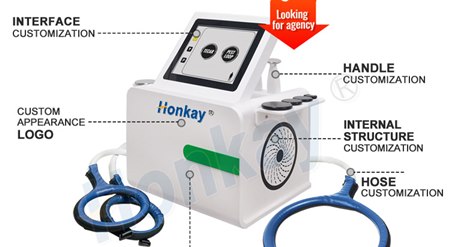
The console above is worth looking at while you design a package, because a package is a promise about a standard. If one unit in the room has a different applicator set, a different interface layout or a different set of stored programmes from the next, the promise becomes hard to keep when two operators share the room. Standardising what the client experiences, rung by rung, is part of what makes a package sellable; the callouts on the unit are the points at which that standard is fixed.
| Rung | What the client buys | Why it exists commercially | The trap to avoid |
|---|---|---|---|
| Trial visit | One session at the standard price, with the intake included | Converts curiosity into a real booking without devaluing the service | Discounting the trial with no conversion path attached to it |
| Block of visits | A fixed number of sessions paid up front at a lower unit price | Pre-books the diary and reduces the cost of acquiring each visit | No expiry rule, no transfer rule, no refund rule in writing |
| Membership | A recurring monthly payment for a set number of visits | Turns one-off clients into a predictable monthly figure | Selling unlimited access before capacity per week is known |
| Add-on to another service | A short magnetic-field session attached to a treatment already booked | Fills the spare minutes around an existing appointment | Attaching it to a service that is already at capacity, which just adds queue |
| Course with review | A block plus a scheduled review at a fixed point in the block | Creates a natural decision point to extend, change or stop | Skipping the review, which turns the course into a silent expiry |
Four rules belong on the back of the price sheet before the first package is sold: how long a block stays valid, whether it can be transferred to another person, what happens when a client cancels inside the notice window, and whether the price of the package is protected if the single-session price changes mid-block. Deciding those four in advance is unglamorous and takes twenty minutes; deciding them one complaint at a time takes a year and costs goodwill.
Capacity is the number that decides whether the service works, and it is almost always estimated by dividing the working day by the session length, which is optimistic. A unit does not deliver sessions for every minute the room is open. It delivers them in the hours when a client can be in the room, with an operator free to supervise, and with a changeover that has already been costed. Utilization is the ratio between the sessions the unit actually delivers and the sessions it could deliver if every eligible slot were filled, and in a realistic first year it is well below the theoretical maximum.
The formula is worth writing into the business case in its own right: sessions per week = bookable hours per week ÷ slot length × utilization. Every term in it is a management decision rather than a fixed property of the equipment. Slot length includes changeover. Bookable hours are the hours when a client will actually come, not the hours the door is unlocked. Utilization is the term owners leave out and then wonder why the numbers on paper never appear in the bank account.

A platform that carries two session formats, as the unit above does, changes the capacity arithmetic in a way that a single-format machine cannot. It lets one unit serve a hands-on session and a hands-off session from the same booking sheet, so the quiet middle of the day can be filled with a format that suits the clients who are free then. That is a scheduling advantage rather than a clinical one, and it is the reason a room that already runs one format often gets more out of a second format than out of a second identical unit.
| Variable in the capacity model | What it means in practice | What usually limits it | How to measure it | What moves it up |
|---|---|---|---|---|
| Bookable hours | The hours a client will genuinely book, not opening hours | Local demand patterns and the operator's other duties | Count bookings per hour band across four normal weeks | Opening a second band, such as early morning or early evening |
| Slot length | Session plus positioning plus changeover plus notes | Room reset and the handover conversation at the desk | Time ten sessions end to end with a stopwatch for a week | Standardising the set-up so changeover becomes repeatable |
| Operator attention | How many clients one person can properly supervise at once | Whether the format needs hands-on input throughout | Ask the operator which format they can run while another client rests | Pairing a hands-off format with a hands-on one in the same hour |
| Room availability | Whether a couch and a socket are free at the same time | Shared use of the room by other services | Mark the room's day on paper and count the free blocks | A fixed weekly block reserved for the platform |
| Utilization | The share of bookable slots that are actually sold | Demand, not equipment; it is a marketing number | Sold slots divided by bookable slots, reviewed monthly | Recall lists, standing appointments and off-peak offers |
| No-show rate | Slots that are lost after being sold | Weak confirmation and no consequence for missing a slot | Track it for a month before deciding it is not a problem | A reminder message and a written cancellation window |
Filling the gaps is a separate job from selling the service, and it belongs to whoever owns the diary. The useful habit is to look at the week in bands rather than in days, and to have one specific mechanism ready for each band instead of a general hope that it fills.
| Band with empty slots | Who can realistically fill it | The mechanism to use | What not to do |
|---|---|---|---|
| Mid-morning | Clients who do not work office hours, and older clients | A standing weekly slot offered at the first visit | Discounting the whole day to fill two hours |
| Early afternoon | The quietest band in most rooms | A hands-off format that needs less operator presence | Leaving the room staffed but idle |
| After work | The band that is usually full already | Protect it for the highest-value format and keep a short-notice list for gaps | Selling cheap packages into the band that did not need help |
| Cancellations | Clients who asked to be called if something opened | A written short-notice list, contacted in order | Absorbing the loss and calling it part of the business |
The cost of a session has four lines, and only one of them is usually counted properly. Equipment depreciation is the line owners forget because it never appears as a payment, consumables are the line they underestimate because the amounts are small, labour is the line they count at the wrong length, and the room is the line they treat as free because the rent is paid whether the unit runs or not.

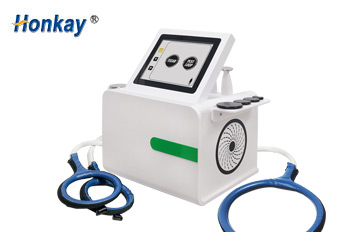
The picture above is the capital line made concrete: the console and the case it arrives in are one purchase, and both have to be paid for out of session revenue. Freight, import charges, installation and the first set of accessories belong in the same figure as the unit itself, because all of them are cash that has left the business before the first client is treated. Spreading only the invoice price across the years understates the true cost per session.
| Cost line | How to calculate it | What is usually left out | How to control it |
|---|---|---|---|
| Equipment depreciation | Landed cost divided by the sessions the unit is expected to deliver over its service life | Freight, duties, installation, and the accessories bought with the unit | Raise the session count over the same life, or extend the life with servicing |
| Consumables | Cost of the items used per visit, tracked per session rather than per month | Wipes, covers, coupling media, straps, and the leads that wear at the connector | Standardise on one accessory system and reorder in sensible quantities |
| Labour | Operator cost per hour multiplied by the full slot, not the dwell alone | Positioning, notes, room reset and the conversation at the desk | Shorter changeover and a second client resting during the same hour |
| Room and utilities | Monthly rent and running costs divided by the hours the room is used for this service | Cleaning, laundry, reception time and card-processing fees | Allocate the room by hours actually booked, not by floor area |
| Service and spares reserve | A fixed amount set aside per session for repairs and replacement parts | The year when an applicator or a lead finally has to be replaced | Keep one spare of the part you use daily and record when each part was replaced |
Add the four lines together and you have the variable cost of a session; add the service reserve and you have a number you can compare against your price. If the resulting margin looks thin, the answer is rarely a small price increase on its own. It is usually a change in slot length, in the number of sessions a day, or in what the session includes that lets the price stand.
Once cost per session and price per session exist, payback is arithmetic. Two formulas cover it, and they are worth keeping on one page with your own numbers written in pencil.
Contribution per session = price per session − variable cost per session.
Payback period in months = cash outlay ÷ (sessions per month × contribution per session − fixed monthly costs added by the service).
Work the second formula with placeholder numbers of your own and the sensitivity becomes obvious very quickly. If the outlay is fixed, the only ways to shorten payback are more sessions a month, a higher contribution per session, or lower fixed costs. Of those three, the session count is the one that moves furthest and the one most owners underestimate, because doubling sessions does not require doubling operators when part of the day uses a hands-off format.
| Variable | Effect on payback | Can you control it directly? | The early warning sign |
|---|---|---|---|
| Sessions per month | The largest single lever; a small rise moves payback months | Yes, through the diary, the recall list and the slot length | The same two hours are empty every week |
| Price per session | Direct, but capped by what the local market will carry | Partly, and more easily through what is included than through the number | Front desk staff quoting a lower number to close a booking |
| Variable cost per session | Moderate; consumables are small, labour and room time are not | Yes, mostly through changeover and accessory standardisation | Sessions running over their slot by ten minutes a day |
| Cash outlay | Fixed at the point of purchase, so it is the wrong place to optimise later | Only before ordering, through configuration and accessory scope | Paying for accessories in the first order that sit unused for a year |
| Fixed monthly additions | Small individually, material together | Yes, by not adding cost until the sessions exist | New software, extra reception hours and a bigger room all booked in month one |
Run the formula three times rather than once: a pessimistic case with low utilization, the case you expect, and a case where the diary fills faster than you planned. If the pessimistic case still pays back inside the period you are willing to wait, the service is worth launching. If it only works in the optimistic case, the answer is usually to launch smaller and add the second format later.
The mistakes below are not pricing errors in the arithmetic sense. Each one is a decision that looks reasonable on the day it is made and costs margin for a year afterwards. Most of them are visible in the diary before they are visible in the accounts.
| Mistake | What it looks like in the room | What it costs | The fix |
|---|---|---|---|
| Pricing the dwell, not the slot | Sessions run late all afternoon | One lost slot a day, every day | Set the slot from timed sessions, then price the slot |
| Discounting the first visit with no path forward | A stream of trials and very few second visits | The whole margin of every new client | Full price for the trial, with the next visit booked before the client leaves |
| Unlimited memberships before capacity is known | Members competing for the same four slots | Refunds, complaints and a diary that cannot absorb demand | Sell capped visit counts until utilization is stable |
| Bundling into a service already at capacity | The add-on has nowhere to go in the day | Longer waits for existing clients and a slower main service | Attach the add-on only to the service with spare room in the diary |
| No written no-show or cancellation rule | Empty slots that were sold an hour earlier | The full contribution of every missed slot | One sentence in writing at the point of booking |
| Quoting per session to a client who thinks in courses | The client hears a number with no horizon attached | A price that sounds high because the plan is missing | Quote the visit and the block together, in that order |
| Advertising only the busy band | A full evening and an empty middle of the day | Half the capacity of the unit | Market the quieter band with a format that suits it |
Before the first session is sold, work through the list below and write the answers down. Each line is a decision that will otherwise be made for you, at the desk, under pressure, by whoever happens to be on shift.
| Item to settle | The answer that should exist in writing |
|---|---|
| Slot length | The full time the room is held, measured end to end rather than estimated from the dwell |
| Price structure | Which of the three structures is used, and how add-ons are defined if there are any |
| What is included | Intake, number of applicator sites, notes and the review, itemised on one page |
| Cost per session | All four lines calculated, with the service reserve included |
| Capacity per week | Bookable hours, slot length and a utilization figure you are willing to defend |
| Package rules | Validity, transferability, cancellation window and price protection |
| Who may quote | One named person, one sheet, no verbal variations |
| Consumable stock | One standard accessory system, a spare set held in the room, a reorder point |
| Spare parts position | The part number and lead time for the accessory used every day |
| Review date | A fixed date ninety days out to compare sold slots against bookable slots |
There is no defensible number to copy from another market. Set it from the bottom up: calculate the cost of one session across depreciation, consumables, labour and room time, add the margin your business needs, and then test the result against what local clients pay for comparable appointments. This page deliberately prints no market prices, because a figure taken from a different city usually pushes a new service either below its cost or above what the local market will bear.
Price by the area when the session involves positioning the applicator on more than one site, because that structure matches how the visit is actually delivered and gives the client a reason to book a longer appointment. Price by time when the room runs one fixed format and you want a simple walk-in offer. Many rooms use a base slot price with a small area add-on, which keeps the entry price comparable while protecting the average value of a visit.
Work it out from bookable hours divided by slot length, then apply a utilization figure below the theoretical maximum. The theoretical number assumes every eligible slot is sold, which almost never happens in a new service. The practical number also depends on how many clients one operator can properly supervise at once, which is the real limit in most rooms rather than the equipment.
Match the band to a format and a client group rather than discounting the whole day. A hands-off session that needs less continuous attention suits a quiet early afternoon, and a standing weekly slot offered at the first visit suits clients who do not work office hours. Keep a written short-notice list for cancellations, and protect the band that is already full instead of selling cheap packages into it.
A package should contain the sessions, the intake, the notes and a review point, and nothing that depends on stock you may not have. Keep accessories and consumables out of the package price and quote them separately, so a change in their cost does not silently erode the margin on visits that are already paid for. Decide validity, transferability and the cancellation window before the first package is sold.
Divide the landed cost of the equipment by the number of sessions you expect it to deliver over its service life, add the consumables used per visit, add the operator cost for the full slot rather than the dwell, add the room cost for the hours booked, and add a reserve for service and spares. The total is the number your price has to clear before the service contributes anything to the business.
Ask in writing for what is included in the price, the lead time on consumables and spares you will reorder, the accessory set supplied with the unit, the training included, the manual language, and the warranty term with what it is counted from. A price list built on a machine whose spare-part lead time is unknown is a price list with an unpriced risk inside it.
The equipment described on this page is made and supplied by Honkay, the brand of Guangzhou Huang-Kai Technology Co., Ltd., an OEM and ODM manufacturer of physiotherapy equipment working from Guangzhou, China. Our factory and offices cover more than 1,000 square metres, and we run an in-house research and development team alongside the production floor.

Because the units are built rather than resold, a service set-up can be configured instead of assembled from a catalogue: the number of applicators and their forms, the programme library, the interface language, the housing form and the badge on the panel are settled at the factory. Buyers who intend to run the equipment as a branded service, or to resell it, order the same platforms under OEM or ODM terms, and the training material, the spare-part list and the manual language travel with the order.

Honkay exports to South America, South Asia, South-East Asia, Western Europe, Northern Europe, Southern Europe, Eastern Europe, Oceania and North America, so most of the questions on this page come from operators who have already run the numbers for their own market. More background is on our about page. Units are supplied with a 24-month warranty counted from the date of shipment from the factory, and the accessory and spare-part list can be confirmed in writing before an order is placed.
If you are building a service around a platform and want the numbers checked against a configuration, send us the session format you plan to run, the treatments you already offer and the client flow you expect, and we will come back with the applicator set, the accessory list, the service position and the documentation that go with it.


 English
 中文