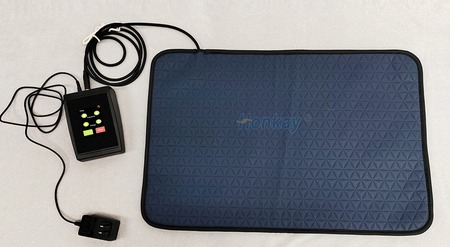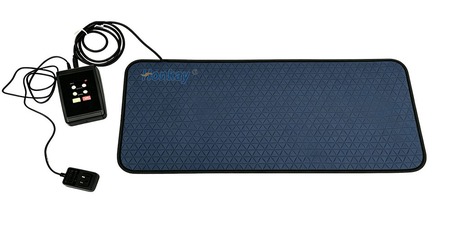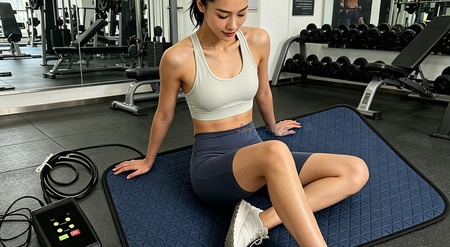
Screening takes about five minutes and it happens before the client lies down. In practice most of the risk in a mat session is settled at that point: whether the device suits this person at all, what has to come off before the session starts, and what the room has to be free of.
This page sets out the screening questions the manual actually raises, in the order a clinic can use them, together with the four checks that belong to every session and the short record that makes the whole process defensible a year later.
The manual is unambiguous on one point: people with cardiac pacemakers, implanted neurostimulators or other electronic implantable medical devices must not use the device, because the changing magnetic field can interfere with how those implants operate. That is the one answer that ends the conversation rather than postponing it.
The practical consequence is that the question has to be asked at booking, not at the mat. A client who has already paid, travelled and undressed is a far harder conversation than a client answering two questions on the phone, and the answer does not change because it was asked later.
When the answer is yes, the session is not booked on this device. That is not a judgement about the client. It is the manufacturer's contraindication, and a clinic that treats it as negotiable takes the risk onto itself.
Three further groups are handled by referral rather than exclusion. Pregnant women and women planning a pregnancy are advised to consult a qualified healthcare professional before use. People with serious medical conditions are advised not to use the device, or to consult a physician first; the manual lists malignant tumours, severe cardiovascular disease, severe infection or acute inflammatory conditions and serious neurological disorders among them. Children should be assessed by a qualified professional before use, and the device should be stored where children cannot reach it.
The clinic-side version of that instruction is a sentence on the intake form with a date beside it: advice sought, advice received, decision recorded. It keeps the clinical decision with the person qualified to make it, and it means the receptionist is never the one deciding whether a condition is serious enough to matter.
| Answer at intake | What it changes | What goes in the record |
|---|---|---|
| Pacemaker, neurostimulator or another electronic implant | No session on this device | Question asked, answer given, date, initials |
| Pregnant or planning a pregnancy | Waiting for the client's clinician to advise | Referral sent, advice received, decision |
| A serious medical condition, recent or current | Assessment before the mat, not during | Condition named, advice or clearance attached |
| Client under 18 | Professional advice first, adult present | Adult's name and consent |
The manual asks for metal accessories to be removed before use and warns against leaving large metal objects on the pad surface for long periods. The wording is about accessories and objects rather than about every trace of metal a client might carry, so the workable rule at reception is a tray by the door: watch, rings, bracelets, earrings, keys, coins, bank cards, travel cards and phones.
The cards matter as much as the jewellery. The manual specifically warns about bank cards, hard drives and magnetic-stripe cards, which are easy to damage when they sit in a pocket on a pad that is running. A tray solves that without a conversation about physics, and it also removes the moment where a client is asked to hand over a phone they would rather keep.
Clothing is the other half of the same point. Zips, buckles, metal buttons and underwired garments are worth a line on the booking confirmation, so the client arrives in something comfortable instead of being sent to change after the session has been set up.
The manual lists four categories the device should not run alongside: electrical stimulation devices such as EMS and TENS, high-frequency therapy devices, shortwave or ultrasound shortwave devices, and any other equipment that generates electromagnetic fields. Combined therapy is possible only after a qualified professional has been consulted.
Two further exclusions are environmental. The device should not be used in humid environments, and it should not be used by anyone under the influence of alcohol. Both are simple to write into a booking policy and easy to overlook on a busy afternoon, which is exactly why they belong on the same card as the session limits.
The manual sets out four inspections before each use: the power cord, the control unit, the surface of the therapy pad and the connection ports. It also names the conditions that take the device out of service immediately — exposed wiring, a damaged housing, or liquid inside the unit.
Thirty seconds is enough for all four once they are part of the setup routine rather than a separate task. The check that gets skipped in practice is the pad surface, because a crease looks like a crease until it becomes a worn spot over a coil.
| Check | What you are looking for | What stops the session |
|---|---|---|
| Power cord and adapter | Fraying, crushed insulation, a damaged plug or a loose adapter joint | Any exposed wire — unit goes out of service |
| Control unit | Housing intact, screen responds, buttons register | Cracked housing or no response |
| Pad surface | Cuts, hard creases, damp patches, stains that will not wipe out | Any break in the outer layer |
| Connection ports | Pad connector fully seated, no movement at the control unit | Liquid at the entry, or a joint that shifts |
Placement belongs in the same routine. The pad lies flat on a hard, heat-resistant surface — the manual names bed surfaces, sofas, therapy beds and flat floors — and nothing that traps heat goes over it. The pad should not be bent or compressed in use, and it should not be folded away carelessly afterwards, because the coils sit inside the padding.
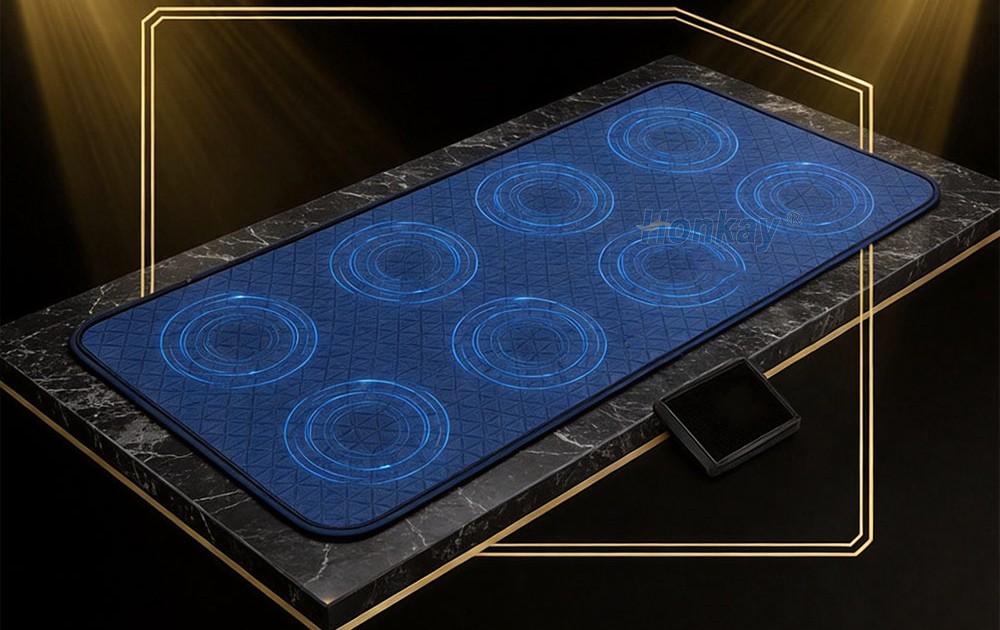
The manual's sequence is worth following literally: pad to control unit first, confirm the connector is secure and not loose, and only then connect the device to the mains. Doing it the other way round means handling a live connector every time the pad is changed.
The same discipline ends the session. Stop the output, return to the first screen, and disconnect the power before the pad is moved, wiped or put away. A connector that is unplugged while the unit is still outputting is one of the small habits that shortens the life of a cable.
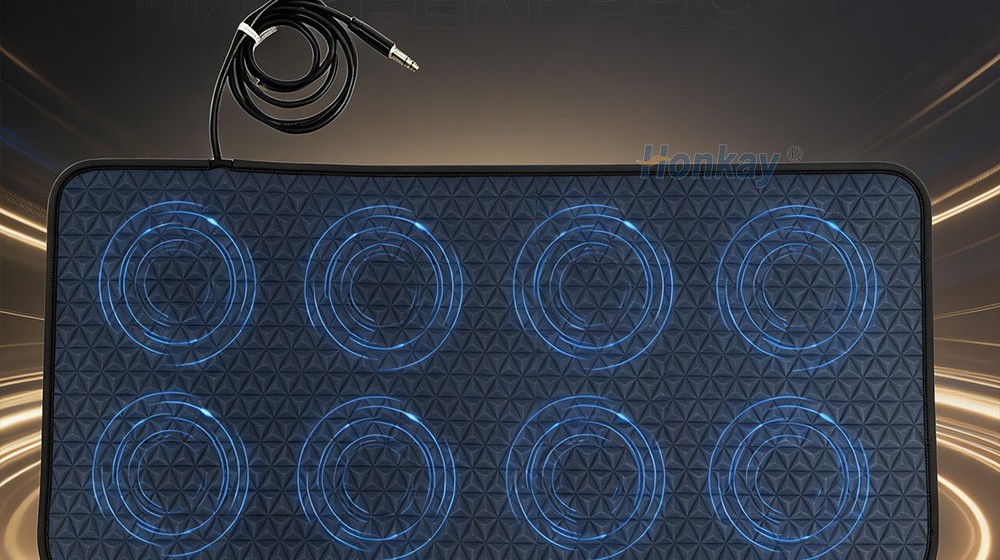
Four numbers are worth printing rather than remembering. A first session runs five to fifteen minutes at the lowest intensity. At least five hours should pass between two sessions. The device should not be used for more than 120 minutes in a day. And the head area should not be treated above 2 Hz.
The manual adds one timing rule that clinics rarely think about until a client mentions sleep: frequencies above 15 Hz are not recommended after 8pm, because the higher settings have a stimulating effect that can interfere with sleep. For an evening appointment that is a setting decision, not a clinical one.
For specification purposes the output is given as 1–100 Hz with intensity expressed as 0–25 Gs, and the same control unit drives pads in four sizes, from a two-coil 40 × 60 cm pad up to an eight-coil 60 × 200 cm pad. That matters at the screening stage: the size question is answered by the area to be covered, not by choosing a different machine, and the manual's five programmes are available on all of them.
A screening record does not need a folder. It needs a date, the three intake answers, the area treated with the frequency, level and duration used, and one line on how the client responded. Add the initials of the person who asked the questions.
Short records get completed, and a completed record is the difference between a clinic that can answer a question eighteen months later and one that cannot. If a client reports discomfort afterwards, the same page already holds the settings, which is the only part a practitioner cannot reconstruct from memory.
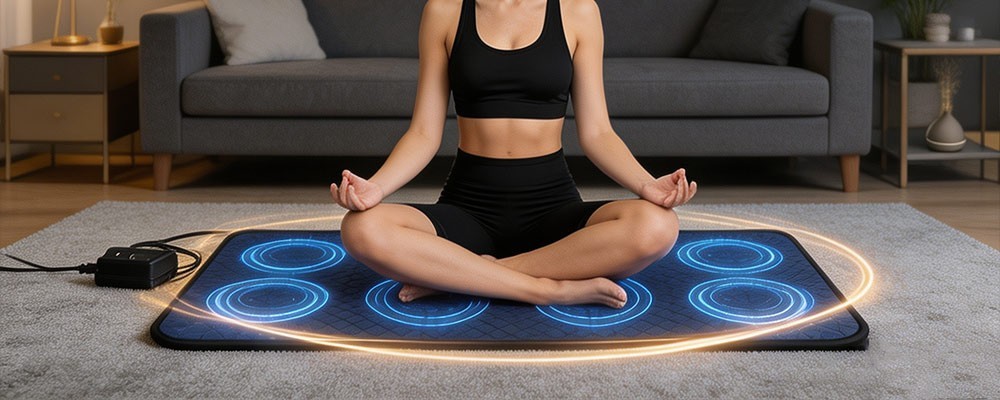
The difficult part of screening is not the list, it is the conversation. A client who has been told on arrival that the device is not for them will hear it as a rejection unless the reason is specific and the alternative is named.
Two things make that easier. Name where the decision comes from — the manufacturer's contraindication, not the clinic's opinion — and name what happens next, whether that is the client's own physician or another service the clinic offers. In practice a clinic that screens well gets fewer cancellations than one that screens late, because the awkward conversation happens on the phone rather than in the treatment room.
The manual's contraindication is written for electronic implants, not for passive metal, and it does not address joint replacements either way. That makes it a question for the supplier in writing and for the client's clinician, rather than something a receptionist should decide at the desk.
Remove them before the session starts and put them in the tray rather than on the trolley beside the pad. The manual asks for metal accessories to be taken off, and a ring left on the hand resting against the pad is the most common version of that mistake.
Off the pad and away from it. The manual specifically warns that bank cards, hard drives and magnetic-stripe cards can be affected, so the tray by the door is a better home for them than a pocket.
The manual rules out running the device alongside other equipment that generates electromagnetic fields, and two units side by side is exactly the situation it is describing. Keep a clear distance between them, or run them on separate slots, and confirm the arrangement with the supplier before a clinic builds a two-mat room.
At least five hours, and no more than 120 minutes in total across a day. Both limits are in the manual, and both are easier to keep when the day's mat appointments are blocked together rather than scattered.
Stop the output immediately. The manual names dizziness, palpitations and other abnormal reactions as reasons to stop at once rather than to reduce the level, and the session should not be resumed on the same visit.
The input is rated 110–240 V at 50/60 Hz with a 24 V, 100 W output, so it is not a high-draw device and a normal socket in the treatment room is enough. Confirm the plug type for your market when ordering, and keep the adapter off the floor where a chair can roll over it.
Honkay has been building physiotherapy and wellness equipment since 2005, including the mat range described here, and supplies clinics, studios and distributors across South America, South Asia, South-East Asia, Europe, Oceania and North America. The mats carry a 24-month warranty from the factory shipment date. If you are writing an intake form for a mat service and want it checked against the manual before it goes to print, send the draft and the team will go through it line by line.
This device is intended for adjunctive use alongside professional care, not as a replacement for diagnosis or treatment. Suitability should be confirmed with a qualified clinician; individual experience varies.
Chat with the Honkay team on WhatsApp: +86 13751821215
Email the Honkay team: hk6@huang-kai.com
Also available in Spanish: Evaluar a un cliente antes de una sesión con manta PEMF: implantes, metal y registros


 English
 中文