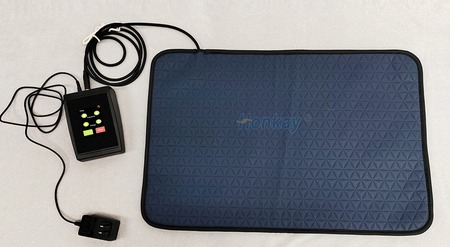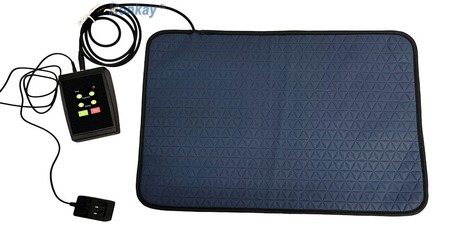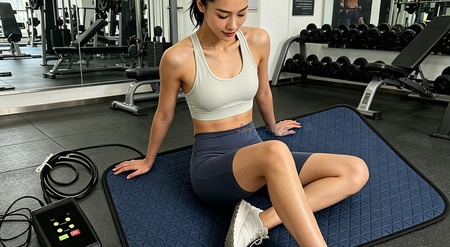
The mat range is easier to stock once you notice what it actually is: one control unit and four therapy pads. Every pad size runs from the same controller, with the same programmes and the same operating method, and only the pad changes.
That single fact decides most of the commercial questions a distributor or a clinic asks afterwards — how many SKUs to hold, what to keep as a demo, whether a second treatment room needs a second machine, and what has to be written on a purchase order for the factory to ship the right thing.
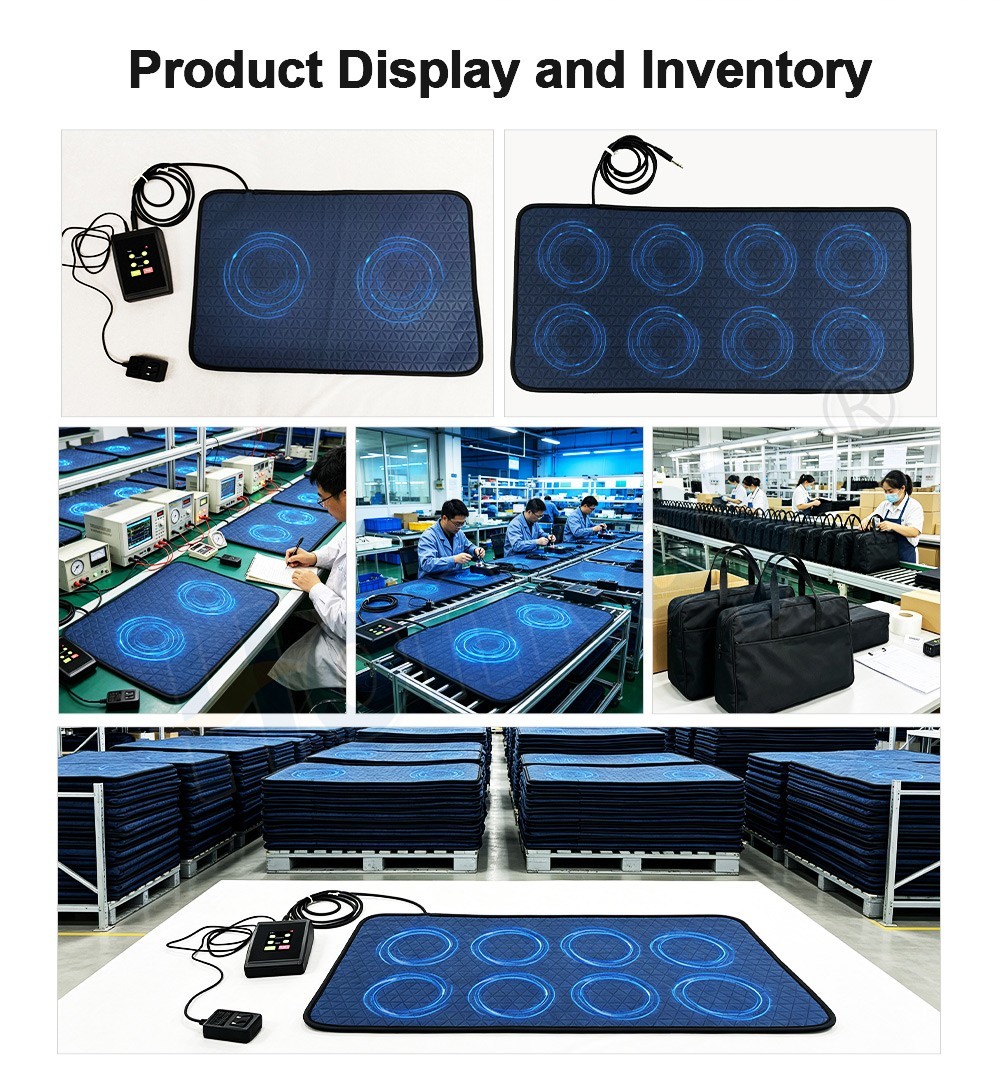
Four sizes are listed in the manual, and the coil count rises with the area rather than with the price tier: a 40 × 60 cm pad carries two coils, the 60 × 100 cm and 40 × 120 cm pads carry four each, and the 60 × 200 cm pad carries eight. Different sizes cover different areas; the control unit and the way it is operated do not change.
The two four-coil pads are the pair that gets confused on a price list. One is wider and shorter, the other narrower and longer, and the difference decides whether the pad suits a treatment bed or a narrow couch. That is a room question, not a specification question, which is why it belongs in the demo rather than in the datasheet.
| Pad size | Coils | Where it fits |
|---|---|---|
| 40 × 60 cm | 2 | A single area rather than a body: a consultation room, a chair, a demo table |
| 60 × 100 cm | 4 | Torso-length on a standard treatment bed; the size most clinics start with |
| 40 × 120 cm | 4 | Narrow benches and couches where 60 cm of width does not fit |
| 60 × 200 cm | 8 | Full body length on a plinth or a floor mat, where the session covers more than the torso |
The output range is the same across the range: 1–100 Hz, with intensity expressed as 0–25 Gs, from an input rated 110–240 V at 50/60 Hz and a 24 V, 100 W output. The five programmes in the manual are available on every pad, and the start, stop and setting sequence is identical.
For a distributor the practical consequence is a single training script. Staff learn one controller and one set of limits — a first session of five to fifteen minutes at the lowest intensity, at least five hours between sessions, no more than 120 minutes in a day, no more than 2 Hz on the head area and nothing above 15 Hz after 8pm — and that knowledge transfers to every pad in the catalogue without retraining.
For a clinic it is simpler still: the size decision is made once, and the settings conversation stays the same when a second pad is added later.
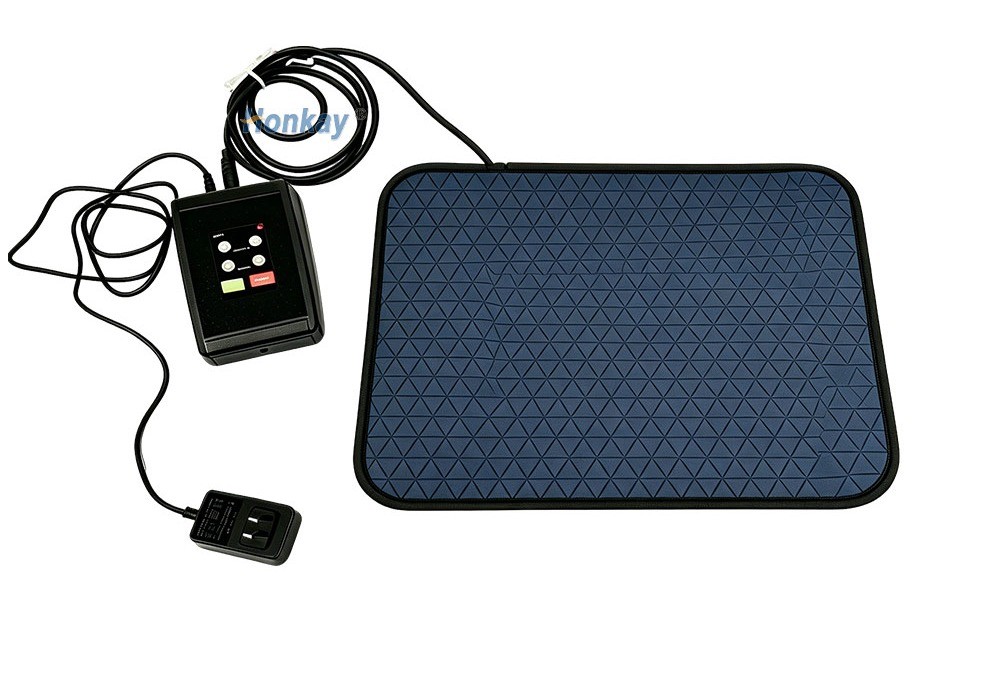
Because the controller is shared, a stocking plan that mirrors the product rather than the price list is short: one control unit line, one adapter line, one carry-bag line, and four pad lines. A distributor holding a spare controller is not holding a spare for one model; it is holding a spare for the whole range.
The demo question is where stock plans usually go wrong. A single 60 × 100 cm demo pad covers most conversations, but a clinic buying for a full-body room will ask to see the 200 cm pad before committing, and a clinic with a narrow couch will want to know that the 40 × 120 cm pad exists at all. Keeping one pad open for demonstration and the rest boxed is cheaper than unboxing stock on request and repacking it afterwards.
Pads also outlast the accessories around them, which is the other half of the stocking maths: a clinic that adds a second room usually needs a pad and a bag rather than a complete second set.
The most common configuration question is not which size to buy, but whether a second treatment room needs a second machine. There are three honest answers, and none of them requires a new product.
| Arrangement | What it asks of the clinic | When it is the right answer |
|---|---|---|
| One unit, moved between rooms | A socket in each room and a reset between sessions | Rooms alternate and sessions never overlap |
| One unit, two pads | A pad stored in each room; the connector is re-seated at switchover | Both rooms need the same coverage and the practitioner walks between them |
| Two complete units | A second unit to inspect, store and keep in service | Two practitioners treat at the same time |
Whichever arrangement is chosen, the manual's warning about other equipment still applies: the pad should not run alongside EMS or TENS units, high-frequency devices, shortwave equipment or anything else generating an electromagnetic field. Two mats in one room is exactly the situation that sentence is describing, so keep them apart and confirm the arrangement with the supplier before a clinic builds around it.
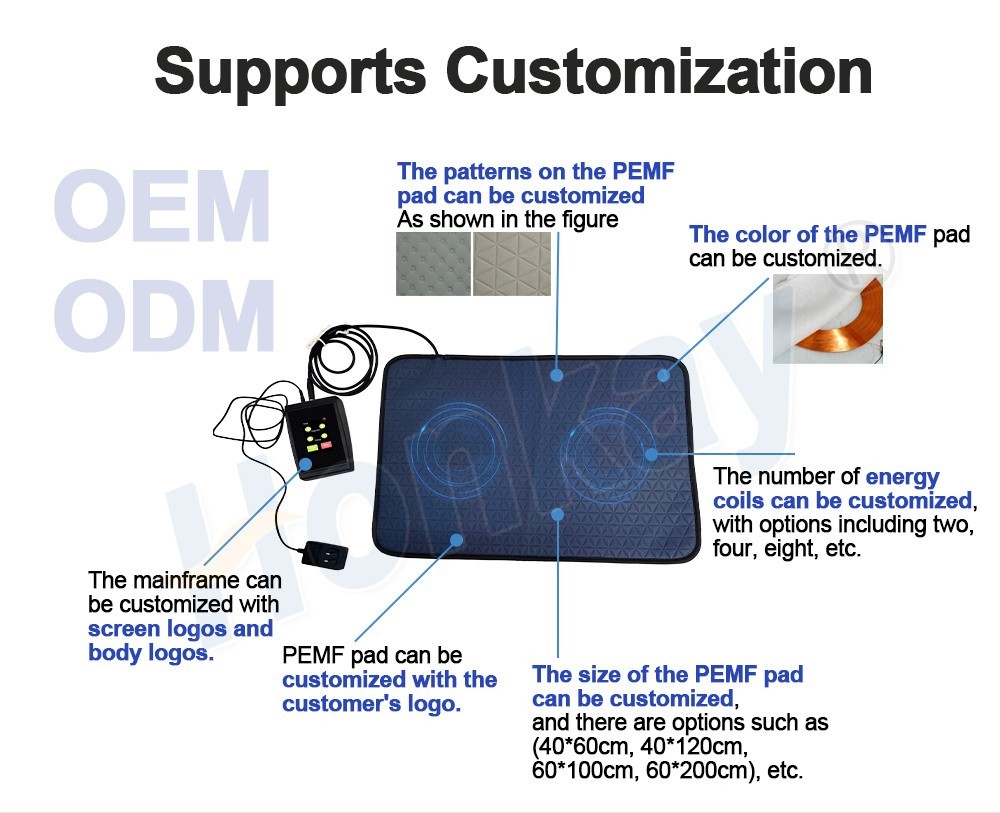
For distributors working under their own brand, the pad is the part of the system that carries the identity. Size and coil count can be specified within the four standard sizes and their coil configurations, the surface pattern and the colour of the pad can be changed, and a logo can go on the pad itself and on the control unit's screen and housing.
Two practical notes belong beside that list. First, customisation is a document exercise before it is a production one: colour references, logo artwork and the exact wording for the screen need to be agreed in writing, because a screen logo is the piece that cannot be corrected after assembly. Second, a customised pad is a separate stock line from the standard one, so a distributor running both needs two reorder points rather than one.
Four items account for almost every interruption in a mat service: the pad, the power adapter, the connector cable and the carry bag. The pad is the part that wears, the adapter is the part that gets lost or borrowed, and the bag is the part that keeps the other three intact in transit.
Because the control unit is shared, a distributor that holds one spare pad in the most-sold size can keep a clinic running while a replacement crosses customs. The mats carry a 24-month warranty from the factory shipment date, which is the clock to quote when a client asks how long a claim has to be raised — not the date the unit was installed.
The manual gives storage conditions rather than a storage method: 5 °C to 40 °C, relative humidity at or below 80% non-condensing, away from direct sunlight, high temperature, humid air and strong magnetic fields. A cupboard in a treatment room meets all four; a van parked in the sun does not.
The pad itself should return to the carry bag after use and should not be folded hard or at random, because the coils sit inside the padding. A pad that is folded along the same crease every day for a year is a pad that will fail at that crease, and the manual's warning about avoiding excessive bending or compression is written for exactly that habit.
Once a clinic owns two pads of different sizes, the pads look alike in a cupboard and the labels that matter are the ones a practitioner reads while kneeling at the end of a bed. A printed tag at the connector end — size and coil count, nothing else — is enough, and it survives being wiped far better than a sticker on the surface.
It also makes the accessory count visible. A tag that names the pad, the adapter and the bag as a set turns "where is the 200 cm pad" into a question with an answer, which is the difference between a two-minute and a two-session interruption.
Six lines prevent almost every shipping dispute: pad size in centimetres, coil count, plug type for the destination market, whether the unit is standard or customised, quantity per size, and the destination port or address. A seventh line is worth adding for multi-unit orders — the pad size written on the carton label, so a pallet can be split without opening every box.
Clinics ordering a single unit can simplify the same list to three items: size, plug type, and whether the invoice needs to show the pad and the controller separately for their own asset register.
Yes, one at a time. All pad sizes use the same control unit and the same operating method, so switching between a 60 × 100 cm pad in one room and a 40 × 60 cm pad in another is a matter of re-seating the connector, not of changing settings.
A 60 × 100 cm four-coil pad is the usual starting point for a standard treatment bed. A 40 × 120 cm pad is the better answer where the couch is narrow, and a 60 × 200 cm pad belongs in a room set up for full-body sessions.
No. The five programmes in the manual are available on every size, and the settings are adjusted on the shared control unit in the same way regardless of which pad is connected.
It is the same unit with the same interface and the same output range of 1–100 Hz and 0–25 Gs. That is why a spare controller covers every pad a clinic owns.
Size, coil configuration, surface pattern, pad colour and logo placement can be specified, including a logo on the control unit screen. Agree the artwork and the screen wording in writing first, and treat the customised pad as its own stock line with its own reorder point.
24 months from the factory shipment date, for the mats described on this page. Quoting the shipment date rather than the installation date keeps the claim window unambiguous when a unit sits in stock before it is installed.
Between 5 °C and 40 °C, at or below 80% relative humidity, back in the carry bag and away from direct sun, heat sources, damp rooms and strong magnets. Do not fold the pad tightly or stack weight on it.
Honkay has been building physiotherapy and wellness equipment since 2005, including the mat range described here, and supplies clinics, studios and distributors across South America, South Asia, South-East Asia, Europe, Oceania and North America. The mats carry a 24-month warranty from the factory shipment date. If you are building a stock plan across several sizes or need the OEM options confirmed for your market, send the size split and the branding requirement and the team will work through the configuration with you.
This device is intended for adjunctive use alongside professional care, not as a replacement for diagnosis or treatment. Suitability should be confirmed with a qualified clinician; individual experience varies.


 English
 中文